Posted on Leave a comment

DIY TV Tray and Couch Side Table

Happy New Year!

Since my girls have moved on from their little table and are trying to eat on the couch now, I needed something to spare my couch from as much cereal as possible. Since I had an extra board and these pipe table legs available, I was able to make a cool little table for the side of the couch that turns to become a TV tray when we need it.


Supplies:

(As an advertising affiliate and Amazon Associate, I earn a small commission from qualifying purchases. But it doesn’t cost you anything extra and helps me keep up my site!)

  • 3 pipe table legs (mine were 28″, but 24″ would work better)
  • One 1×10 board, around 48 inches long
  • Screws (usually come with the pipe legs)
  • Stain
  • Furniture pads (optional)

Tools:

  • Miter saw
  • Drill or screwdriver
  • Sander (or sandpaper)
  • Brush for stain


Close-up of black pipe table legs on a couch, with a colorful plaid blanket in the background.
BEFORE: spare table legs.

Step 1: Measure. I measured the arm of my couch and decided on 21 inches for the length of the tray top (and base bottom). The board I had was 10 inches wide, which is about perfect for a plate, but you could do 12-14 inches for a little extra width. Just be aware that it will stick out farther into the room – I wanted the space for walking around. For height, my legs were 28 inches, which makes the tray a nice height above the couch arm and also leaves plenty of room for adult legs when it’s sitting in front of you on the couch. (I would probably go down to 24-inch legs like the ones I linked above if I do this again, as 28 inches makes it a bit high for kids.)

A person measuring the arm of a brown leather couch with a yellow tape measure, with a wooden table and holiday decorations in the background.
Measuring for length.

Step 2: Cut wood. I took my board to our miter saw and cut two pieces at 21 inches long. That was it.

Step 3: Sand and stain. Taking my two boards inside, I gave the cut ends a quick sanding to round off the edges and any sharp corners. Most of this leftover board was already stained, but I did have to stain the cut ends and touch up the edges.

I didn’t bother staining the bottom side of what would be the bottom board, but I did stain both the top and bottom sides of the board that would be the top tray piece.

Close-up view of a stained wooden board featuring visible wood grain and two holes, placed on a work surface.
Boards cut and stained. (This is the underside)

Step 4: Position and attach the legs. First, I did the bottom board, with the unstained bottom on the floor. With this bottom board down, I positioned two of the legs so that the edges of the round bases were 3 inches in from the back end of the board. I also positioned each leg 1/2 inch in from each side.

Close-up of a measuring tape being used to measure the distance between two pipe table legs attached to a wooden board.
Positioning leg bases.

It’s important with these legs to be sure they are tightly screwed together (the pole into each end’s base), and be sure they stand at equal heights. If one is a little taller than the other, you can loosen the screwed on base from the pole a little bit to adjust for level. I also checked for level vertically around each pole to be sure they were straight.

Once happy with the position, I screwed the base of each leg onto the board. BE SURE your screws are shorter than the width of your board so they don’t poke through.

A close-up view of wooden boards and black pipe table legs intended for a DIY couch side table, with a power drill and screws on a carpeted floor.
Screwing legs onto the bottom board.

Once the bottom was attached, I set the top board on the floor with the underside facing up. Then I flipped the legs and the attached bottom so that the legs’ other ends/bases now sat on this board. I positioned them the same way — 3 inches in from the back and 1/2 inch in from each side. I again checked for level and then screwed the bases into the board.

Once those two legs were on, I flipped the whole thing so it was right-side-up. It had a little movement from side to side, so for added stability I added a third leg right at the back in the middle of the board. (Plus, I just liked how this looked.) After measuring to make sure the base was centered, I screwed it in place on the bottom board. Then I checked to make sure the top of the tray was level. All good, I reached up from underneath and screwed the top base into the top board.

Close-up of three black pipe legs attached to a wooden tabletop, showcasing the industrial design elements.
Adjusting and adding the third leg.

Step 5 (optional): Finishes. If you’re worried about scratching your floor, you can add furniture pads to the underside of the bottom board. I didn’t bother since it’ll often be on our rug anyway.

Also, as you might’ve noticed, I ran out of black screws. 😆 If you have this problem too, a black sharpie solves this easily.

A DIY side table with pipe legs next to a couch, holding a decorative mug on top.
Before blackening screws with sharpie.

That was it! I like how this turned out a lot. It’s rustic and kind of modern, and it fits with the look of our other decor and my other little DIY table without being an exact match.

A wooden side table made with pipe legs, positioned next to a chair, against a light wall. The table features a smooth top and a base, with a cozy blanket draped over the chair beside it.
AFTER: Side table and TV tray
A rustic DIY side table made from a wooden board and metal pipe legs, placed next to a brown couch, holding a colorful cup.
A cozy scene featuring a custom-made side table with a mug that says 'Create Your Own Sunshine,' placed on it. The table is next to a couch, with a colorful blanket draped over the lap. In the background, a Christmas tree adorned with lights is visible beside a fireplace decorated for the holidays.


DIY Must-Have Lists

Click to see more!
Click to see more!
Click to see more!
Posted on Leave a comment

From Table to Shoe Rack

How do we still need more shoe storage?! I couldn’t take it anymore, and the constant pile of shoes by our garage door had to go. But this is obviously the best spot to have shoes, so we needed another shoe rack right by the door for all my girls’ shoes.

Cue the old, falling apart, outdoor table that I’ve ignored all summer.

An old, weathered outdoor table sits against a house, surrounded by gravel and a metal fence.
BEFORE: Old table. She looks so sad.

Supplies:

(As an advertising affiliate and Amazon Associate, I earn a small commission from qualifying purchases. But it doesn’t cost you anything extra and helps me keep up my site!)

  • 1x3s (for shelf slats, so amount depends on length you want)
  • 1x2s (for shelf supports and front piece)
  • 2x3s (for legs, so amount depends on the height you want)
  • Wood stain or paint

Tools:

Step 1: Take apart the table. I’m going to assume not everyone has an old IKEA table lying around for this project, but if you do, 👍. If not, the wood is basically a bunch of 1x3s, 2x3s, and 1x2s, so that’s how I’ll give instructions for assembly. But if you’ve got an old table made of slats like this, take that puppy apart and use the wood if it’s salvageable!

First, I removed all the hardware connecting the table legs, sides, etc. All of the top and hinged side sections were in good shape, so I did not take apart the slat sections – that’s what I was hoping for! The rest of the table parts like the legs and surrounding pieces came off pretty easily, and gravity helped.

Once apart, I carried all the pieces up to my garage.

A collection of wooden table slats and storage bins in a garage setting, surrounded by tools and bicycles.
Wood pieces to work with.

Step 2: Cut pieces. I decided 8 inches wide was perfect for storing my girls’ shoes without sticking out too far into the narrow hall area. It just so happened that 3 slats equaled 8 inches, so I used a jigsaw and cut the ends to free up the first 3 slats and the ends connecting them. I did this for 4 sections that would become my 4 shelves.

A close-up view of a jigsaw cutting through wooden slats placed on a work surface, showcasing sawdust and a partially disassembled outdoor table.
Cutting free the first 3 slats as a section.

If you’re using wood pieces and not a table, you can use 3 long 1x3s for slats and shorter, 8-inch pieces of 1x3s for each end. These could be attached by screwing holes on each piece where they connect, then using pegs and glue. That would give you the same thing as what I cut free – slats connected by end pieces.

Along with these sections for the shelves, you want 2x3s for each leg of the shoe rack. I used the front and back surround pieces that I’d taken off the table, so mine had character-adding screw holes to display. 😆 I wanted my legs to be 25.25 inches tall, as this would allow me to get 4 legs out of the 2 pieces of wood I was using. (This was also the perfect height to allow my girls’ backpacks to hang over the shoe rack.)

A close-up view of a wooden piece being measured with a tape measure on a work surface, with additional wooden slats and a shoe in the background.
Cut leg pieces.

Next, I needed little support pieces to attach to the legs where the shelves would rest and attach. The table had had 1×2 pieces of wood running under the tabletop for support, and these were perfect, so you can use 1x2s for sure. Since my shelves were 8 inches wide, I went with 6-inch little pieces so the shelves would hang over them to hide these supports. I needed 2 of these for each shelf – one for each end of each shelf – so 8 total for my 4 shelves.

Also, I needed 2 more 1×2 pieces for each end of my top shelf to add length and cover the tops of the legs. These needed to be 8 inches, just like the ends of my 8-inch wide shelf.

With all these pieces cut, I sanded everything lightly and wiped them clean.

A collection of wooden slats and pieces from an old table, laid out on a workbench, showing a weathered and rustic appearance.
Wood pieces ready!

You might notice from the picture that I had 2 little scrap pieces. I used these to help me figure out exactly how high the shelves would sit on top of my support pieces before deciding on the supports’ placement.

(FYI: There will be 2 more wood pieces to cut, but I’d wait until later to be sure of your measurements.)

Step 3: Attach supports to legs. I wanted the lowest shelf to be right at the bottom so things won’t get lost on the floor under it. This also made things easy as far as positioning.

Lining up 2 of my 2×3 legs, I made sure they were less than 8 inches apart, since this would let the shelves stick out a bit farther to cover some edges. I went with 7.25 inches apart.

With the legs lying square and 7.25 inches apart, I lined up one of my 1×2 support pieces at the very bottom of what would become the inside side of the table legs. You could use little nails or screws, but I used my nail gun and shot in 2 nails at each end of the little support 1×2.

Once that bottom support was attached, I did the same at the very top.

A close-up view of an old wooden table being disassembled, showcasing slats and a measuring tape on a workbench.
Top and bottom supports in place.

Then, because I wanted the bottom shelf to fit rain boots, I literally held a rain boot in the space over that bottom support – with my little scrap piece mimicking where the shelf would sit – to find where I should position the next shelf up. With that figured out, I attached a 1×2 support piece in that spot. That left one more support for a shelf, so I positioned it where it looked right and nailed on that one too.

With that one side/set of legs done, I took the other 2 table legs and positioned everything exactly the same so everything would be level and equal on either side of the shoe rack.

Step 4: Attach the shelves. Starting at the bottom for stability, I held up one side (2 legs with supports) and set one of my 8-inch wide shelves on that bottom support. I lined it up so that the back of the shelf was exactly lined up with the back of the back leg, and the front of the shelf hung over the support and past the front of the front leg a little bit. Then I nailed down through the shelf into the support it rested on.

Close-up view of the corner of a wooden shoe rack highlighting the joint between the shelf and vertical leg, showcasing texture and wear.
Shelf sitting on legs’ support.

After repeating this on the other side, I had my bottom shelf connected to both sides/sets of legs.

I did this again for the next shelf up, then the next, and finally the top shelf piece. Each time, I made sure to keep things square by holding the shelf tight against the table legs (sides) when I nailed them on.

A wooden shoe rack with three shelves, sitting on a concrete floor in a garage setting. The shoe rack has a rustic design with slats and a reddish-brown stain.
All shelves on.

Step 5: Add additional pieces. Because I wanted nothing getting lost under the shoe rack, I used another 1×2 to run across the very bottom, under the overhanging bottom shelf, to cover the front of the rack at the bottom. This I cut to 23.5 inches long so that it fit inside, between the legs. I attached this front piece by nailing it into the ends of the bottom support pieces. I did lay the rack down with the front side up to make this easier.

Top view of an old wooden outdoor table frame, partially disassembled, showing wooden slats and hardware.
Bottom front piece on under bottom shelf.

While I was at it and had the bottom of the rack exposed, I added some screws through my bottom supports into my legs, just to help out my little nails.

Standing the rack back up again, I took my two 8-inch 1x2s and positioned them over the tops of the legs, making sure they sat flush with the ends of my top shelf. I attached these by nailing down through the pieces into the tops of the legs. I was worried this might look weird, but because of all the slats going on – and running in different directions – it looks like added detail that belongs.

A close-up view of a wooden shoe rack sitting on a garage floor, next to a garbage can. The rack features slatted shelves and a rustic finish.
Ends 1x2s to cover the top of the legs.

Lastly, I added a crosspiece to the back of the rack to help with stability. I figured out the angle of my cuts by holding the 1×2 in place and then marking lines with a pencil. Once it was marked, I used my miter saw to cut along the lines. I attached the back by nailing each end onto the back of the legs. I like the rustic detail this gives, plus you can’t really see it from the front once shoes are there.

A wooden shoe rack with three shelves, positioned in a hallway, displaying a rustic look with a cross-support brace.
Back support on.

Step 6: Stain or Paint. My wood already had stain…in places. Rather than sanding it all off, I embraced the rugged look this would add. Taking a rag dipped in darker stain, I wiped stain over the whole thing. This gave a really cool, aged effect to the wood where the stain took differently to the stained and unstained wood.

You could paint your rack, obviously. That would look nice too, though I’d suggest a darker color to help hide dirt from the shoes.

Step 7: Set in place and add shoes! The rack fit great in the space – not too big, not too small. I really like how rustic but detailed it looks because of the slats and old screw holes and such. It looks old but in the right way now. 😂 And, most importantly, the girls’ shoes aren’t in a pile!

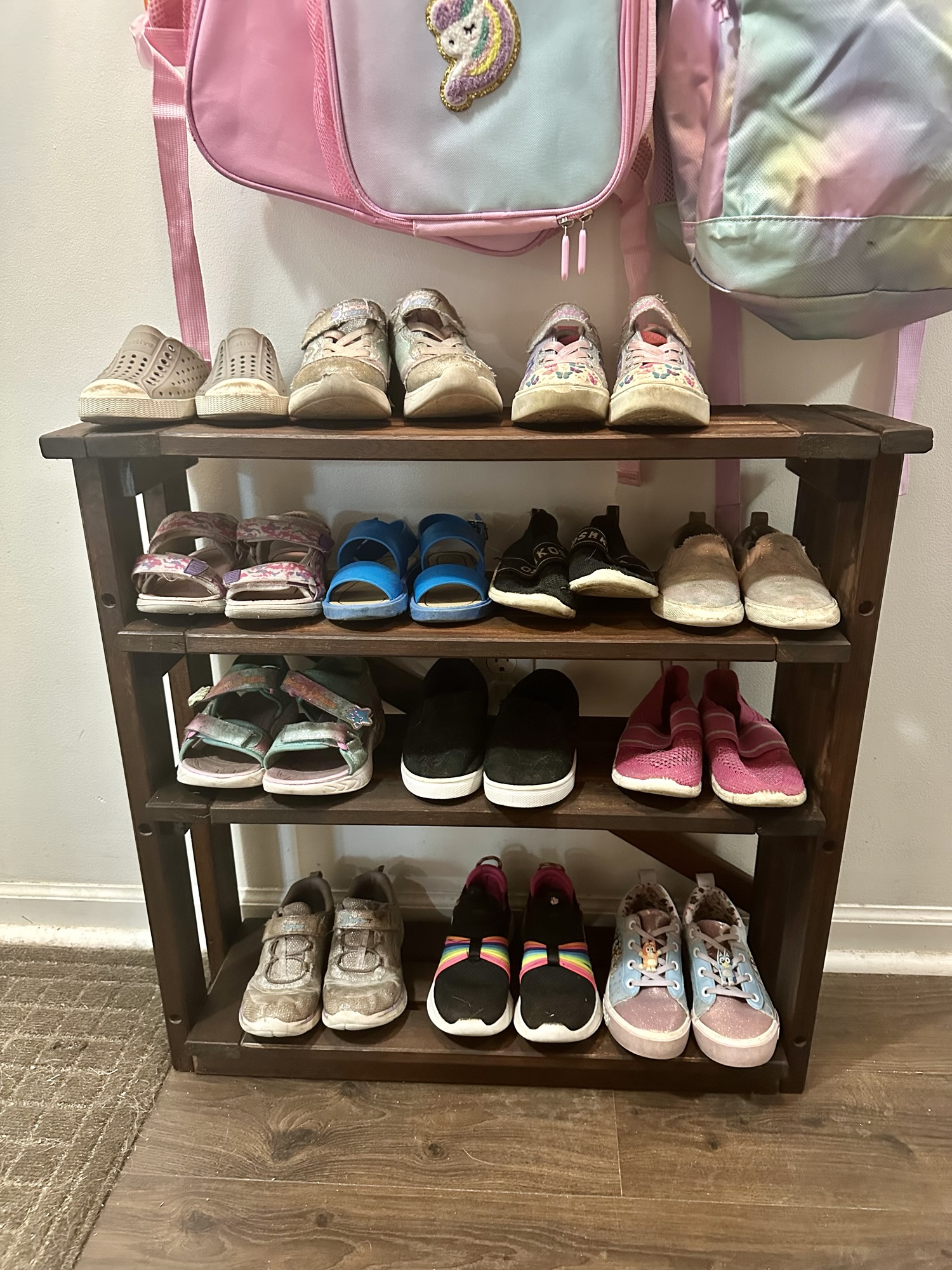
A wooden shoe rack against a wall, filled with various children's shoes, with two pink backpacks hanging above it.
AFTER: New shoe rack.
Wooden shoe rack with multiple shelves, storing various pairs of girls' shoes and bags hanging above.


DIY Must-Have Lists

Click to see more!
Click to see more!
Click to see more!
Posted on Leave a comment

Doorbell Chimes Cover/Planter

This project was one of those little things that’s been an eyesore forever, and I finally found a way to make it pretty. Since I did an entryway bathroom door makeover (and still love it), I decided to use a similar look to cover our ugly, old doorbell chimes cover on the wall facing that door.

A view of a hallway featuring a bathroom door, a wall-mounted doorbell chime cover, and a ceiling light fixture.
BEFORE: Old, ugly doorbell chimes cover.

Supplies:

(As an advertising affiliate and Amazon Associate, I earn a small commission from qualifying purchases. But it doesn’t cost you anything extra and helps me keep up my site!)

Tools:

  • Tape measure
  • Miter saw or hacksaw
  • Sandpaper
  • Nail gun or hammer
  • Paint brush

Step 1: Measure the spot and cut wood pieces. First, I measured the existing cover and decided to go with a new cover of 7×11. That would give me a little wiggle room for placement. I also needed to come out about 3 inches from the wall.

A close-up image of a plain, beige doorbell chime cover against a white wall, with a measuring tape placed beside it.
Measuring.

Using spare 1/8 inch plywood pieces, I cut a front piece at 7×11 using my miter saw. (This wood is thin enough that you could easily cut it with a hacksaw or other small saw.) Then I cut 2 side pieces at 3×7, and my bottom piece was 3×11.

To attach these pieces, I found some little 1×1 wood pieces and cut 4 to about 6 inches each. These go on the inside corners, so they don’t have to be perfectly even or pretty.

I sanded all of these pieces lightly to remove any rough parts.

Various pieces of wood laid out on a work surface, including plywood and wood strips, ready for a DIY project.
Wood pieces cut.

Step 2: Assemble pieces. I used my brad nailer, but you could use little nails and a hammer or even wood glue, if you have more patience than I do.

First, I attached a side piece to one of the inside corner pieces. I made sure to line up the long edges so the side piece would cover the corner piece, but I didn’t want it to overlap because the front piece would do that, hiding the side piece from the front (see picture). I also made sure to leave a little room at what would be the bottom – this would let the bottom piece fit in place so the side piece would cover/hide the bottom edge. And, I left about an inch of space at the top so the corner piece wouldn’t be visible at all from the top.

Next, I took the front piece and also attached it to the first corner piece, making sure it lined up to cover the edge of the side piece. (Again, see the picture for a visual of how all this lined up. The picture is from the bottom, showing the little bit of room I left for the bottom piece.)

A person holding a piece of cut wood at an angle, showing a joint or connection point, with a workshop background containing various wood pieces and tools.
Side and front on a corner piece.

(You may note from the pictures that I used nails that were too long, but these were easy to bend back. Again, you’re not going to see the insides of this little box you’re making. So, if you don’t have small enough nails, no worries.)

With that one side and front piece on the first corner, I nailed on the other side piece and corner piece, lining them up the same way.

Next, the bottom piece was pretty easy because it fit right at the bottom of the 3-sided box I’d made. This bottom piece also helped me be sure everything was square, because I squeezed the front and side pieces to sit right tight against the corners of the bottom piece. One little nail at each end into the corner pieces was all it took to hold this bottom piece in place.

A person holding a vertical piece of plywood, displaying its edge and grain pattern, with workshop tools in the background.
Bottom added.

From there, I could easily add the last 2 corner pieces at the back of my open box. These I made sure to place flush behind the side pieces so they didn’t stick out. I nailed them into each side first, and then I used my bottom piece to again made sure everything was square. One little nail from the bottom piece into the ends of these corner pieces held them in place.

This created a “box” with an open top and back.

Interior view of a wooden box being constructed, showing corner support pieces and nails. The box is held by a hand against a background of wood and tools.
Construction complete.

Step 3: (Optional) Add decorative parts. Just to add a little visual interest, I cut 4 pieces of 1×2 down to 7 inches, used my miter saw to create 30-degree cuts at the ends, and nailed them over the ends of my cover. This created some curves and made the whole thing look less “boxy,” plus it helped cover the nail holes and edges, making the whole cover look a little nicer. You don’t have to do this, but I liked it.

A wooden box structure prepared for staining, placed on a workbench surrounded by woodworking tools and materials, with a window in the background.
Decorative parts on.

Step 4: Stain or paint. I debated between painting this cover green (like other accents in our living room) or staining it, but I ended up using the same dark walnut stain as the door nearby – the door that gave me inspiration in the first place. I’m glad I used this stain because the wood looks surprisingly nice stained, and the color looks great against the plants I used in the final step.

Step 5: Hang the cover. Because this cover is so light, I was able to just use command strips on the back of either end. I placed mine on the 1x2s along the back, but you could use the back corner pieces instead if you didn’t want to add the 1x2s.

Interior view of a wooden box frame, featuring wood corner supports and Command strips on the sides.
Command strips ready.

After climbing on a stool to reach high enough, I did check to make sure the cover was level before pressing the command strips to stick on the wall on either side of the existing chimes cover.

Step 6: (Optional) Add greenery. You could leave the cover as it is – it looks nice alone as a wood cover. But, I really like how it looks after adding a few strands of fake greenery to hang out – it looks like a planter! I didn’t have to secure my fake plants at all because they tucked down around the existing chimes cover, and they hang down over the wood in a way that the leaves help hold it in place.

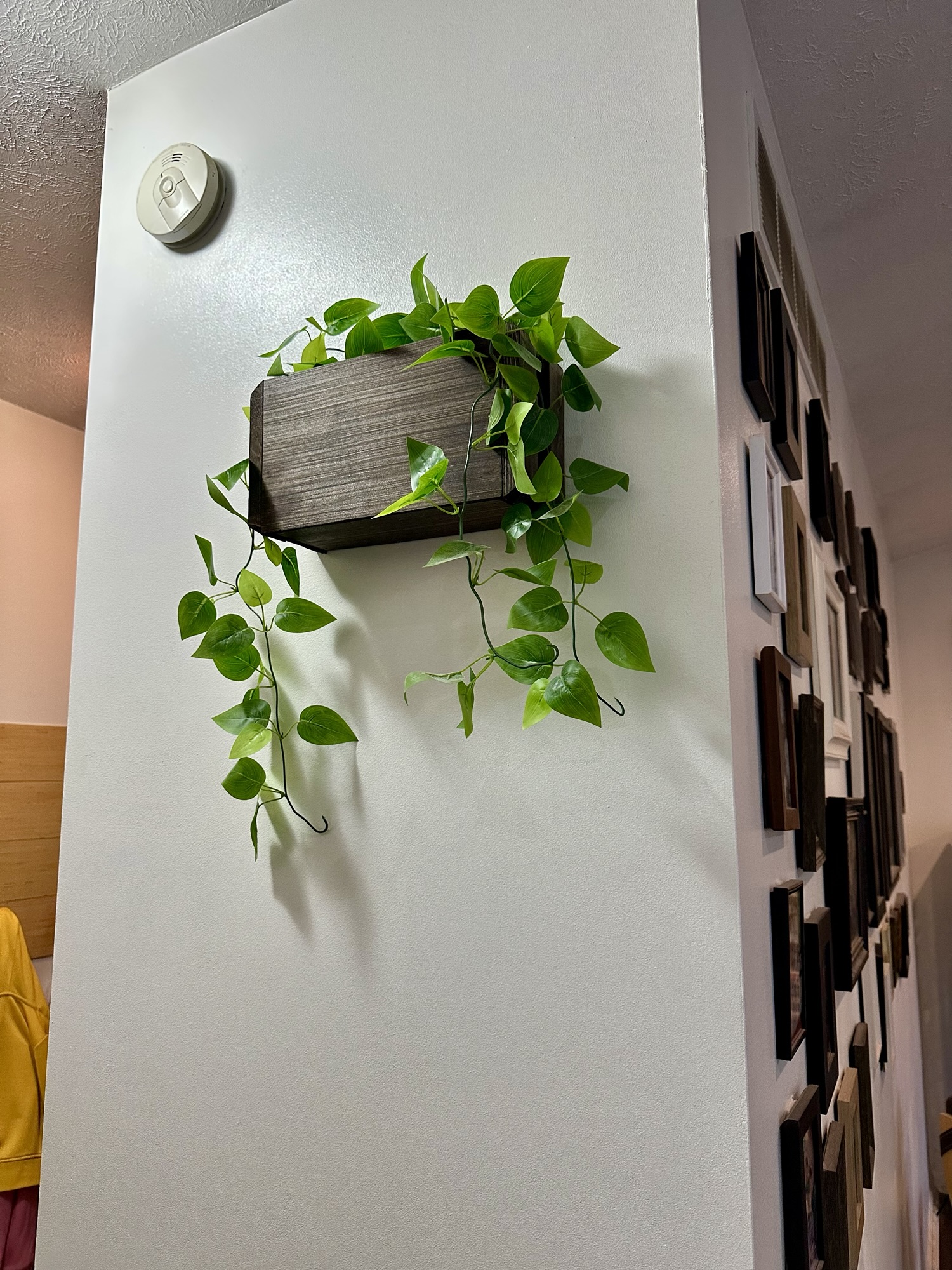
A wooden cover for a doorbell chime mounted on a white wall, adorned with artificial green ivy leaves.
Greenery added.

That was it! This looks so much better than the old, off-color doorbell chimes cover.

A wooden box with fake greenery hangs on a wall near a door, next to a light fixture and a clipboard.
AFTER: New doorbell cover/planter!


DIY Must-Have Lists

Click to see more!
Click to see more!
Click to see more!
Posted on Leave a comment

On-The-Wall Headboard

My parents’ guest room bed needed a headboard, and the empty wall also needed something decorative to add interest to the room at all (aside from one poster on another wall). Since they have a lot of scrap wood, we decided to create a headboard that would attach right to the wall and add some rustic charm to the room.

A guest room with a bed dressed in patterned bedding, a bedside table, a lamp, and a burgundy upholstered chair against a grey wall.
BEFORE: No headboard and bare wall.

This was a very easy project and took me about an hour and a half…and that half hour was mostly spent looking for my dad’s level. 😜 You could use nice, new wood, but the scrap wood they had worked very well to create a rustic looking headboard.


Supplies:

(As an advertising affiliate and Amazon Associate, I earn a small commission from qualifying purchases. But it doesn’t cost you anything extra and helps me keep up my site!)

  • old scrap wood
  • nails
  • painters tape

Tools:

  • level
  • pencil
  • miter saw (or other saw for cutting small pieces of wood)
  • nail gun (or use small nails and a hammer)

Step 1: Plan and mark the sides. After sliding the bed a little bit away from the wall, I took a pencil and lined it up with the side of the bed, marking on the wall to identify how far over the headboard should go. I did this to both sides.

A hand holding a pencil with a small level attached, positioned near a wall, indicating a marking for a headboard installation.
Marking the sides.

Then, taking the level that I eventually found, I drew a straight line up from that mark and ended up deciding that 45 inches was a good height up the wall. That would give plenty of room for the headboard to stick up above the pillows and take up some of the blank wall space. I used the level again and marked a line across, connecting the two side lines.

Taking painters tape, I ran it along my lines to outline my shape. That let me visualize the space where my headboard would go. It also made it very easy when attaching the boards, because I lined up the ends of the boards against the tape for a straight line.

View of a guest room bed with green painter's tape outlining the area for a headboard on an empty wall.
Headboard space outlined.

Step 2: Cut wood. From side to side of my headboard space was 53.25 inches (this is a full-size bed). I wanted the shorter pieces of wood staggered, but I also cut a few the full length across. Basically, I went through the scrap wood and held pieces end-to-end that looked good, then marked one at 53.25 inches to cut with a miter saw.

Because my wood was so rough, I did scrape off some loose chunks and wipe them down quite a bit so it wouldn’t create splinters. If you’re using nice wood, now would be a good time to sand the pieces.

I didn’t worry about getting exactly the right amount of wood cut, but I did enough to make several rows and then took the pieces inside, stacked together so I knew which boards went together to make 53.25 inches.

A collection of scrap wood pieces stacked on a bed, with a level and painter's tape visible, set against a patterned bedspread.
Wood pieces ready.

Step 3: Nail wood onto the wall. I started at the bottom and used one of my long pieces that ran the whole length across. Using the level, I held the board in place and used Brad (my nail gun) to secure the board onto the wall. You definitely want to be sure this first, bottom board is level before stacking the rest on top of it.

A hand holding a level against a wooden plank attached to a wall, with a bed and floor visible in the background.
First board on.

SIDE NOTE: Since my wood was so rustic, I didn’t worry about the nail holes. If you’re using nicer wood, you might want to be sure to space your nails evenly for less chaotic holes, and/or you could use wood filler to fill the holes if you’re going to stain or paint the wood.

From there, I took the rest of my boards and added one row at a time, making sure the ends lined up at the tape.

A partially completed rustic wooden headboard affixed to a wall, with painter's tape outlining the intended shape above the bed.
Staggering each row.

I worked my way up to the top, and I’d cut enough initially to make it almost all the way – I only needed to go back to cut one last row at the top. And for the top, I found a piece of wood that had a cool, natural edge, so I used that for the very top. The top did overlap my tape slightly, so I pulled the tape off before securing that final row. But the tape did show me that everything was still straight and level! The rest of the tape I pulled off once I was finished.

That was it! This was a very cheap and easy way to create a permanent headboard that’s big and adds some rustic decor to the room. Hopefully guests like it too!

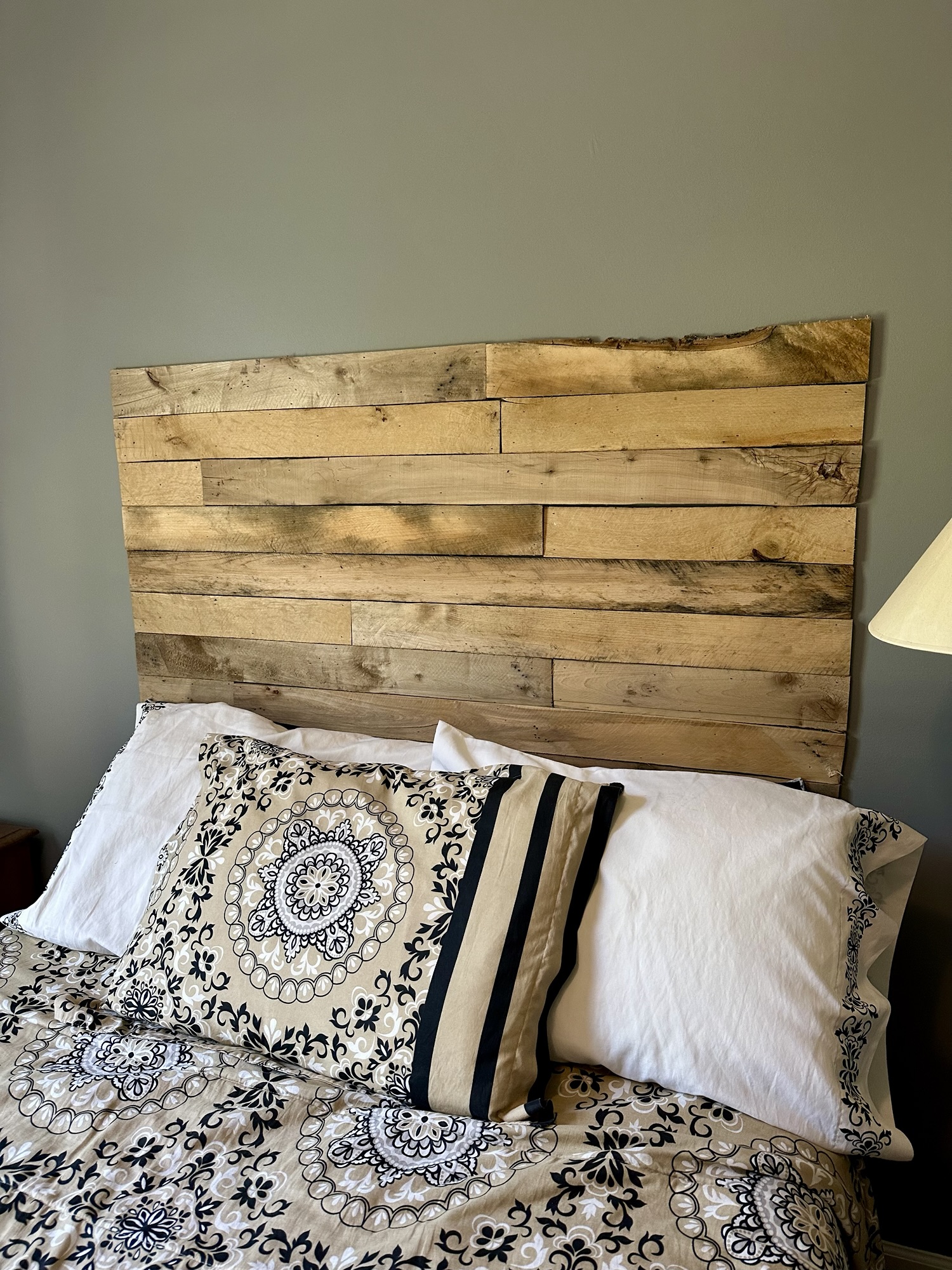
A rustic wooden headboard made from scrap wood is mounted on a wall above a bed adorned with a patterned comforter and pillows. A nightstand and a lamp are visible beside the bed, with a cushioned chair in the corner of the room.
AFTER: New rustic headboard.
A rustic wooden headboard mounted on a wall above a bed with white and patterned bedding and decorative pillows.


DIY Must-Have Lists
Click to see more!
Click to see more!
Click to see more!
Posted on 3 Comments

Outdoor Chair Makeover

These chairs have needed my attention for quite a while. They were still in sturdy shape, so I knew they had a little life left in them. They just looked terribly worn out.

Two weathered wooden outdoor chairs on a deck, one with faded paint and the other slightly cleaner, surrounded by greenery.
BEFORE: Chairs in need of love.

Supplies:

(As an advertising affiliate and Amazon Associate, I earn a small commission from qualifying purchases. But it doesn’t cost you anything extra and helps me keep up my site!)

Tools:

…I’m just now realizing that I intended to use my new paint sprayer on this project, but I completely forgot. 🤦‍♀️ If you have a paint sprayer, you could do this much more quickly, but I used a cheap brush. You could also use painters tape if you need help with a clean edge between the different paint colors, but I always find I do okay with just a simple little craft brush to make clean lines.

Step 1: Sand and clean chairs. I took my handheld sander and went over every part of the chairs that I could. I used 80 grit sandpaper but only needed one sheet.

A handheld sander being held over a wooden deck with outdoor furniture visible in the background.
Sander ready.

There was some old stain peeling away that needed to be sanded. There were rough spots that I wanted smoother. And there were other places where the wood was just really worn and old, so I sanded those parts down too. Really, you want to sand all over at least a little bit to help the paint adhere.

Once the chairs were sanded, I wiped them down with a wet rag to get off cobwebs, dirt, dust, etc.

Worn wooden chair on a deck, showing a weathered surface with slats and a structure in need of refinishing.
Roughly sanded.

Step 2: Spray paint the hardest parts to paint first. Really, you could paint your outdoor chairs a bunch of different ways, but I focused on how the slats ran across the back and seat. The arms of the chairs and sides of the back and seat had pieces that ran a different way, so these slats seemed like they would look good as their own thing.

I went with black. You could use any color as long as it’s a paint that’s intended for outdoor use. I had some leftover black spray paint, so that’s what I used.

For these harder-to-do parts of the chairs, I definitely recommend spray paint (or a paint sprayer 🤦‍♀️). Spraying on the slats was easier than trying to use a brush and get around all the sides. It was definitely faster. Did this spray paint get on the other parts of the chairs that would be a different color? Sure. But I didn’t worry about this since I knew I’d be painting the other parts next and covering the black anyway.

Basically, start painting the chairs by using spray paint in the color that you want on the majority of the chair, or the most difficult-to-paint parts of the chair. Some might say to use the lighter color first so you can be sure your other paint color will cover it, but my lighter blue covered this black just fine. 🤷‍♀️

Close-up view of a worn outdoor chair with a black slatted seat and backrest, showing signs of damage and peeling paint.
Black spray paint on.

Another good reason to use spray paint first is because it dries quickly, helping you get to the next step.

Step 3: Paint the other chair parts. Once the tricky slats were painted, I took my lighter blue paint and used a brush to paint the arms of the chair, the bottom braces, and the side pieces around the seat and back. There wasn’t much need to spray this paint, since these sections were so large that a brush worked just fine. To paint where the blue met the black of the slats, I used a tiny craft brush and made clean lines of blue paint against the black.

Close-up view of a recently painted outdoor chair with black slats and light blue arms, resting on a tarp.
Painted where blue meets black.

If you use a spray for the rest of the chair too, you’ll need to cover the first painted areas and tape along the edges. That seemed like too much effort, and I figured that a brush would be faster than the prep required for my paint sprayer.

Two outdoor chairs in a garage setting: one is already painted light blue with black slats, and the other is partially painted. There is a paint can nearby, and the chairs are placed on a tarp.
Painting the blue.

I did 2 coats of this light blue, just to be sure the coverage was good over the old wood. I also had a 5-year-old helper, so I went over her areas a few times. 😬

Step 4: Seal. Once all the paint was dry, I gave it overnight to gas off and settle in. The next day, I took a clear gloss spray paint and went over every inch of the chairs to seal and protect the paint.

Once that was dry, the chairs were done! These look so much better than before, and they go nicely with the blue decor I have on the rest of my deck. I like that painting them this way looks a little more interesting than just painting or staining them one solid color too.

Two freshly painted outdoor chairs in light blue with black slats, placed on a wooden deck surrounded by greenery.
AFTER: Painted chairs.


DIY Must-Have Lists

Click to see more!
Click to see more!
Click to see more!