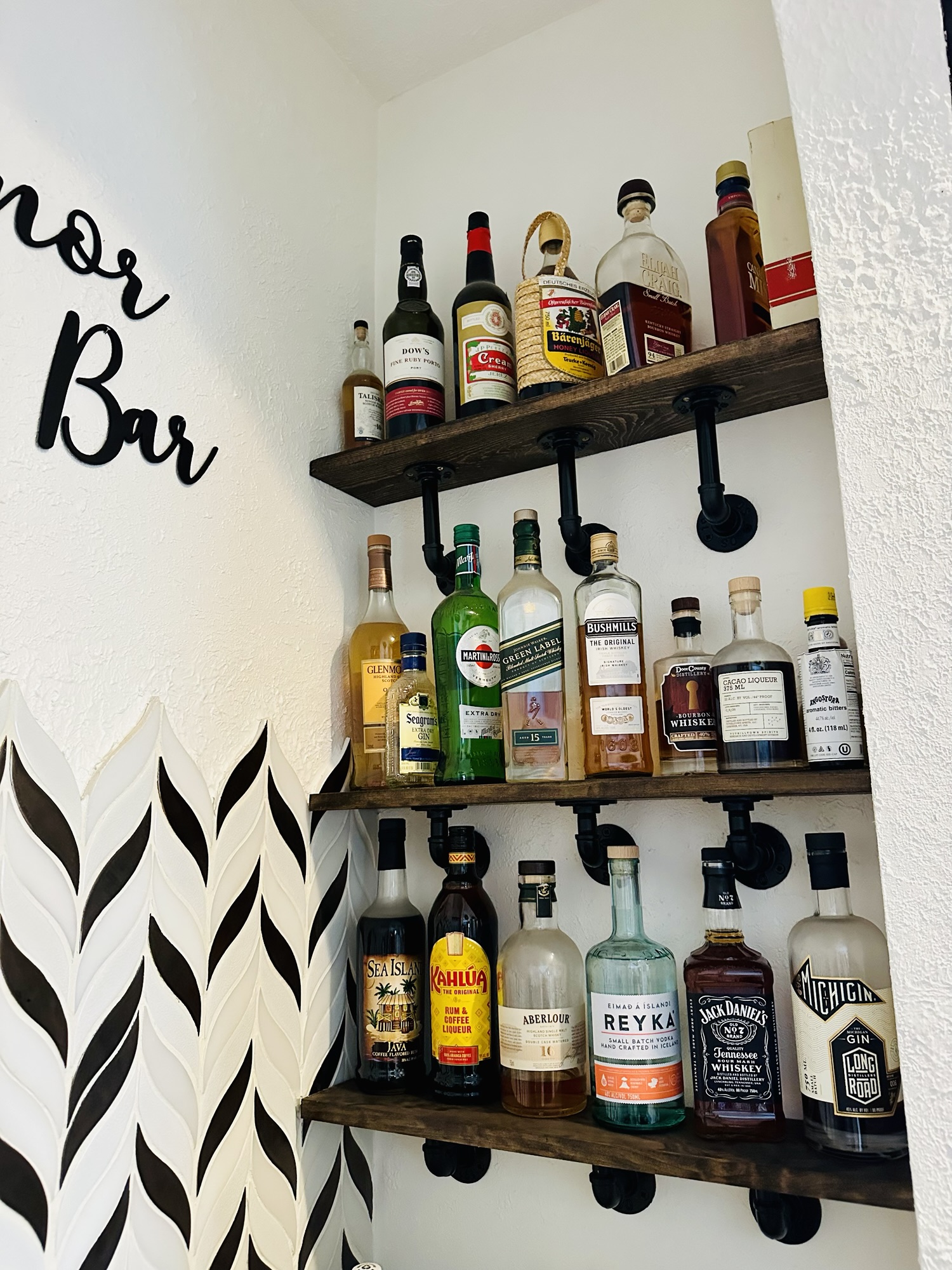
Recently I realized that we have more liquor we don’t drink than liquor we do drink. And the problem was that all those bottles were starting to encroach upon the counter space of my bar nook…which is also, most days, used as an overflow for coffee stuff.
I’d always intended to use the full vertical space along the sides of our nook for more shelves, and I finally got around to it this week. I also wanted a cooler way to hang our copper mule mugs. We’ve had them just hanging from hooks along the other side of the nook, across from the liquor shelves, but I wanted something a little better that matched the other side.


This project is basically just…how I hung shelves. But by using these pipe shelf brackets, you can do all kinds of custom arrangements, and I was really glad I found a way to make both sides of the nook match while also having different functions. This is a really good starter DIY project, if you’re looking to try something and want cool shelves!
Supplies:
(As an advertising affiliate and Amazon Associate, I earn a small commission from qualifying purchases. But it doesn’t cost you anything extra and helps me keep up my site!)
- Pipe shelf brackets (with mounting hardware)
- 1×6 wood board
- Stain or paint
- Screw-in hooks
Step 1: Measure and mark the wall. Honestly, this is what takes the most time for this project – get this right, and the rest is easy.
You’d think that the two sides of our nook would be the same width, but no. One side was a little under 23.5 inches, and the other was 23.75 inches. Glad I checked! Since I wanted these shelves to be as tight as possible (especially the mug-hanging side, for reasons I’ll explain in a bit) I wanted my measurements exact. This meant I needed one 1×6 board to be slightly under 23.5 inches and one slightly under 23.75 inches so they’d fit in the spaces.
For the shelves’ wood pieces, that’s all you have to measure – the length of the space you’re filling. I wanted 6-inch boards so there was plenty of room for wider bottles, plus my pipe brackets stuck out about 3 inches from the wall (I made the 5-inch side go vertical), so this put the brackets right in the middle to support each board.
Next, I had to measure the spacing for the shelf brackets’ bases that went on the wall. For the liquor shelf side of my nook, I already had lower shelves in place, so I literally just measured the spaces between all those screw holes and copied it for the new, highest shelf. (How did I decide on the height? I used our tallest liquor bottle. 😂 I also wanted to use slightly taller pipes on this top shelf’s brackets, so the height was flexible because it was going to be different from the lower 2 shelves anyway.)
I DID remember how I originally measured for those lower shelves, and I used that method to double-check my spacing for the new shelf too.
First, I used a stud finder…and discovered only one useful stud, right in the center of the wall. For all the other places I’d need screws, I’d have to add wall anchors. (These come with the pipe brackets I bought, along with the screws. 👍) So, for that center bracket, I held the round base in place so that 2 screw holes would be on that stud. I marked these and the third hole with a pencil…and I labeled which holes had the studs because I knew I’d forget. 🤪

Since I wanted this liquor shelf to be really strong, I wanted 3 shelf brackets in place to support the weight (2 probably would have been fine at only 23-24 inches long, but I also liked the look of 3). Since I already had the middle bracket’s base marked as above, that left me needing one on either side.
The easiest way to find the right placement was to measure from the back wall to the marks I’d made for the middle bracket. I went off of the top of the 3 marks, for consistency. Using a level and ruler, I marked the middle point between the back wall and that top mark, and this new mark became the top hole’s mark for my back bracket. I held that bracket’s base in place, lining up the top hole with my mark, and marked the other 2 holes with my pencil.
Then, I did this again for the bracket on the other side – between the front wall and the middle bracket’s marks.

Just to be sure, I checked my hole marks with a level (or…a cocktail collection box, as pictured above 🤪) and found everything lined up.
Moving across my nook to the other side, I again used my stud finder and discovered one usable stud, right in the middle of the wall. Because I wanted this shelf to sit at the same height as my new, top liquor shelf across the nook, I measured from the ceiling to my middle bracket’s top mark on that side of the nook. This was 28.75 inches.
So, for my mug-hanging side of the nook, I marked at 28.75 inches down from the ceiling and 12 inches in from the back wall (this was the middle where the stud was).

Using this mark, I held my bracket’s base so the top hole lined up with my mark, and I marked for the other 2 holes. Again, I made it so 2 holes lined up with the stud, and one would need a wall anchor. This was the only bracket I planned to use for this side’s shelf, so that was all I needed to measure!
SIDE NOTE: Do you really need wall anchors with these brackets? In my experience, yes. I used only one wall anchor per bracket base for shelves I hung in our pantry, and they started to pull out from the wall. I was able to fix this while I was on a roll this week, but I wish I’d done it better earlier, obviously. Save yourself the headache and use the wall anchors now, even if you’re not putting super-heavy things on your shelves!
Step 2: Cut and stain/paint the wood. This was the easiest part of this project. Using my miter saw, I cut one 1×6 board a tick short of 23.5 inches and one a bit short of 23.75 inches. After a quick test, I found they’d fit perfectly, with very little wiggle room between the ends of the shelves and the walls.
SIDE NOTE: If you’re not cramming these shelves in a tight space, obviously you’ve got more room to play with how long the shelves are and how they fit in your space. I will say, though, that for the mug-hanging side, it helped to have walls on either end to help that lone middle bracket – the walls will keep the board from wobbling at all.
I quickly sanded any rough spots or sharp corners on the 2 boards. After wiping them clean, I lay them out and used a little brush to stain the boards. I did the tops and bottoms as well as the ends and front sides. I didn’t bother with the back sides since they’d be tight against the wall. You could paint the boards instead, if you like that look better or want to match them to something else.

Step 3: Install the brackets. While my stain dried, I got to work installing the brackets. First, I used my drill and installed all my wall anchors over the holes where I needed them.

Next, I held each bracket base over these holes and used screws to secure them on the wall.
I screwed on each of these bases, then took the horizontal pipe sections and screwed them onto those bracket bases. BE SURE to use the same length of pipe for each one! I messed this up with one and had to unscrew it after I’d gotten it really, really tight. 🤦♀️

After that, I took the curved connectors and screwed those on. If you can’t screw them tight in the correct, upward-pointing direction, it’s okay to have them a little loose. The important thing is that they’re pointing as straight up as possible.
Then came the pipe sections that rose vertically. Try to get these as tight as you can.
Lastly, I screwed on the other ends of the bracket bases – the ends that your boards will sit on. Try to get these as tight as you can while ALSO, making sure they are level with each other. If one needs to be a little looser to line up level, that’s okay. Once it’s screwed into the board sitting on it, it won’t go anywhere.


I used the bubble level app on my phone to check all this, and to make sure each of my vertical pipes was level. Once I was happy, it was time for the boards.
Step 4: Attach shelf boards. With my stain dry, I set each board in place, making sure there was no gap along the back wall. I quickly checked that the board was level, then used my drill to screw in short screws up through the bases into the wood. (Use short screws that won’t come all the way up through the wood!) Each base should have 3 screws through the holes, so this holds on the board quite well.
Step 4: Add hooks (optional). For my mug-hanging shelf, obviously I needed ways to hang the mugs. This is why this side only had 1 bracket – this left room on either side to hang the mugs from hooks in the underside. I measured every 2.5 inches along the underside of that shelf, marked with a pencil, and then easily enough screwed in my hooks. I did 2 for each side.

This shelf, with only one bracket, might not be as strong as the liquor shelves with 3 brackets, but it’s still pretty strong. Since the board sits so tight in the space, it literally can’t tip one way or the other, either. I could safely set bottles on top of this one too, if needed.
It would also be cute to hang coffee mugs from a shelf like this, and in that case you could set coffee stuff on the shelf too.

That’s it! This adds some much-needed, out of the way storage to our little bar nook. Our seldom-used liquor bottles are out of the way but still look like they belong. The higher shelf also helps draw the eye upward and makes better use of the whole space. And I really like the way our mule mugs look now rather than just hung on the wall like an afterthought.


I might already have an idea for how to hang a few wine glasses under the mugs since there’s room to do a second shelf…but I’m also accident-prone and not allowed to touch our nice wine glasses, so we’ll see. 😆

DIY Must-Have Lists