Posted on Leave a comment

Color Splash Furniture Makeover

This would have gone a little differently without the help of my 4-year-old, but she wanted to help and I didn’t want to disappoint her. It was fun to work together, and at least she’s proud of her work. So, here’s how I made over her dresser…with a few pointers on how I’d planned on doing it by myself.

When we first moved into our current house, I did a quick paint job for my old dresser that had been revamped MANY times already. I didn’t figure a dark brown would be very kid-approved, so I painted the whole dresser a plain white for the time being and added cute knobs. But I didn’t even do 2 coats, and clearly it needed something new.

BEFORE: Plain dresser in need of love.

Fast-forward to now, and it was time for something more fun. Ruby wanted a “color splash” and, boy, did we find a way to make that happen. 😜

Supplies:

(As an advertising affiliate and Amazon Associate, I earn a small commission from qualifying purchases. But it doesn’t cost you anything extra and helps me keep up my site!)

Step 1: Prep and base coat. Our dresser had a glossy white paint that first needed to be cleaned off (think years of sticker gunk and…slime, possibly?). Taking the dresser into my garage, I next removed the drawers and sanded the main body of the dresser. I used my little handheld sander, but you could just use a strip of sandpaper. I went over the whole dresser, sanding over the glossy paint to roughen it up a bit so that new paint would adhere better to the surface.

Lightly sanded.

If your furniture has fresh, never-painted wood, you’re probably fine to just paint a base coat of whatever color you want.

If your wood is stained, you definitely want to sand that down before painting a base coat. If your paint is peeling, you definitely want that off too. There are a lot of videos out there about stripping paint, but basically, just get your wood to the point where new paint will adhere.

Because the pouring paint won’t cover every part of the dresser, you want to give the dresser a base coat of paint that the pouring paints will go over. I left most of our dresser white. For the front pieces that would be exposed around the drawers, however, I used a purple spray paint and quickly did a base coat of that for the front. I didn’t worry about it getting on the top, sides, or bottom because I figured that might look kinda cool with the pouring paint going over these places anyway.

Whatever you use for this base coat, it doesn’t have to be perfectly flawless, since the “color splash” will cover a lot.

Base coat of purple added.

Step 2: Remove hardware. I had an interesting situation where I’d had to use washers to make the drawers thick enough for screws to tighten on the knobs. I’d apparently put on these washers when the white paint had been a little wet, because most of they would NOT come off. So, I decided I’d simply paint over the washers to help hide them anyway.

You can probably just remove whatever knobs or pulls are on your drawers and set them aside for later use.

Hardware removed.

Step 3: Make a plan and set up. I planned to do one drawer at a time simply because that’s what I had room to do. You could try all at once if you have a bigger space, but I liked taking my time too. Just be sure that you put something (I used cardboard) under where you’re working, because the paint will drip. Each drawer should stand on their backside, with the drawer front facing up. Also be sure they are fairly level so the paint will flow evenly.

I kept all of the drawers ready nearby and carried them over one-at-a-time to my piece of cardboard where I was working. I also made sure I had space to set them to dry once each was done – I used my kitchen island for this, since I’d be able to easily wipe off any paint that dripped while drying.

As for the pouring paints, I/we picked the colors we wanted and set these out so they were ready. We used neon yellow, purple, hot pink, and light pink from my box set of pouring paints. (Ruby picked her own, completely different colors for the sides of the dresser that she was painting…yay.) I also kept the Floetrol bottle open and ready next to my pouring paints as well. And, I ran an extension cord for my blow dryer so I’d have room to maneuver. Lastly, I kept a few spare gloves ready if I needed them – though I ended up only using one, and you don’t necessarily have to use a glove, because the paint washes off easily.

Narrowing down colors 😜

It really helped to have all of this ready first so I wasn’t making a mess as I moved things around, and it helped me be able to work more quickly.

Side note: I set up so that I could do the drawers first. However, you could start on the main part of the dresser rather than the drawers…which would have been my plan if I’d had my way. I would start with the top, and once that was dry, then I would turn the dresser on its side and do one side, let that dry, and then turn it over and do the other side. This process would take quite a while because you’d need to let each side dry before moving to the next, but at least I could’ve started the process and given the drying time a head start before starting on the drawers. It is probably easier to practice and get the hang of pouring paints on smaller drawer fronts, but you could tackle the main dresser first if you’re confident!

Step 4: Pour the paints! It is absolutely necessary to use Floetrol for this project, or else the paints won’t flow like they should. I had a leftover bottle that wasn’t even half-full, so it doesn’t take a lot. Also, it’s important to use the appropriate kind of pouring paints for the colors, because regular acrylic paints don’t flow as well. You could mix acrylic paints with Floetrol, but buying the right kind in the first place seemed easier. 🤷‍♀️

Anyway, start by pouring a little bit of Floetrol on each drawer front and then wiping it around so that it covers the whole surface. You also want the Floetrol going over the edges slightly, as this will help the colors flow over the sides instead of building up at the edges.

Floetrol on.

Once the Floetrol was on (and keep in mind that this will basically disappear, so don’t count on it for color coverage), I took each paint color and squeezed out lines, drips, and swirls over the drawer fronts. It doesn’t have to look pretty! The trick is really to just get enough colored paint on so that you’ll be able to blow it around and cover the space you want – you get a feel for this as you go.

Colors ready.

With the Floetrol and pouring paints on, I took my blow dryer and turned it on high. (Yours might work better at a different setting, so practice a few times to get the feel for what you need.) Holding my blow dryer pretty close to the paint, I blew it around and moved in different directions until I got the look I wanted. This is the fun part!

Blowing colors around!

Once all your color is blown around and no longer shows lines or dripped circles, you can stop. Be careful not to overdo it, or your colors will run together too much and get all muddied.

If you make a mistake and don’t like it, you can wipe it off quickly and start over – that’s another nice thing about the Floetrol. Or, if you don’t like a part of the painting, you can add more colors and blow that around to fill in or go over that part.

Step 5: Dry. After I was done with each drawer, I carefully went around the undersides and wiped off the dripping, excess paint with my finger. This helped get rid of the majority of the dripping right away so that I could move them to dry on my counter. I lifted each drawer and kept the top level, making sure they didn’t touch each other in case the drying paint stuck.

As I finished more and more drawers, I paused every now and then to wipe the undersides if I saw drips. After a while I stopped seeing drips altogether, so I just left them alone to dry.

Drawers drying.

I let the drawers dry overnight to be sure they were entirely dry before putting the dresser back together.

Side note: Now is when I poured paint for the top of the dresser. I used the exact same process as I’d used for the drawer fronts, only this was a bigger space. Ruby liked the drips over the sides of the dresser (which she’d painted herself), so I sucked it up and left them be. As I explained above, I would have done the sides of the dresser the same way too. This would have required more time as each side dried before turning the dresser for the next side, but the process would have been the same, repeating the steps above.

Painting the top…with supervision.
Top painted.

Optional step: Apply a clear coat. You could go over the dried paint with a spray-on, clear gloss if you want a protective finish. I opted not to bother, since I’m hoping someday to talk her into letting me do the sides. 😉 But, it would help to protect the paint and also to give the dresser a nicer finish.

Step 6: Return hardware. I used the same knobs I’d used before, but you could always change it up if you like.

After putting the drawers back in place, the dresser was finished! This certainly is a fun way to add some color to a bedroom, and it completely changed the look of the boring white, banged up dresser. My daughter also really likes that she can switch which drawers go where, changing the look even more if it gets too “boring” in this current configuration…which I don’t see as a likely issue, but what do I know? 😆

AFTER: Color splash dresser!


DIY Must-Have Lists

Click to see more!
Click to see more!
Click to see more!
Posted on Leave a comment

Easy Painted Glass Windows

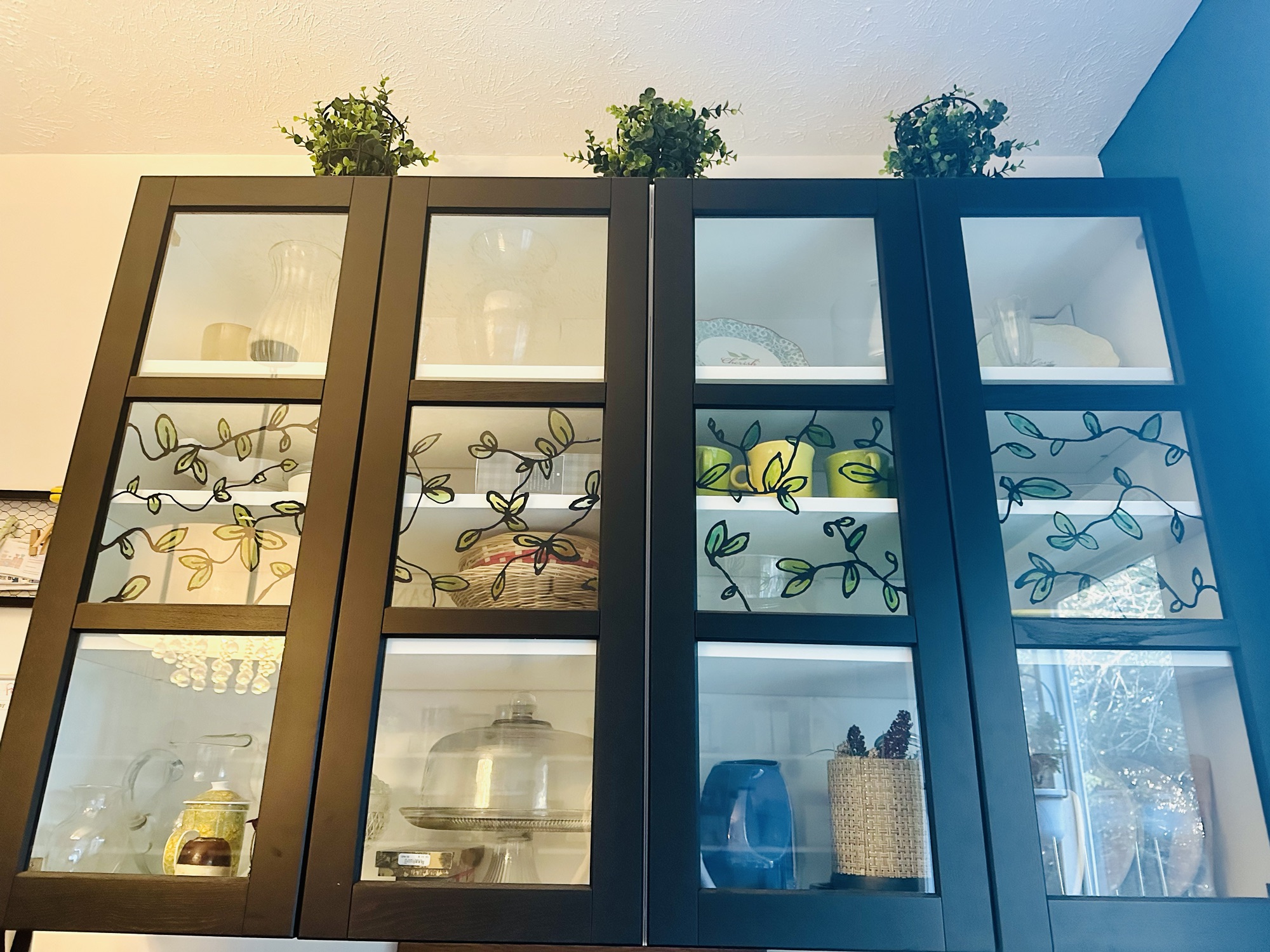
A looooong time ago, I came up with a way to decorate my pantry’s glass cabinet doors so that they looked kind of like stained glass — temporarily. They’ve been like this for so long that I knew I liked the design, so I decided to make it more permanent. The old method (See my post “Faux Stained Glass for Windows or Cabinet Doors”) was done by painting Saran Wrap and then taping that to the backside of the glass door. But now, I’d paint directly on the glass. This is a much better look if you decide you want it to be permanent, because it eliminated the plastic crinkles of the Saran Wrap that you can see from the front.

BEFORE: Temporary version.

I put this off for so long largely because I thought I’d have to take the doors down in order to paint them for real, but after painting vases vertically (see how I did that at “Faux Stained Glass Vase”), I realized the liquid leading didn’t drip like I’d thought it would! This meant I could leave the doors in place and just paint them as they were. I didn’t even have to empty the cupboards at all. Phew!!

Supplies:

(As an advertising affiliate and Amazon Associate, I earn a small commission from qualifying purchases. But it doesn’t cost you anything extra and helps me keep up my site!)

Step 1: Clean the glass. It was very easy to remove the painted Saran Wrap that I’d taped to the inside of the cabinet door, so again I can safely recommend that method if you just want something temporary. Once those sections of wrap were off, I gave the inside of the cabinet doors a quick wipe, but they weren’t that bad. Just be sure that you remember you’re doing this on the INSIDE of the glass doors…though I suppose you might as well feel productive and clean the outside too.

If you’re doing this on real windows (and I’m already looking around my house for options 😜) then you definitely want to give them a good quick wash with Windex or whatever. You don’t want a bunch of dust stuck on the glass while you paint. And remember, this will only work on the INSIDE of the windows, because you don’t want the paint getting ruined by the elements outside.

Step 2: Draw outlines with liquid leading. Again, it’s probably best to do this on the inside of the glass doors, so as to keep your work safer from everyday handling of the doors. So, you’ll want to open the doors and work on that side.

Ready with the liquid leading.

For my vases, I’d painted with the colored glass paints first, but here it seemed smarter to make my outlines first. That way, the black would show up best on the front side of the doors, and the color could slob a little on the black without showing from that side.

Anyway, I tried to make the stems and leaves look like what I’d done temporarily on the Saran Wrap before, since I’d liked that design so much. It helped a lot to stand on a chair so my arm didn’t get tired, but it didn’t take me too long to draw my design with the liquid leading. As with my vases, it didn’t drip, I could wipe it off quickly if I messed up, and it was easy to apply by squeezing out lines as I went.

I did try to get as close to the edges as I could, and it helped that my doors had those black divider sections on the front, so I could go behind those a bit without it being noticeable from the front.

Drawing my outlines.
Outlines drying.

I gave this several hours to dry, just to be sure it wouldn’t wipe away as I used my brush while painting with the colors.

Step 3: Paint with colors! I’d run out of the dark green (Viridian, from my set) that I’d used earlier on the Saran Wrap, but it was easy enough to use the light green first and then add a bit of Cerulean blue to make green leaves – blending these paints looks really pretty when light goes through. I squeezed out a quarter-sized amount of paint at a time and used a small craft brush to paint inside the leaf outlines, not worrying if it got over the black since that would not be visible from the front side of the glass.

The glass paint I used.

Once this was all dry, that was it! The cabinet doors look much nicer now without the plastic crinkles, and the look is now much more permanent, like it was always part of the doors.

AFTER: Finished painted glass doors.

There are SO many different designs you could paint, so let me know if you come up with other great ideas!


DIY Must-Have Lists

Click to see more!
Click to see more!
Click to see more!
Posted on Leave a comment

Painting Fan Blades

This was the last project for my 6-year-old’s room makeover! She wanted a “kelp forest” ceiling, but after creating a cave over a good chunk of her ceiling, we compromised by deciding to paint her fan blades so that they looked seaweed-y.

Painting fan blades was something I’d never tried before, and it was super easy! This might not be a new idea to anyone, but I can now personally recommend that you give it a go if you’re interested!

BEFORE: Plain white ceiling fan.

Supplies:

(As an advertising affiliate and Amazon Associate, I earn a small commission from qualifying purchases. But it doesn’t cost you anything extra and helps me keep up my site!)

  • Screwdriver
  • Paints

Step 1: Detach fan blades. I suppose I could have painted the blades while they still hung from the fan in the ceiling, but I didn’t want to risk dripping paint. Also, it seemed like my arm would get tired. Plus, by taking them down, I was able to clean them. 😜 I was also glad I’d detached them because, in the end, this meant that the painted portions went under the metal decorative parts where the blades attach to the fan, and that looked pretty cool.

My fan blades were held on by 3 screws each, so I used a screwdriver and simply unscrewed one blade at a some, carefully setting aside the washers and screws to reattach the blades later.

Removing the fan blade screws.

Step 2: Clean the blades. Mine were not real wood, and they wiped down pretty easily with a lightly damp cloth. After removing a considerable amount of dust from the top side of the fan blades, I made sure to use a clean paper towel to wipe and dry off the bottom side, which was the side I’d be painting.

Cleaned and ready.

Optional Step: My fan blades were in pretty good shape – and a nice white color – but you might want to apply a base coat of paint over each blade if they look rough. I considered painting them blue (which would make sense with our “under the sea” theme), but I did not obtain permission for that. You could start with whatever base color you choose, especially if your blades are wood and you really want to change the look.

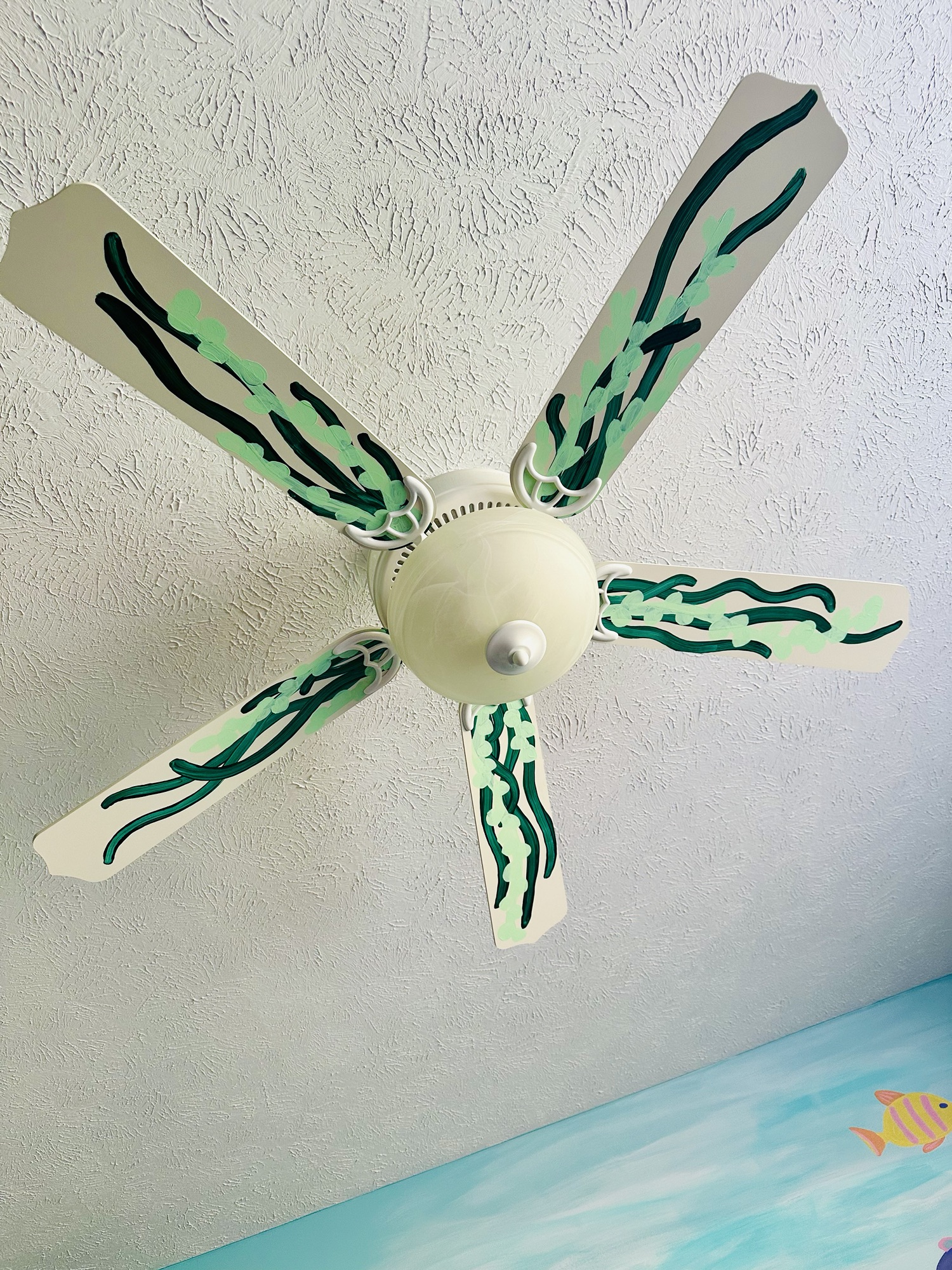
Step 3: Paint the design. I took 2 different green colors – one dark and one light – to make my seaweed/kelp/plants. My dark green was a latex paint, and my light green was acrylic. Both adhered just fine. I started with my dark green and made long, weedy, wavy lines. Once that dried, I took my lighter green and painted more leafy-looking plants. I didn’t want to overdo it, so I stopped there…

Dark green painted.
Light green added.

You could do really pretty flower designs, abstract shapes, stripes, or really anything! I have a feeling I will end up painting my other daughter’s fan too, so let me know if you come up with any great ideas!

Step 4: Reattach the fan blades. Once the paint was dry, I took the blades one at a time and lined up the holes to screw the washers and screws back in place. I did find it was easiest to start with the screw nearest where I was standing between the blades, secure that one first, and then have everything stable to screw in the screw closest to the actual fan.

Screwing the blades back on.

That was it!

This was incredibly easy, and the painting possibilities are endless!

AFTER: Painted seaweed fan!


DIY Must-Have Lists

Click to see more!
Click to see more!
Click to see more!
Posted on Leave a comment

Easy Closet Shoe Shelves

Growing kids have growing feet, and we have a lot of shoes around here. Somehow, it’s almost impossible to keep both shoes of a pair in the same room of our house (why?!), and shoes become invisible once in a pile.

BEFORE: Empty closet nook. Pile of shoes.

So.

For anyone who doesn’t want to buy those shoe racks that sit at the bottom of a closet (which take up floor space, are difficult to see if hanging clothes are in the way, and unfortunately encourage kicking off shoes “near” the shelves on the floor), here was my DIY solution. It also allowed me to make use of that weird nook space inside the side of the closet. This project was very easy, very quick, instantly useful, and WAY better than piling shoes on the floor.

Supplies:

(As an advertising affiliate and Amazon Associate, I earn a small commission from qualifying purchases. But it doesn’t cost you anything extra and helps me keep up my site!)

  • Wood boards, about 1x12x36 inches
  • Paint or stain
  • L-brackets and screws

Step 1: Measure and mark shoe shelf placement. I initially thought I’d put a shelf pretty low, but then I realized it might be good to leave a decent amount of space between the floor and the underside of the lowest shelf. For now, my daughter can put her dirty clothes basket under there. When she’s older, she could put taller boots and heels on the floor as if it’s the lowest shoe shelf.

First, I found a stud along the back wall. Mine was about 8 inches out from the corner. If you don’t have a stud where you’re putting your shelves, you can just use wall anchors, which is what I had to do on the other side between the closet door and the corner. It really doesn’t matter if the two marks are the same distance from the corner or not – it might even help if they’re spaced a bit differently to help balance and support the shelf.

Once I had that stud marked 8 inches from the corner, I decided on 18 inches up from the floor. Like I said, I wanted a pretty good space between the shelf and the floor. If you want to run a lot of shoe shelves up the whole side of your closet (I would if this was MY closet), you could start lower to really commit that side of your closet to shoes.

Marking for bracket placement.

With that lowest shelf’s placement figured out, I decided to put the next shelf 10 inches up from the first. Easily enough, I measured 10 inches straight up from each wall’s marks.

If you’ve got more shelves to do, just keep going up! I’d personally change up the spacing to allow for different kinds of shoes – flats on shorter shelves, heels on higher shelves, etc.

Step 2: Attach L-brackets. With my wall marks done, I took my drill and a screw, held my first L-bracket over my back wall’s mark, and drilled the bracket onto the wall, into the stud. My bracket only required 2 screws, so that was easy!

I then went to the other side where the shelf would run across the side of the closet and repeated this for that wall’s L-bracket, only this time I needed to add a wall anchor first. Finally, I did the next shelf’s brackets the same way.

Back wall brackets on.

I will say that, if you plan to put a lot of really heavy shoes on your shelves, you might want to add a bracket on the side wall too, near the center of where your shelf is going to sit. But really, just these two brackets hold the shelf pretty stable, and that’s also why it helps to drill into a stud.

Step 3: Find and/or cut wood for a shelf. I’m running out of scrap wood, but I do still have a bunch of cabinet doors. With an unusual degree of luck, I had 2 cabinet doors that were exactly 35 inches long – just what I needed to go across the side of the closet! They were 11 inches wide, too, which fit perfectly and would be wide enough to fit even grown-up shoes once my daughter’s feet get to that point.

If you have nice 1×12 pieces of wood, that would work nicely too. Just be sure to measure your space’s width and length, and cut the wood accordingly.

My daughter decided that she wanted her shelves bright yellow, so I painted them quickly before moving on. If you use real wood, I think staining them would look really pretty…or paint them, or wrap them in contact paper – anything goes!

“Shelves” ready for painting.

Step 4: Attach the shelves to the L-brackets. To be sure I could get the drill under the shelf, I started with my top shelf first so that the lower shelf wouldn’t be in the way. Taking 2 little screws, I placed the shelf on top of the highest brackets and drilled the screws through the top of the bracket into the underside of the shelf. Repeating this for the other end, my top shelf was secure!

I lay on the floor and repeated this for the lower shelf.

Bracket screwed into shelf.

That was it! Like I said, this was extremely easy. It’s a great use of that goofy space at the end of a closet, it still leaves the floor free for other uses, and it’s SO much easier for my daughter to store and find her shoes. It’s also low enough that there is still plenty of room to hang clothes on the far end of her closet system, too.

Now, I just have to talk her into taking the stickers off the walls. 😬

AFTER: New shoe shelves!


DIY Must-Have Lists

Click to see more!
Click to see more!
Click to see more!
Posted on 1 Comment

Custom LEGO Table

Hosting a lot of play dates this summer, I quickly realized our makeshift LEGO setup wasn’t cutting it. I also felt judged by a five-year-old boy who clearly was less than impressed with it. And since the kids always had to dig and dig and dig in the bin to find what they wanted, I knew it would make my life easier if I found a better way to sort through the LEGOs. So, I decided it was finally time to do something about our LEGO problem and make a table with storage. I wanted room for several kids to build at once, and I wanted them to have an easier time where everything was accessible.

Supplies:

(As an advertising affiliate and Amazon Associate, I earn a small commission from qualifying purchases. But it doesn’t cost you anything extra and helps me keep up my site!)

BEFORE: Scrap wood waiting to be a table.

Step 1: Decide on size and cut pieces. I wanted even small kids to be able to reach across to the other side while they build, so I decided on a 20-inch wide tabletop. And to make the table long enough to accommodate several builders, I went with 48 inches long for the tabletop.

Using my table saw, I cut down a large piece of leftover MDF to 20×48 inches. This would be my tabletop. I then took 2 wood 1x4s and cut them to 45 inches each. These would be my braces, where I’d attach the legs, and also how I’d attach my gutters/containers.

Once these pieces were cut, I sanded all the corners to round them smooth.

Step 2: Attach the brace pieces and table legs. Next, I flipped the tabletop piece upside down and positioned the two 1×4 wood pieces so that each end was 1.5 inches in from the edge. I also positioned the boards 1.5 inches from the sides. You want the braces a little under the table, but not too far, so that the attached gutters run under the table just a little bit – this hides the screws.

Positioning braces.

I marked the corners where my 1.5 inches needed to be, and then I double-checked that the boards were right before using 1.25-inch brad nails and nailing the boards onto the tabletop.

With the braces on, I next positioned the 20-inch table legs that I’d purchased. These I brought 6 inches in from the ends of the table, and it was easy to screw them onto the 1×4 braces.

Adding legs.

Step 3: Paint. I flipped the table back over and rested it on sawhorses just because I didn’t want to bend over to paint. 🤷‍♀️ You could more easily set the table on the floor, but I wanted a little elevation.

I initially had grand plans about drawing map-like scenery on the tabletop that the kids could use to play while building, but my girls requested that the table just be blue instead. That made it easier, but it’s another idea if you’re not sure how you want to paint your table! Taking my blue paint, I brushed it on the MDF tabletop and also along the sides, going a little bit under the table as well.

Once that was dry, I used a light coat of clear gloss spray just to help protect the paint a little and make the surface smooth.

Paint drying.

Step 4: Attach side gutters. If you get new gutters, or if your leftover gutters are longer than mine to begin with, you could just run a gutter the whole length of your table. I, however, had small sections of gutters to work with, and I liked how they let me make different divided sections. It’s a good idea to use vinyl gutters so the corners aren’t sharp and the material is pretty light.

Basically, I measured out my gutter sections until I got enough to make a 48-inch stretch for the length of each side, plus two 16-inch sections for the ends of the table. (These end gutters will be used later.) I needed to cut down one section a little, and this was pretty easy with a small hacksaw. I then took sandpaper and smoothed out that cut side.

Measuring gutter sections.

After cleaning the gutters, I positioned them one at a time along the length of my table so that the taller side of each gutter was against the outer side of the 1×4 brace underneath the tabletop. I marked 3 places where the gutter could screw into the brace, and then I drilled 3 little holes into the gutter where I’d marked.

Underside brace ready for gutters.

Holding the first gutter back in place along the brace, I had to use a handheld screwdriver because the gutter’s angle didn’t leave room for a powered screwdriver. This was easy enough, though. I used a simple drywall screw through each of the gutter’s drilled holes and screwed it into the side of the 1×4 brace.

I repeated this for each gutter along the sides. (They didn’t meet perfectly, but this isn’t a problem because of how I made dividers in a minute!)

Side gutters attached!
Kids were impatient 😂

At this point, I decided to hold off on attaching the end gutters. It’s easier to do the ends a little differently, so you might want to do the same.

Step 5: Cut and attach foam ends. First, I took 4 sheets of colorful foam and measured for 8 rectangular pieces that would cover the ends of the gutters. You want a little overlap around the gutter edges, but not so much that they’ll be in your kids’ way when they’re building. My rectangles ended up about 5×3 inches. I made each end of my long gutters a different color, then made each end of my – still unattached – end gutters a different color, so I had 2 rectangles from each color.

Cutting rectangles.

Next, I cut 6 round foam circles for each of my 8 colored rectangles. (I also made sure to cut 3 more circles of each color for my next step when I’d decorate the dividers.) After warming up my glue gun, I glued these circles onto the rectangles so they looked like LEGO pieces.

Attaching circles.

Once these rectangles were ready, I spread hot glue along the end edges of each gutter, one at a time. Positioning each rectangle in place, I pressed them into the glue so they stuck on the gutter ends.

I also did this for the unattached end gutters (pictured below), and I’m glad I did things this way for the ends because it would’ve been more difficult to get them on correctly if I’d waited until the end gutters were attached. You might have a little more wiggle room with your spacing, but mine were pretty close.

Ends on an unattached gutter.

Step 6: Cut and attach dividers. Using the rest of my foam sheets, I cut a strip of each color about 2 inches wide. These I used like tape by spreading hot glue along one side and then wrapping them to connect one gutter section to another, folding the strip down over the front edge of the gutters to cover the uneven edges.

I had 3 gutter sections along each side, so I used 2 strips for each side of the table.

Glueing on divider strips.

Next, I cut rectangles about as big as before, but these I trimmed and tested until they sat like dividers in the gaps between the gutter sections. Once they were the right size, I glued them in place.

Again, I had 3 gutter sections for each side, so I needed 2 dividers for each side of the table. I made sure to match each divider to the color of the strip they connected to.

Prepping my dividers.

As a finishing touch for these dividers and strips, I took those extra foam circles and glued them down along the strips. This added a nice little LEGO detail and also helped cover any uneven parts showing under the strip.

Dividers done.
Side gutters finished!

Step 7: Attach the end gutters. With all my details glued on, I could now attach the end gutters without having to worry about getting my glue gun in the smaller space at the end.

Similar to what I’d done before for the long-side gutters, I marked where each gutter could be screwed into the ends of the 1×4 braces. Then I drilled holes in the side of the gutter. Finally, I held each gutter and screwed it into place.

Done with that, all I had left to do was sort LEGOs (for over an hour 🤪) and put them in the waiting sections!

AFTER: New LEGO table!

Now my kids (and the five-year-old LEGO expert) have a table where they can all fit, get to the LEGOs easily, and reach everything with ease. I like that the gutters fit all the blocks without being so deep that the kids have to dig forever, and the little foam details look pretty cute.


DIY Must-Have Lists

Click to see more!
Click to see more!
Click to see more!