Posted on Leave a comment

Window Frame Kids’ Art Display

We only have so much room on our fridge for the art my kids make me that we HAVE to keep. I wanted a slightly nicer way to display these masterpieces without just tacking them on a corkboard, and those cute little frames you can buy to display kids’ artwork would never be enough, plus you never know the size of paper that’s going to come my way.

But I did have 2 old window frames, so…


Supplies:

(As an advertising affiliate and Amazon Associate, I earn a small commission from qualifying purchases. But it doesn’t cost you anything extra and helps me keep up my site!)

  • Window frame (can use craft store window frame with chicken wire removed for smaller frames, or search Etsy for full-sized window frames)
  • String
  • Staples
  • Paperclips

Tools:

An old wooden window frame with six panes, a staple gun, a ball of twine, and a small container of colorful push pins, placed on a marbled surface.
BEFORE: Old window frames, string, and paperclips.

Step 1: Paint or stain the frame. Mine were already painted black, and I thought that would look nice for a distinct frame, so I left them black.

Side note: I know not everyone has spare window frames lying around, but you can buy the same size as mine on Etsy or smaller frames at a craft store – the kind that have chicken wire to clip things onto. If you’re like me and don’t really like the farmhouse-y, chicken wire look, you can snip off the chicken wire and go from there. Or, if you want to be really creative, you can make frames from 1x2s. For my project, I used old window frames all ready to go (like you’d find on Etsy).

Step 2: Cut string. Here’s the thing – I didn’t want to just stick the artwork on the front of the frames because that would hide the frames, and the artwork would flap around from open windows and fall off too easily. So, I wanted the artwork to sit behind the frames and be…well, framed by each section of the frames. This meant I’d need to attach the art papers to the backside of the windows. To do this, I needed something that wouldn’t stick out or keep the window from hanging flat against the wall.

Solution: string, paper clips, and staples, all lying flat against the back of the window so it wouldn’t make the frame stick out or fall off the wall.

Turning the window frames backside-up, I unspooled my string to stretch from one side of the window to the other and cut the string so a little extra would go on either end. I needed 2 strings at roughly the same length for each window.

Close-up of an old wooden window frame with a partially painted edge, resting on a surface. A yellow tool is visible next to the frame.
Cutting the right amount of string.

Step 3: Staple on the string. For the topmost string, I needed to bring it down about a half inch so the hanging screws in the wall would have a place to catch/hold the frame without getting caught on the artwork or string. Starting at one end, I looped the string a bit to add to how it would be held down, and then I stapled the string onto the window frame. Holding that tight all the way across to the other side, I also looped that end and stapled it in place.

To keep the string from sagging, I stapled the string onto the interior divider sections of the frame too.

Close-up view of a wooden frame with black and white paint, featuring a piece of white string threaded through a corner joint.
Stapled top string to a middle divider.

For the lower section, I ran a string from side to side right along the middle divider. Again, I looped each end to add to the grip of the staples, keeping the string tight across the center. Also again, I kept the string from sagging by stapling the string onto the interior divider sections.

Close-up view of a wooden window frame with a black finish and visible weathering, featuring a tied rope secured with a metal clip.
Stapled end.

Step 4: Add art papers with paper clips. Lying each piece of art face-down, I arranged one at a time and used paper clips to attach each paper onto the strings. I ended up using 2 paper clips for each paper just because the papers were a bit heavy and I didn’t want them to tilt all crazy.

A person holding a paperclip while attaching a string to the back of a picture frame with a glass front, resting on a textured surface.
Placing paper clips.

Step 5: Hang the window frames. I’d already screwed or nailed 2 screws/nails for each window frame, and you just have to be sure they are level and in position to catch the window frames so they hang nicely. Because of that half-inch gap at the tops of my windows, this left plenty of room to hang the windows and see what I was doing without poking into the papers. (Spacing this top string also makes it easier to change out the artwork later, without having to take the whole thing down.)

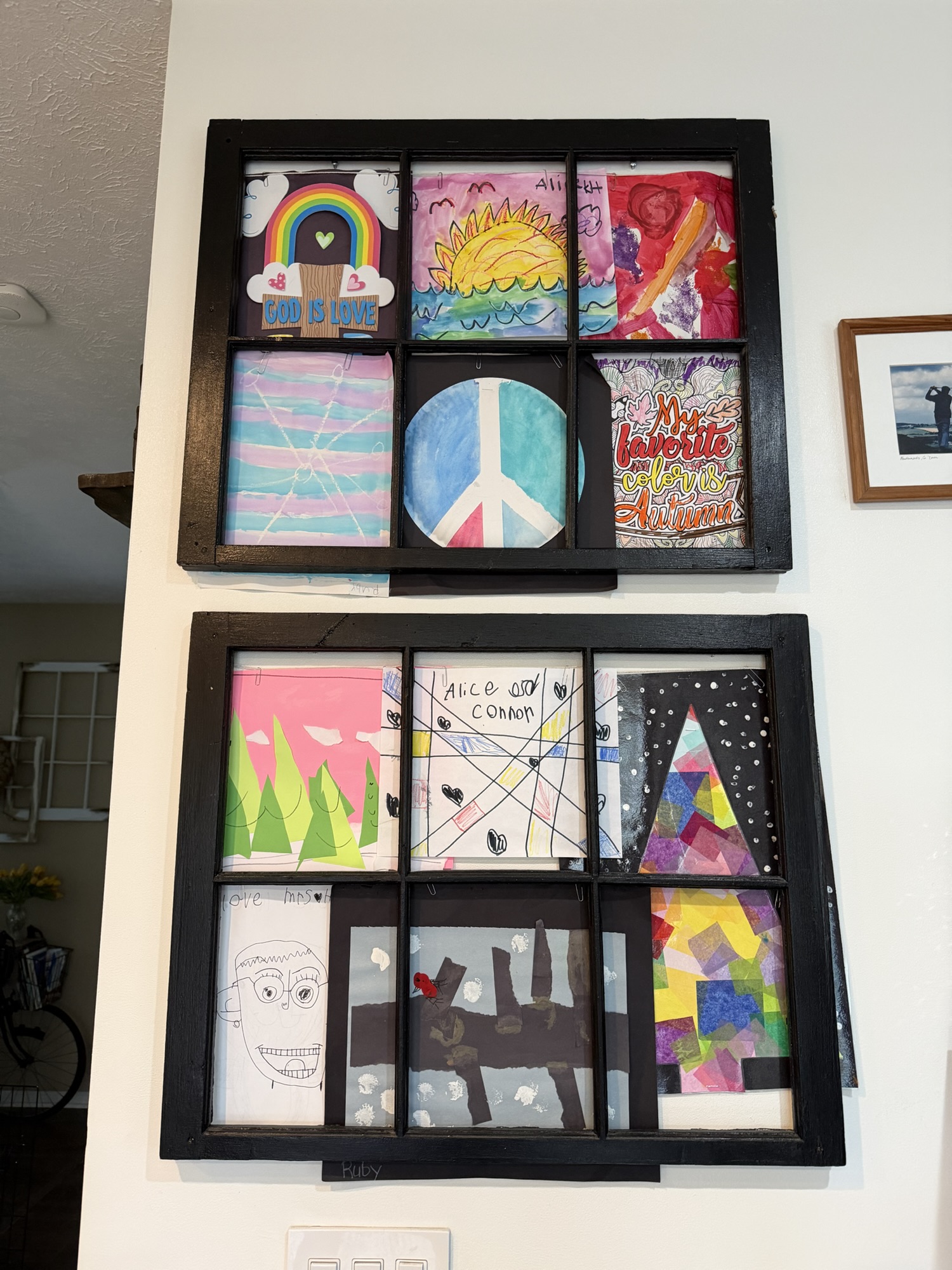
That was it! I can easily swap these artwork pieces when new artwork comes along by pulling the art off the paper clips and replacing them. I like that they’re secured in place and won’t fall or blow around, and they look nicely framed, kind of like a collage, without needing a dedicated frame for each piece.

A collage of colorful children's artwork displayed in a black-framed grid. The pieces include drawings of a rainbow, a sunset, a peace sign, and various abstract patterns.
AFTER: Kids’ artwork display!


DIY Must-Have Lists

Click to see more!
Click to see more!
Click to see more!
Posted on Leave a comment

Making a Cement Wall Pretty

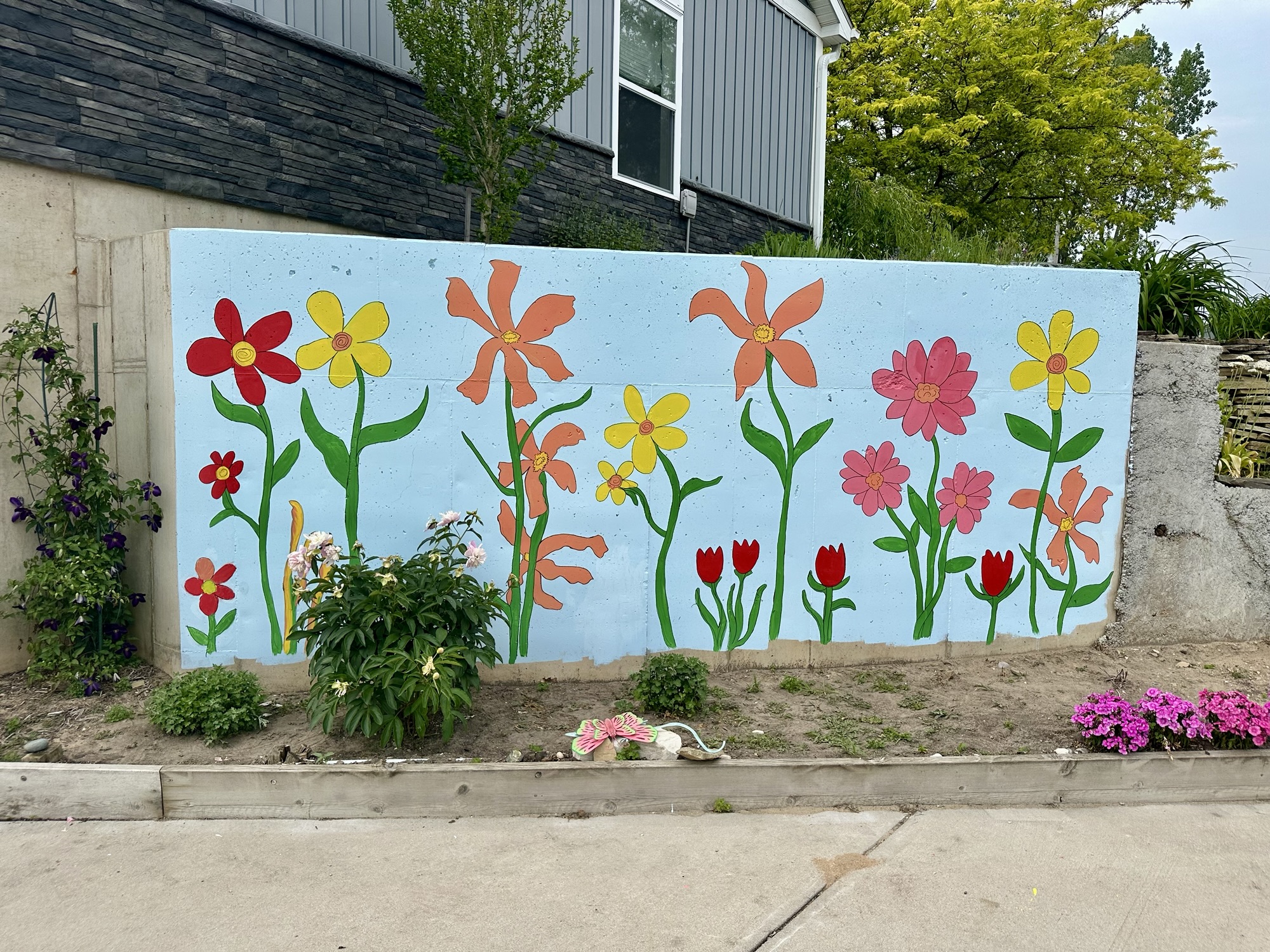
My mom had a very specific request for her Mother’s Day present this year. She wanted me to paint flowers on a cement retaining wall in her back yard. This wall stands behind a small flower garden, and the large, grey cement backdrop was definitely asking for some love.

If you have a cement retaining wall similar to this, or if you have cement exposed along the side of your house on a hill, this is a fun way to add some colorful artwork – especially if you have kids or grandkids who play in the area.

A cement retaining wall in a backyard, partially covered by a small flower garden with green plants and blooming flowers. Supplies for painting the wall, including a paint roller, paint tray, and concrete paint, are set on the ground.
BEFORE: Plain cement wall.

Supplies:

(As an advertising affiliate and Amazon Associate, I earn a small commission from qualifying purchases. But it doesn’t cost you anything extra and helps me keep up my site!)

Tools:

  • Paint roller
  • paint brushes (craft brushes work great)

Step 1: Clean the cement. You could hose down the wall and wait for it to dry, if there’s mud or other gunk stuck on the cement. My mom did this part on her own (yay, group effort on this project!) and just wiped the wall down to get off dirt and cobwebs.

Step 2: Background paint. I’d definitely recommend using outdoor cement paint that will be durable and also adhere properly to the wall. We used the Dutch Boy Porch and Floor paint because I’d used it before on other projects and trusted it to work.

Containers of Dutch Boy paint for a DIY flower mural project, featuring various colors including red, green, blue, and white.
Paint.

This comes in a variety of color options, and my mom picked a light sky blue for the background. She again did this step herself, and it dried very quickly so that she was able to do 2 coats within an hour. Honestly, a quart probably would have been plenty rather than a whole gallon, if you don’t want to spend quite as much.

A cement retaining wall painted light blue, surrounded by colorful flower beds and greenery in a backyard setting.
Base/background paint on.

Keep in mind that the cement doesn’t have to be in great shape for this to work. Our cement wall was pitted with uneven chunks all over, but you’ll be covering this “character,” and it’s easy to work around the bad parts. My mom did use a smaller brush to really get the background paint into the holes and cracks all over the wall, but for the most part she used a roller. You might notice that she did not go all the way to the ground, and this was because she wanted to add a bit more dirt to the flowerbed, plus plants will be growing along the bottom to cover that up. If you want a nice, straight line along the ground, you could either paint right down to the dirt or roll a straight line across the bottom.

Close-up of a light blue cement retaining wall, showing pitted texture and imperfections.
Close-up of imperfect wall.

Step 3: Outline flowers/design. This is when I came in. Using a permanent marker, I drew outlines of flowers, stems, and leaves all along the cement wall. I did this fairly quickly because we were just going for a cartoon-y flowerbed design. If you want to do something nicer and more detailed, I’d still use a marker to get your planned outlines, but it will take longer, of course.

A cement retaining wall painted light blue with outlines of various flowers drawn on it, situated behind a small flower garden.
Outline in marker.

Step 4: Paint the art! Rather than painting one flower at a time, I did one color at a time. I liked doing one color at a time because it helped me get a feel for where I wanted how much of each color, and it also meant I didn’t have to go back and forth cleaning my brushes between colors.

First, I used green to get the stems and leaves filled in.

A cement retaining wall painted light blue with outlined flowers and green stems in a backyard garden, surrounded by blooming flowers.
Green first.

Again, you can get this paint in whatever colors you want, and my mom bought a quart each of green, white, yellow, and red as well as the gallon of the base blue color. This was WAY more paint than I needed, even with a wall this big. The small 8 ounce sizes of your individual colors might be plenty, so keep that in mind when buying paint.

Anyway, I used a few different brushes, but small craft brushes worked just fine. I did like having straight-edged brushes when doing the parts that went right against my outlines. Straight little brushes definitely worked best for the long stems, too.

It’s worth noting that this kind of paint wipes off easily if you slob a bit – which happens when you paint vertical surfaces, if you’re like me. I just used my finger or a paper towel. Just be sure to wipe off the mistakes before the paint dries, since it dries pretty quickly!

Also worth noting: The paint often went over the black marker of my outlines, but not really enough to cover it completely, so keep that in mind if you make a mistake with the marker. Before you paint, you may want to use your base/background paint to cover over any outline mistakes.

After the green, I used red to paint red flowers. Then I mixed in a little white to make a pink color.

A colorful mural of flowers painted on a cement retaining wall, with a light blue background and various flower designs outlined in black marker. The wall is situated in a backyard with green plants and pink flowers visible in the foreground.
Red and pink painted.

Next I mixed a little yellow into that to make a pretty orange/coral color. I did a few flowers with this color, and I also used it to do the centers of some of the other flowers.

Coral color added.

Only then did I clean my brush, and I used yellow to finish the last flowers. I also used my yellow to make the centers of the rest of the flowers.

Colorful painted flowers on a blue cement retaining wall, surrounded by a flower garden and grass.
Yellow painted.

You could mix your colors to do MANY different colors and shades of flowers, but we were happy with this much. (You might’ve noticed where I missed a green leaf. I did fix that once I was done with my other colors. 😜 We also let my daughter paint a flower…once I had the majority of this done and looking how I wanted.)

Step 5: Outline. Because I wanted a cartoon-y feel, I went back over my outlines with the permanent marker to outline the flowers, leaves, and stems. If you’re painting a lot more detail or going for a more realistic look, you could skip re-outlining everything. This really did help make our flowers pop, though.

A large, cartoon-style flower design painted on a light blue cement wall, featuring orange petals with a yellow center and green stem.
Outline.
Outline.
Colorful flowers painted on a cement wall, featuring red and yellow flowers with green stems against a light blue background.
Outline.

Step 6: Apply a clear sealer. This sealer should also be made specifically for cement. This is definitely an important step to help protect your painting from sun, rain, scratches, etc. it’ll also add a nice shine over the painting.

That’s it! This certainly adds some cute artwork and color where there was bland and unattractive cement before. I also laughed a little bit as I was finishing up because bees started checking out the bright flowers. Guess we’re not the only ones who like it! 😂

Colorful mural of various flowers painted on a cement retaining wall in a backyard, with a light blue background.
AFTER: Pretty painted wall!


DIY Must-Have Lists

Click to see more!
Click to see more!
Click to see more!
Posted on Leave a comment

Don’t Throw Away That Packing Paper!

After last winter, as I was taking down our front door’s wreath, I looked at the wire wreath frame and thought, “I’m sure I can use this for something.” So I kept it. Fast forward to a week ago when I was watching a video of a woman using packing paper to design a basket, and I had my “Ah-ha!” moment. Could I braid packing paper and make a wreath out of it?

This turned out to be very easy, a little sticky (because I over-glue everything), in the end really pretty, and basically free!!

BEFORE: Scrap wreath form and packing paper.

Supplies:

(As an advertising affiliate and Amazon Associate, I earn a small commission from qualifying purchases. But it doesn’t cost you anything extra and helps me keep up my site!)

  • Long strips of packing paper
  • Hot glue and glue gun (I used 5 glue sticks)
  • Wreath form
  • Decorative ribbons, fake plants, flowers, etc.

Step 1: Cut strips of packing paper. My husband and I are always amused by how Amazon, Bed Bath and Beyond, etc. overpack our orders with way more packing paper and way bigger boxes than seem necessary. We are pretty good about recycling, but I happened to have a large amount of this packing paper in our garage, so I grabbed the 2 longest pieces and brought them inside.

First, I flattened them out on the floor. Then, I folded them lengthwise in thirds. This made it easier to cut even strips, using scissors to cut down each fold. This left me with 3 equally long pieces.

Making 3 strips.

Now that I had my pieces, I squeezed each one back to being scrunched, more like paper rope.

Squeezing paper ropes.

Side note: About the length of your paper… The longer the better, but you could use shorter pieces too if that’s all you have. You’ll just end up tucking them in and glueing more often.

Step 2: Braid the paper “ropes.” I channeled my inner middle schooler and did this like I used to make friendship bracelets. I took each of the 3 ends and taped them to my counter, then began to braid the paper. I was worried that it might rip if I pulled my braid too tight, but it didn’t at all. I had to keep making sure the long ends weren’t getting too twisted up as I went, but that was easy enough.

Braiding.

When I was done, I took my hot glue gun and glued the braid together at the ends. For one end, I really mashed it up and made it as narrow as I could. This would be the end I would tuck into my wreath form to start. For the other end, I tried to make it a little more decorative, kind of like a bow, but I ended up not using that, so don’t worry about it. Just make sure you glue both ends to hold the braid together.

Step 3: Wrap the wreath form. Taking that narrow end, I shoved it between the prong-things and was glad to find that it held pretty well. You may need a string or something to hold it in place, or even glue it. Next, gently pressing the braid around the wreath form, I stretched it carefully all the way around. This part should be the sides of the wreath, not lying flat on top but rather around the sides.

Once I had the braid back where I started, I cut the braid there. Then I used my hot glue gun to hold the cut end in place, blending it into the existing braid where it met the other end.

Cutting the right length.

I then took my second braid (created the same way as what I described before) and tucked the one end near the start of my first attached braid. I kind of wish I’d spaced these differently so I didn’t have an obvious narrower area, but it didn’t end up being too noticeable. Wherever you start your second braid, this is the one you’ll use to wrap around the topside of the wreath, facing up as you work. I again gently pressed the braid around the wreath form, only on top this time. Once I got all the way around, I again cut the end and glued it to blend into the start.

Tucking in the second braid.

There was a gap between the first braid and the second that sat on top of it. This was fixed easily enough by going around with my glue gun and pressing the two braids together.

Gap needing to be glued together.

For my third, inner braid, I used the leftovers from my first braid. Taking the one end, I glued it against the other braids and then pressed the braid in place all the way around the inside of the wreath. Where it ended, I again glued. Then I quickly went around and glued this inner braid to the others where any gaps showed.

Again, how many strips/braids you use depends on the length of your paper. But basically, however many pieces of braids it takes, do an outside layer, a top layer, and an inner layer. OR, you could wrap the braid around the wreath form again and again as you go around – I bet that would look great too, though it would probably take a bit more paper. For my wreath, I like how it looks like a couple of connected braid rings.

3 braid layers on. (With a narrow spot)

Step 4: Decorate. Like I said, I had a narrow spot because of where I attached all the ends. But, since I wanted to add some decorations to my wreath, I knew my decorations could make this spot less noticeable. You could leave your wreath plain, because the braid itself is pretty. Or you could add ribbons, a big bow, fake birds – whatever!

I took a little strip of burlap and tied that on. Then, after hanging the wreath so I could see how I wanted it, I stuck little plastic plants into the braid.

Adding plant decorations.

I really like how this turned out. It’s thick because of the 3 layers of braids, and I can change the decorations depending on the season or holiday.

AFTER: Braided wreath!


DIY Must-Have Lists

Click to see more!
Click to see more!
Click to see more!
Posted on Leave a comment

Painting Fan Blades

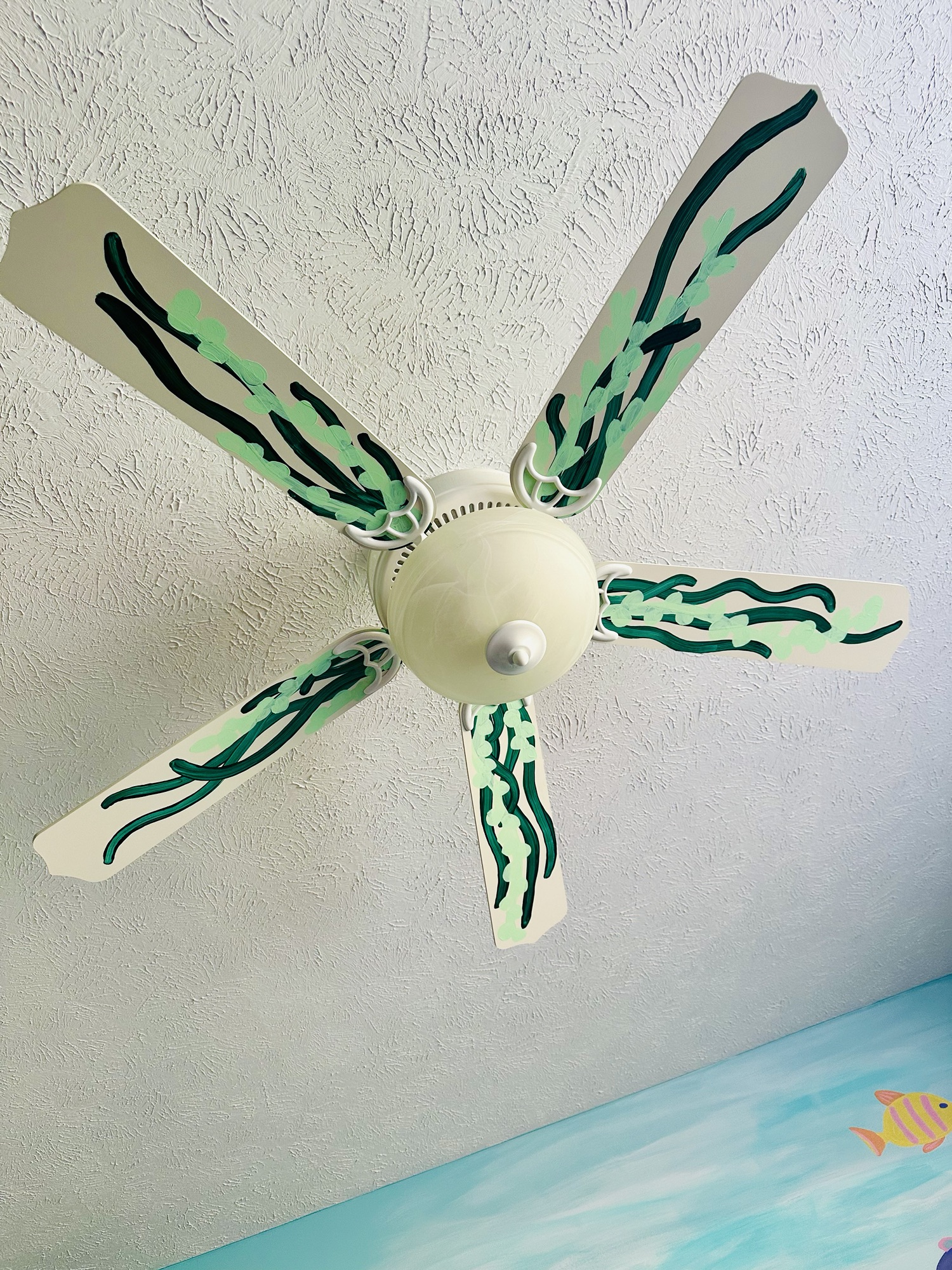
This was the last project for my 6-year-old’s room makeover! She wanted a “kelp forest” ceiling, but after creating a cave over a good chunk of her ceiling, we compromised by deciding to paint her fan blades so that they looked seaweed-y.

Painting fan blades was something I’d never tried before, and it was super easy! This might not be a new idea to anyone, but I can now personally recommend that you give it a go if you’re interested!

BEFORE: Plain white ceiling fan.

Supplies:

(As an advertising affiliate and Amazon Associate, I earn a small commission from qualifying purchases. But it doesn’t cost you anything extra and helps me keep up my site!)

  • Screwdriver
  • Paints

Step 1: Detach fan blades. I suppose I could have painted the blades while they still hung from the fan in the ceiling, but I didn’t want to risk dripping paint. Also, it seemed like my arm would get tired. Plus, by taking them down, I was able to clean them. 😜 I was also glad I’d detached them because, in the end, this meant that the painted portions went under the metal decorative parts where the blades attach to the fan, and that looked pretty cool.

My fan blades were held on by 3 screws each, so I used a screwdriver and simply unscrewed one blade at a some, carefully setting aside the washers and screws to reattach the blades later.

Removing the fan blade screws.

Step 2: Clean the blades. Mine were not real wood, and they wiped down pretty easily with a lightly damp cloth. After removing a considerable amount of dust from the top side of the fan blades, I made sure to use a clean paper towel to wipe and dry off the bottom side, which was the side I’d be painting.

Cleaned and ready.

Optional Step: My fan blades were in pretty good shape – and a nice white color – but you might want to apply a base coat of paint over each blade if they look rough. I considered painting them blue (which would make sense with our “under the sea” theme), but I did not obtain permission for that. You could start with whatever base color you choose, especially if your blades are wood and you really want to change the look.

Step 3: Paint the design. I took 2 different green colors – one dark and one light – to make my seaweed/kelp/plants. My dark green was a latex paint, and my light green was acrylic. Both adhered just fine. I started with my dark green and made long, weedy, wavy lines. Once that dried, I took my lighter green and painted more leafy-looking plants. I didn’t want to overdo it, so I stopped there…

Dark green painted.
Light green added.

You could do really pretty flower designs, abstract shapes, stripes, or really anything! I have a feeling I will end up painting my other daughter’s fan too, so let me know if you come up with any great ideas!

Step 4: Reattach the fan blades. Once the paint was dry, I took the blades one at a time and lined up the holes to screw the washers and screws back in place. I did find it was easiest to start with the screw nearest where I was standing between the blades, secure that one first, and then have everything stable to screw in the screw closest to the actual fan.

Screwing the blades back on.

That was it!

This was incredibly easy, and the painting possibilities are endless!

AFTER: Painted seaweed fan!


DIY Must-Have Lists

Click to see more!
Click to see more!
Click to see more!
Posted on Leave a comment

Bifolds – “Under the Sea” Theme

While struggling over how to make a cave (??!!) for my daughter’s “Under the Sea” themed bedroom makeover, I found another easy project to follow up the mermaid dresser I did last week. Her room needed a mirror, and I needed an excuse to take down the gazillion (approximately) pictures taped to her closet’s bifold doors. I also had a bunch of old shells that I’ve kept in a bowl for years, and I wanted to incorporate them into our design. Plus, I wanted to try a cute craft I’d done many times as a kid, and I had a feeling I’d need it for this project…

BEFORE: Chaotic bifold door.

Supplies:

(As an advertising affiliate and Amazon Associate, I earn a small commission from qualifying purchases. But it doesn’t cost you anything extra and helps me keep up my site!)

Step 1: Plan spacing of mirrors. Since 12 mirrors came in the pack that I’d purchased and I had 4 bifold door panels, that pretty clearly meant I had 3 mirrors for each door panel. Testing on a door, I held one square mirror (mine are 12×12) and moved it up and down to eyeball how the mirrors would look before committing to their placement. I decided that I wanted to cover the top portions of the bifold doors, hiding the decoratively indented portions. This would leave the bottoms of the doors with the knobs exposed and the lower sections still showing the decorative indentations.

Trying out placement.

I decided on 2-inch gaps between each mirror, running vertically. As far as centering the mirrors from the sides, I brought each mirror 1 inch in from the center/hinged side of the door panels. That meant I had a 2-inch gap again between the mirrors on each pair of door panels.

To mark where I would place the mirrors, I made lines at the 1-inch point in from the hinged side of the door. I made sure I had 2 inches between these marks, and then I held the mirrors level on these marks. Next, I traced the corners of each mirror as I held them in place.

Making marks.

Step 2: Attach the mirrors. The mirror pack I purchased came with plenty of little adhesive squares to put on each corner of each mirror. I found it worked best to put the squares directly on the door to be sure they’d be within my markings.

Because of my door’s indented sections, I cut a few of the adhesive squares a bit smaller where they wouldn’t connect with the indentations along the back of the mirror anyway. For the mirrors covering these indentations, I made sure to also place an adhesive square in the center where the mirror’s back would touch the door again.

Adhesive squares ready.

Once I had the adhesive squares on the door, I lined up each mirror with my marked corners and pressed the mirrors gently so the adhesive stuck.

Mirrors on.

Before you start decorating around the mirrors, be sure to remove any film protecting the mirrors. You don’t want that to get stuck under the decorations!

Step 3: Add shells. You could put SO MANY different decorative things around your mirrors. Fake flowers would be pretty. Decorative rope would work. Different wood molding would look very nice too. Because of our theme, I went with shells.

First, I used my hot glue gun and attached as many shells as I could fit over the doors’ exposed indented areas. These were exposed in the 2-inch gap between my middle and lowest mirror.

Shells filling the gaps.

Once I had those funky gaps filled and it looked good, I sighed in relief. Next, I did the easier, solid 2-inch gaps between the vertically spaced mirrors.

Gluing on the shells was very time-consuming, but it was kind of like a fun puzzle where I got to decide which shells looked best together.

However, I ran out of shells. 😜

Optional step: Sculpt shells. I didn’t want to buy even more shells, and I only needed enough for the tops of the mirrors, anyway. So, remembering a craft I often enjoyed as a kid, I asked my mom for the recipe she’d used whenever I wanted to sculpt little figurines or make beads.

Recipe: 1 cup cornstarch, 2 cups baking soda, and 1-1/4 cup cold water. Pouring all ingredients into a medium-sized pan, I stirred it up and cooked on medium heat until it looked like mashed potatoes. Then, I took it over to our counter and scooped it out onto some wax paper.

Glob of sculpting dough.

Once it had cooled enough to handle (it didn’t take long), my girls and I grabbed small globs at a time and sculpted our own shells. I started by rolling a clump into a little ball, next using my palm to flatted the ball. Then I squeezed together a little bit at the bottom to make the bottom of the shell. Taking a toothpick, I softly pressed it to make lines in the shell. Very easy!

Making shells!

We made a few starfish for variety, and a few of my rolled balls I flattened and used a toothpick to make sand dollars too.

When done, I carefully took our creations and placed them on a baking sheet. Heating the oven to 200 degrees, I baked the shells for a few hours until they were no longer damp to the touch. They might crack a tiny bit on the surface as they dry, but they’re still strong and hold together. You can air dry, but it takes much longer.

Keep it mind that the bigger and thicker you make your shells (or beads or flowers or whatever), the longer it takes for them to dry. We made a range of sizes, and the starfish in particular took a while to dry because they were about a half-inch thick.

Once dry and cool, the shells were ready for paint! We used a set of watercolors, and this makes pretty and soft colors on the shells – the watercolors soak in better than normal paint and look more natural without the color being overpowering.

Shells painted.

These dried quickly, and within an hour these “shells” were glued onto the door just like the real thing!

That was it!

AFTER: Bifold doors with character!

I considered putting shells all the way around the mirrors, but that might’ve been too much. I also wanted to avoid breaking any when the doors opened and closed against the doorframe on the sides, so leaving the sides empty saves me from that trouble.

Most importantly, the 5-year-old is happy! Now her doors have mirrors she can “check her makeup in,” and she can admire all her favorite shells, especially the ones she created herself. 😃


DIY Must-Have Lists

Click to see more!
Click to see more!
Click to see more!