Posted on Leave a comment

TP Roll Christmas Ornaments

Here is yet another craft idea I found on Pinterest, couldn’t find instructions for, and figured it out myself. It was pretty easy to collect these materials (free!) and easy to make these too. You could make as many as you want, but I used 11 TP rolls and 1 paper towel roll to make 2 angels and 10 flowers.

I also like the variations you could make to these. I used gold tape to add some sparkle, but you could paint them or use stickers or whatever to change the color. I like the simple but pretty look of the “natural” paper color with the light brown/white beads and gold accents, especially because that looks nice around my gold-ornamented Christmas tree.

BEFORE: TP rolls and supplies.

Supplies:

(As an advertising affiliate and Amazon Associate, I earn a small commission from qualifying purchases. But it doesn’t cost you anything extra and helps me keep up my site!)

Step 1: Cut the rolls into rings. For my flowers, I mostly cut the TP rolls into 4 equal sections. I did this by first pushing down on the rolls to flatten them a bit. Then I just used scissors and eyeballed my measurements. If you want to be sure you’re precise, you could use a ruler and mark them into equal parts, then cut.

For the angels, I cut more narrow strips – the same width as the gold tape, so be sure to do that if using colored tape! I didn’t worry about how many narrow strips I cut per TP ring, since I could use the paper towel roll to make up however many I needed after my TP rolls were used up.

Cutting rings.

I also used the paper towel roll to cut some extra pieces to finish off some flowers, so it’s a good idea to leave yourself some extra (whether a TP roll or paper towel roll) if you need more as you go.

Once you’ve got your rolls cut, you’re left with a whole bunch of rings. I grouped them together by width, with my bigger ones in flower piles and smaller ones in piles for my angels. I needed 5 rings for each flower. Each angel needed 1 for the head, 3 for each wing, and 6 to make the 3 bottom skirt parts. It was at this point that I cut up the rest of my paper towel roll to finish off my piles if I needed more. I also had a few extra narrow rings, so I cut enough narrow rings to make a few narrow flowers too.

Grouping rings.

Step 2: Adjust shape/size for certain pieces. First, for my angels’ bottom skirt parts, I cut rings (6 per angel) at one bent side. Then I took pairs of these and connected them together, making bigger rings. I used just a little bit of hot glue to connect the cut ends. This left me 3 larger rings for each angel.

Making bigger pieces.

For the angels’ heads, I took one ring for each and unbent them as much as I could so they were round again.

Step 3: Tape/Color/Decorate angel rings. Next, for each of my bigger angel rings, I took strips of gold tape and ran the tape around the rings evenly before smoothing it on. I did the outside of the rings first, then decided I wanted the insides to have gold tape too, since they were so visible. Running the tape around the inside of the bigger rings was a little tricky for my fingers, but it ended up looking nice.

I also did the outside and inside for each round head piece.

For the angel wings, I only did the outsides of the rings. The insides ended up so squished that you couldn’t see them much anyway, but you could do these insides too, if you want.

Taping rings.

Again, you could paint or color or use glitter or whatever you want for decorating these! I left my flower rings alone during this part, but you could decorate those as well.

Step 4: Assemble the rings into flowers and angels. The flowers were VERY easy to assemble. I took my grouped piles of 5 and arranged them like flowers. Taking my hot glue gun, I smeared on a little glue and held them together, adding one at a time, until they were all connected.

Making flowers.

For the angels, I took the 3 wing parts for each side and glued them together, first the wing at the left side onto the one on the right side, then the next on the left, then the next on the right, then the other on the left, then the other on the right. When all 6 (3 on each side) were together, I added a little glue to the inside of the rings and squeezed to make these ends more smooshed and flat where they met.

Making wings.

For the bottom skirt pieces, I held the ends of the three pieces together to make sure they were even, and then I glued the sides to each other where they met at that end. Either side of the middle piece connects to that side of the side pieces, basically.

Adding bottom to wings.

To connect the bottom to the wings, I glued the undersides of the bottommost ring pieces and stuck the bigger rings against those. I made sure to hold the bottoms all the way up against the wings until the glue dried and held them in place.

Finally, I took the round head piece and glued that on where the wing ends overlapped – like a head on shoulders.

Step 5: Add final decorations. To cover where all the glued wing pieces met, I took a little white ribbon and tied it on to cover the “body” of each angel. This also added little back wings where the ribbon tied.

Adding ribbon.

For the flowers, I took little wooden beads that I had leftover from other projects and glued them on in a number of different ways. For the thicker flowers, I had to decide which side was front and which was back so the beads showed up best at the front. The beads stuck on the TP rolls really well, which was good because I was initially worried about them falling off.

Adding beads.

For other narrower flowers, I took some more of the gold tape in about 1-2 inch strips and stuck that on the ends, folding it over each tip.

Adding tape tips.

Step 6: Add hangers. I used clear fishing line and tied them in loops through a ring of each decoration. You could also use twine or ribbon.

That was it! These turned out pretty cute, considering they were basically free and made from TP rolls! 😂

AFTER: Christmas decorations!


DIY Must-Have Lists

Click to see more!
Click to see more!
Click to see more!
Posted on Leave a comment

Fake Pumpkins for Fall

This idea was inspired by 2 different things I saw on Pinterest. Apparently I’m late to the game – there are a ton of people who knew you could make fake pumpkins out of grocery bags! I wasn’t exactly going for real-looking pumpkins with mine, so I used the basic instructions I found combined with another idea for how to decorate them. And, my kids helped, so this was a fun way to make decorations for Fall that we all can take some credit for. Best of all – it cost me practically nothing!

BEFORE: Piles of grocery bags.

Supplies:

(As an advertising affiliate and Amazon Associate, I earn a small commission from qualifying purchases. But it doesn’t cost you anything extra and helps me keep up my site!)

  • plastic grocery bags
  • painters tape
  • twine and/or clear line
  • joint compound or glue
  • sturdy paper towel
  • acrylic paints
  • petals, tissue paper, leaves – whatever you want to decorate with!
  • hot glue and gun

Step 1: Stuff and bundle grocery bags. We have an embarrassing pile of plastic grocery bags in our garage, waiting to be taken for recycling. Now for this project, I was glad we had them! Taking one bag, I fluffed up a bunch of others and stuffed them inside. For 3 of my pumpkins, I also added an empty, cleaned gallon jug to fill some space. You could add newspaper too, or packing paper – whatever will fill the main bag and still let it be squishy around the sides.

Once I had a bag full and generally sphere-like, I tied the top handles together so this could become the stem layer.

Tied stem.

Step 2: Wrap to make dividing grooves and stems. I tried to make pumpkin grooves a few different ways.

For one pumpkin, I used painters tape. Starting at the top “stem” (which I wrapped in tape to create), I put on a long strip of tape and held it tightly near the stem, then ran it down and around the bottom of the bag. I did this a few more times around to make dividing sections around the bag. This worked okay but didn’t make as obvious grooves as other methods.

Tape grooves.

For another pumpkin, I used twine to make the grooves. I tied it around the stem, then wrapped it down and around the bottom of the bag, spacing it a bit and wrapping it around and around until I had a bunch of denting divides. This was my favorite look and worked the best, in my option. When I was happy with it, I tied off the twine at the stem again.

Twine grooves.

Unfortunately, I ran out of twine, so next I tried fine, clear fishing line for the last 2 pumpkins. This worked okay but slipped around a lot more than the twine had done. It was also harder to tie off and keep tight. But, it worked pretty well to make a lot of deep grooves.

Line grooves.

As I’d done for the first pumpkin, I used painters tape to make the other pumpkins’ stems. Holding up the tied handles, I wrapped the tape around the handles to make a stiff, single stem. You can bend these a little bit to give the stems different shapes sticking out the top of your pumpkins.

Pumpkins formed and ready.

Step 3: Paper mache the pumpkins. I’ve seen a lot of paper mache recipes that use flour, but that seemed kinda gross to me and I didn’t want a mess. 🤷‍♀️ Instead, I took about a spoonful of joint compound and stirred it around to dissolve in a bowl of water. If you don’t have joint compound, you could use glue – just be use you get the mixture right so that it sticks and hardens when dry.

You also normally use paper/newspaper, but I used sturdy paper towel. This worked really well because it was pliable and also had a nice texture. Be sure to use a good, thick paper towel so it doesn’t fall apart when wet, though.

Strips ready.

After ripping the paper towel into smaller strips, I dipped each strip in the bowl’s mixture, let it drip off against the side of the bowl, and then stuck it on the pumpkin/grocery bag. I made sure to push the paper towel down into the dividing groves around the pumpkin to keep that shape.

Adding the strips.

It worked really well to set the grocery bag on a whole paper towel to catch the excess water – once this was wet enough, I flipped the pumpkin and used that paper towel to covered the bottom side of the bag. I then added a layer of paper towel strips around the edges of that bottom piece to help it stay on and also blend the edges.

Spreading the bottom piece.

Once I had the whole bag covered, I added a few strips over places where some edges didn’t stay flat. A good trick was to make sure all sides of my strips were ripped so that the wet edges really blended in. This looked better than leaving the paper towel strips with straight, blunt edges.

Step 4: Dry and paint stems. I set my pumpkins in the sun to help them dry, but mine still took overnight to completely dry and harden. The joint compound on the paper towels makes them just stiff enough to hold the pumpkin solid so that you can work with a harder surface for the following steps.

Drying.

Step 5: Paint the pumpkins. Because you’re painting paper towel, little acrylic paints work just fine. One pumpkin I wanted to have a white base, so that one was easy to paint white, barely brighter than the dried paper towel was naturally anyway.

Another pumpkin I painted with a “realistic” orange , then added some brown touches in the groves.

Painting the orange pumpkin.

The remaining 2 pumpkins were claimed by my daughters…and I let them go nuts since I planned to mostly cover these anyway. 😁 They had fun, and the reds and yellows in particular added a cool touch to the end result.

Also, to finish the stems, I took a dark brown paint and painted each stem, covering the blue painters tape.

Girls painting with me.

You don’t have to paint the pumpkins if you’re going to cover them, but I thought it was a good idea to do so in case anything showed through in the end. (I also considered painting a pumpkin in a light brown, since the paper towel looked a lot like burlap – so that’s another option if you’d like to try it for me and see how it looks! lol)

Step 6: Cover the pumpkins in…

For my white pumpkin, I took an enormous, dried hydrangea that I’d spray painted with a rose gold paint last Fall. Pulling off a bunch of individual petals, I glued them on one at a time all over the pumpkin. I even took a few of the dried leaves from the hydrangea and added those around the stem. This option took a lot of time, but it looks really pretty!

LOTS of petals.

For my “realistic” orange pumpkin, I took a lovely tissue paper and cut it up into strips that I then glued onto the pumpkin. Yes, I covered the whole thing, but I’m glad I painted the pumpkin because you can slightly see through the tissue, and this way the pumpkin looks like the real thing. Once I had all the tissue paper on, I added a little strip of burlap tied around the stem for an added decorative touch.

Adding strips of tissue paper.

For my girls’ pumpkins, we headed outside and collected a whole bunch of fallen leaves. This was quite fun. We brought them inside and set them on paper towels to dry, and I placed a paper towel over them along with plates on top to keep them flat.

Taking the biggest leaves first, I spread a little hot glue around the edges and then pressed them onto the pumpkins, pushing them especially into the groves to keep the pumpkin shape as much as I could. I put mostly green leaves down first, then added the prettiest orange and red leaves on top, layering them like a collage.

Adding leaves.

Fun fact: if you spread hot glue on wet, green leaves, they make a smell like cooked spinach. 🤣🤣🤣 I learned after a while to turn the glue gun off if it got too hot, and it was much less painful on my hands to press the leaves on if the glue wasn’t so hot.

Because I didn’t want all their painting efforts to be lost, I left a few gaps where the red or yellow or even blue paint could show through. Much to my surprise, these leaf-covered pumpkins ended up being my favorite.

All finished, here were the end results:

AFTER: Petals pumpkin.
AFTER: Tissue pumpkin.
AFTER: Leaf pumpkin 1.
AFTER: Leaf pumpkin 2.

There are a LOT of ways you could decorate these fake pumpkins. Let me know what you come up with! I ended up putting mine on the top of my kitchen cabinets for some added Fall decor, but you could use them as centerpieces on a dining table or on a mantle or on bookshelves – anywhere they’d look nice! It’s great that they won’t rot like real pumpkins, so all our crafty efforts might even be enjoyed next year.


DIY Must-Have Lists

Click to see more!
Click to see more!
Click to see more!

Posted on Leave a comment

Candle Holders from Pop Bottles

Here’s my last DIY project for the year on the last day of 2023!

Once the charm of Christmas is over, I remember how much I dislike the early darkness of winter. (I can practically hear you people making jokes about my name, but trust me – I’ve heard it all. 😆) In my younger/single days, I often left up white Christmas lights all winter to make my living spaces more cozy despite the cold, dark nights. Now, I live with a husband and 2 small children who can’t remember to turn off a room’s “big lights” for anything. So, cozier light is harder to come by these days.

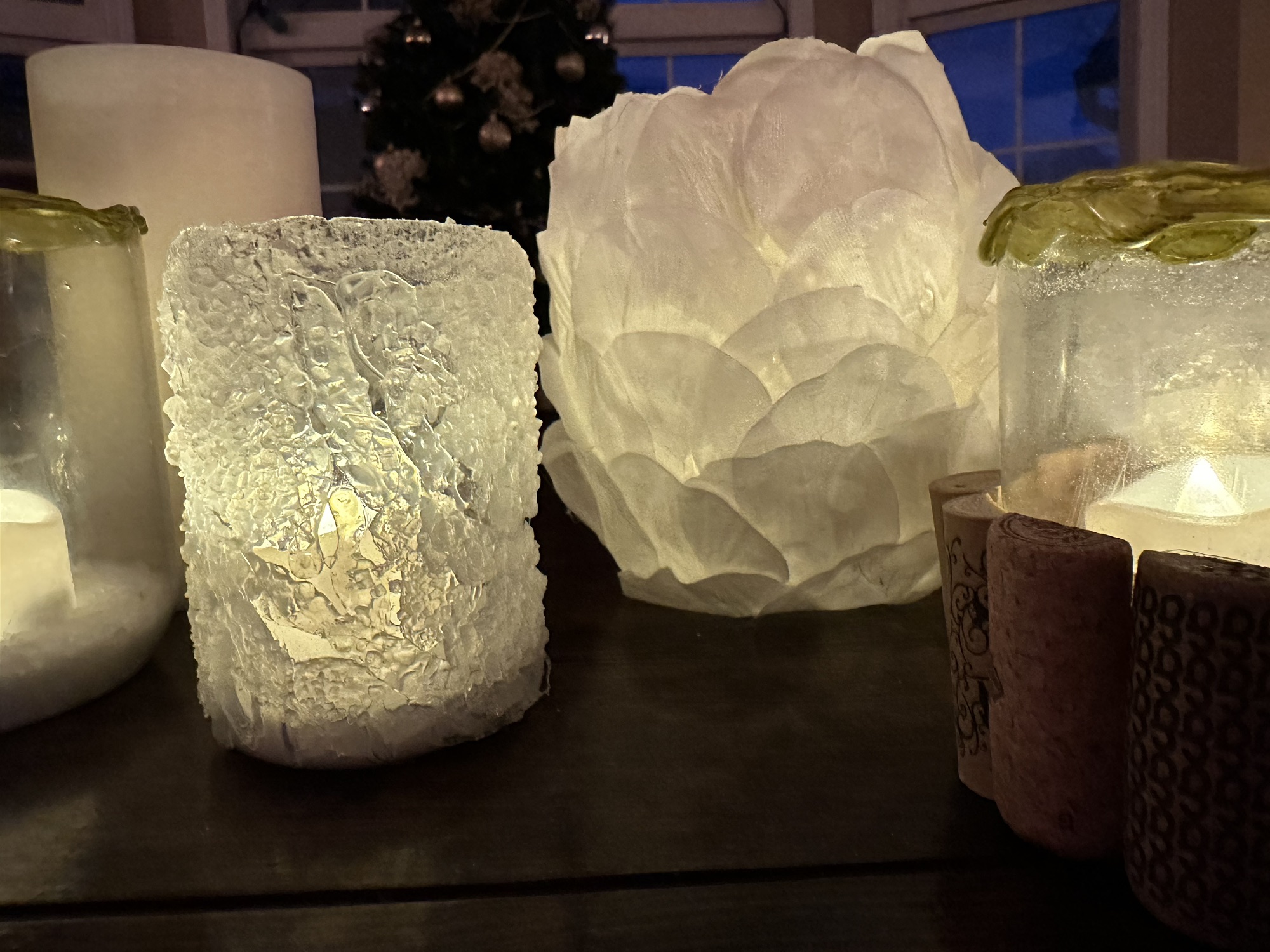
BUT, my girls do enjoy candlelight, and flameless, LED votive candles are a great, safe way to add touches of coziness scattered about where my family is least likely to leave on the house lights. Plus, I get the extra fun of figuring out cool holders for the candles…

Enter my second use for the pop bottles from my last project. I used the top halves of pop bottles to make Christmas bells, and now I found a use for the bottom halves – candle holders!

BEFORE: Empty pop bottles.

Supplies:

(As an advertising affiliate and Amazon Associate, I earn a small commission from qualifying purchases. But it doesn’t cost you anything extra and helps me keep up my site!)

Step 1: Cut bottles in half. If you haven’t done my last project with the top parts of the bottles, then take new pop bottles, wash them, and cut them to whatever heights you like. I’d already cut mine a little lower than halfway down, so those were the sizes that I had to work with. But you could make them as tall as you like, or even cut them at an angle so that the “backs” of your candle holders will be tall with shorter “fronts” to show more light. Really, you can cut them any size or design you like!

To cut the bottles, I found it worked best to stab a knife in to make hole, then use scissors to cut around the bottle. Again, I made mine in as straight a line as I could…especially since I didn’t think of the angled idea until way after. LOL.

Cut bottoms of cleaned bottles.

Step 2: Rim with hot glue. As you’ll see in the following options, there are a few ways I made candle holders. But for each option, I started by rimming the tops of the cut bottles with hot glue. This adds some texture, keeps the cut tops from being jagged or sharp, and makes a “melted glass” looking edge.

Hot glued rims.

And now you pick how to finish!

Option 1: Paint the rims. For a few of the bottles that had flat bottoms, I simply used a paint marker and colored over the cooled/hardened hot glue. I used a metallic gold paint pen, and I like how shiny and pretty this made the rims, leaving the rest of the candle holder clear to see the brightest light.

Glue painted gold.

I filled the base of the bottle/candle holder with a bit of coarse sea salt, partly to look pretty and partly to help the base be heavier. Setting a flameless votive candle in the center, these were done! You could fill your bottoms with different things for these candle holders, since this option leaves the insides most visible. I might change things up and replace the salt with pebbles at some point. Or beads. There are lots of options!

Option 2: Glue the sides and roll in salt. For other bottles with flat bottoms (these were SmartWater bottles), I spread hot glue on small sections at a time and then rolled that side over a plate covered with coarse sea salt. This used a lot of hot glue sticks, but honestly these surprised me in the end and were my favorite.

Rolled in sea salt.

Once the salt was stuck all over (some gaps are fine), I took these candle holders down to my workshop and used a clear gloss spray to coat them. This helped hold the salt in place and also added a crystal-like shine to the salt.

With these dry, I took them back upstairs and again poured some sea salt into the base of each candle holder. (You can’t really see what’s inside these options, so the salt was fine just for adding weight.) Setting a flameless votive candle in the center, these were done too!

Option 3: Make a cork base. The bigger, 2-liter bottles had bottoms that were very obviously pop bottles, so I wanted to hide these bottoms a little better. One way I did this was by using wine corks left over from another project. First, I took a knife and cut them in half, lengthwise. Next, I used hot glue and spread it on each cut cork’s flat side, then pressed the cork against the bottom of the bottle. I did this all the way around the 2-liter base, using 17 halves of corks.

Adding cork base.

Because I only had enough corks left to do a smaller bottle, I did one of those the same way. (I guess we need to drink more wine 😆) But I like having a little variety between the sizes with the same style option, so these 2 together look nice. Once all the corks were on, I again poured in sea salt to add weight to the base. This especially helped on the 2-liter-sized candle holder, since the opening was bigger and you can really see what’s inside. I put more salt in this one than I had in the smaller candle holders, and it looked nice against the cork.

I ended up using my gold paint pen on the top, glued parts of these candle holders as well, just because I liked how that looked better than leaving them plain.

Painting the top of my cork candle holders.

Option 4: Faux moss wrap. On another 2-liter bottom, I went around the top again with a thin bit of glue, then quickly dipped the top in salt. This rimmed the top with texture and a bit of sparkle. I didn’t need to spray these tops with gloss since there wasn’t much salt on there.

Next, I spread hot glue over small sections and pressed on faux moss to cover the bottle’s bottom. I decided to go all over with the moss, leaving only the top exposed where the salt/hot glue showed. This ended up looking woodsy and wintery, and it really looks better in person than in my pictures. I used green moss, but you could do this in different colored mosses too!

Adding faux moss.

Again, I added some salt to the base for weight, then placed in a candle.

Option 5: Cover in petals. I’ve had these white flower petals for forever and finally had a use for them! Starting at the top of a 2-liter bottom, I put a dab of hot glue on the bottom of a petal and stuck it on so that the majority of the petal stuck up above the edge of the bottle. I continued to do this with petals all the way around the top, overlapping them a bit and gluing them down onto each other if they stuck out too much.

Adding petals.

Once the top layer was on, I went around with a lower row of petals. Then I did another lower layer. Finally, I heavily glued on petals around the bottom.

Petals done!

This petal-covered candle holder already looked pretty, and once I got a votive candle inside… 😍 This one ended up being my second favorite. …I may need to scrounge up more petals and do more!

That was it! I like the variety I ended up with. They looked cool without candlelight inside, and I’m SO glad this plan worked out and they look even cooler with candlelight shining through! 😆

AFTER: A variety of candle holders!
(Left to right) Options 3, 2, and 4.
(Left to right) Options 1, 2, 5, and 3.
Candle holders in action…

I’m sure there are many other things you could stick on the outside of these candle holders too! Beads, sequins, wood sticks – what else can you think of?

One IMPORTANT note: The hot glue might deform the plastic bottles a little bit if too hot. Since I was covering the bottles anyway, this wasn’t much of a problem. But it’s a good reminder that you MUST use flameless votive candles, because real fire will absolutely melt these and be a serious hazard.

I found flickering, LED votive candles on Amazon, and you can buy packs of them for pretty cheap…so I’m certainly making even more candle holders in the future. 😜


DIY Must-Have Lists

Click to see more!
Click to see more!
Click to see more!
Posted on Leave a comment

Easy Rustic Spring Decor

Now that it’s officially spring (yay!), my girls and I gleefully took down our winter decorations and realized we needed new decorations for spring. I have a few flowery things, but not much. But, I’d seen something on Pinterest that gave me an idea and would also let me use up extra crafty materials without having to buy anything new. Score.

I’m not normally a hot glue gun kind of crafty mom, but I have to say that I’m liking my hot glue gun lately. Since that was the only “tool” I needed for this project, I’m gonna go ahead and say this is a REALLY easy one. Also, I made these 5 decorations in less than an hour, so it’s quick too!

Continue reading Easy Rustic Spring Decor