Posted on 1 Comment

Vase Makeover

Since people enjoyed the last DIY glass vase makeover I did, here’s another way to change the look of a vase! My aunt gave me this whopper of a vase, and I immediately knew what I wanted to do with it. I’ve used this same method on smaller vases and pots before, so I can say pretty safely this works on a number of different shapes, materials, and sizes if you have a container that you want to revamp.

The best part – it’s so easy and costs under $20!

Before: Vase in need of a revamp.

Supplies:

(As an advertising affiliate and Amazon Associate, I earn a small commission from qualifying purchases. But it doesn’t cost you anything extra and helps me keep up my site!)

  • Old vase or pot or any container
  • Drywall joint compound/spackling
  • Paint

Step 1: Smear on spackling. I used quick-drying spackling, the kind that is pink and dries white. I like the texture of that kind because it’s not too wet or runny. You can use your bare hands or gloved hands or, like I did just for the sake of trying it, a baggie over the hand that you use to smear on the spackling.

Applying spackling.

It doesn’t matter whether you start at the top, bottom, side – wherever you want is fine. I took a handful at a time and just smeared it on and around the vase, leaving texture rather than making it too smooth. This gives a kind of pottery look and feel to the vase. You don’t even have to cover every inch of the vase if you want to make swirls, lines, or whatever look you come up with! I also considered running the spackling vertically along the bottom sections while keeping it smeared around the top, just to add some visual interest. This stuff is pretty easy to manipulate, so you could do lots of different designs.

I gave my spackling overnight to dry just to be sure, especially since it was very humid outside at the time.

Spackling drying.

Step 2: Paint. If you like the color and the look of leaving the spackling as it is once it’s dry, that’s cool too, and I’ve done that before as well. But, if you don’t use a paint or some kind of sealer, the spackling can flake off easier and is really vulnerable if it gets wet at all. If you have a container that is never going to be touched, though, the look of the naturally dried spackling is pretty.

Since my vase would be set on the floor (and because we have dogs and children), I chose to paint over my textured, covered base. This helped seal the spackling so it wasn’t as chalky feeling, and it helped me cover some areas where I’d applied the spackling too thin. I used some leftover paint that’s the same color as the top part of my dining room walls, but I’m pretty sure any paint would work fine. I’ve used those cheap little acrylic paints on this spackling before, and that works great too.

I had a helper for this painting step, but it didn’t take us too long. We only needed one snack break.😆

Painting with my helper.

I used a small craft brush to really get the paint in between the grooves I’d created when wiping the spackling on with my baggie-covered fingers. The spackling really soaks in the paint and gives a kind of natural matte finish unless you paint a second coat to get more shine from your paint. The spackling also soaks in the paint so that it dries really quickly, which was nice so I could set it in place almost right away.

Painted and drying.

That was it! So easy, and the end result looks really cool.

AFTER: Vase makeover complete!

Options: You could also paint the vase in several different colors, like an ombré effect or stripes or abstract shapes – anything goes! I wanted my vase to be simple, bright, and fairly minimalistic in color so that the texture really popped, so I went with a very light blue that’s almost white (the same color as the top part of my dining room walls).

Another thing I thought of was the option to add on beads during the process of applying the spackling. Again, I wanted to keep my base pretty simple, but it would look really cool to press a string of beads into thicker sections of spackling, then paint over the whole thing to give it more detail, similar to what I did on my bathroom walls (which I love, and I know it would look cool on a vase too.)

What other options can you think of? I’m sure I’ll do more vases like this in the future, and I’m curious to see how different options could turn out!


DIY Must-Have Lists

Click to see more!
Click to see more!
Click to see more!
Posted on Leave a comment

Eucalyptus Wall Hanger

It’s now the…what? 14th week of January? 🤪 We’ve been slammed with snow and ice, gone crazy from school snow days, and got very lucky when a falling tree narrowly missed our garage. Playing outside lets us breathe in some fresh air, but the freezing winds off Lake Michigan also mean we live in one of those places where the air hurts your face.

Inside, where 4 humans, 2 dogs, and 1 cat live, I wish very much for open windows with summery fresh air. Until then, however, I’m doing what I can to add some nice, fresh smells around here.

I found some dried eucalyptus online and decided to use that in our master bathroom. I have fake eucalyptus in a vase by my sink, but I knew I couldn’t put the real thing there because our cat eats everything. Also, we’re low on counter space and I didn’t want to add another vase. So, I decided to hang this dried eucalyptus. The bunch I purchased came with a nice bit of twine for hanging, but I wanted something a little fancier than just a hanging bunch.

What I came up with ended up looking pretty and was SO easy to do! You could make these out of any size embroidery hoop, with as many wooden beads as you can fit. You could even paint the beads different colors if you wanted. Or you could hang the hoop with twine for a more rustic look. There are many things you could add to the steps below, but here’s the quick and easy way I did mine!

Supplies:

(As an advertising affiliate and Amazon Associate, I earn a small commission from qualifying purchases. But it doesn’t cost you anything extra and helps me keep up my site!)

BEFORE: Supplies ready.

Step 1: Prep the eucalyptus and test the beads. I used the largest size beads from the pack I purchased – the 3/4 inch beads, I think. The hole size in these beads was perfect for inserting the eucalyptus stems so that they stuck tight but could still be removed if needed. I first plucked off the leaves from the bottom 2-3 inches of the eucalyptus stems. I also scraped down the places where the leaves connected to make sure the stems would fit through the bead holes. I ended up prepping all but 2 of my eucalyptus stems, because you want some extra for the last step.

Prepping the stems.

Step 2: Glue wooden beads together. Taking my embroidery hoop, I tested with beads until I figured out about how many I would need. Be sure that the beads at either end sit on top of the hoop, not on the inside, so that the eucalyptus will stay straight rather than bending around the hoop. If your end beads don’t sit exactly on the hoop, all you have to do is move the beads a little up or down on the hoop, depending on your placement preference, until everything lines up right. I ended up needing 8 beads.

Keep in mind that your holes will go up and down. To be sure I glued them all together straight, I did 2 at a time. I only had to use one small dot of hot glue to stick 2 beads together, and I pressed them tight until the glue dried. Once I had all my beads paired up, I set them on my counter to make sure they’d be straight. Then I pressed more small dots of hot glue between each pair to connect them all together.

Glueing beads together.

Step 3: Connect bead ends to the hoop. Next I held the strand of beads in place over my hoop and glued one end bead to the front of the hoop. Then I did the other end. Again, make sure the holes aim up and down (according to how it will hang) when attaching to the hoop. To be really sure the beads stayed on, I went all around the backsides of the end beads with glue to really secure them in place.

Glueing beads to the hoop.

Step 4: Insert the eucalyptus. With my eucalyptus already prepped, it was easy to push each stem down through the bead holes. I cut a few shorter to add some depth to the look of things, now that I was arranging the eucalyptus in place.

Stems inserted.

Step 5: Glue eucalyptus to the bottom stems. Remember how I didn’t prep a few eucalyptus stems? I cut these into lengths long enough to cover the exposed, naked stems that stuck through the bottoms of the beads. It took one whole eucalyptus branch plus a little bit of the last one. These short bits I glued onto the empty stems, gently pressing to make sure they stuck. The last long bit of eucalyptus I just tucked behind the beads to fill out the the finished look.

Adding to empty stems.

That was it! I took the finished piece up to my bathroom, tapped in a nail where I wanted to hang it, and hung it by the hoop at the top.

AFTER: Eucalyptus wall hanger!

I really like how this fills in an empty space on my walls (which honestly are pretty cool on their own, and you can find that tutorial here). The eucalyptus hanger looks pretty, adds an organic touch to the room, and smells lovely!


DIY Must-Have Lists

Click to see more!
Click to see more!
Click to see more!
Posted on Leave a comment

Candle Holders from Pop Bottles

Here’s my last DIY project for the year on the last day of 2023!

Once the charm of Christmas is over, I remember how much I dislike the early darkness of winter. (I can practically hear you people making jokes about my name, but trust me – I’ve heard it all. 😆) In my younger/single days, I often left up white Christmas lights all winter to make my living spaces more cozy despite the cold, dark nights. Now, I live with a husband and 2 small children who can’t remember to turn off a room’s “big lights” for anything. So, cozier light is harder to come by these days.

BUT, my girls do enjoy candlelight, and flameless, LED votive candles are a great, safe way to add touches of coziness scattered about where my family is least likely to leave on the house lights. Plus, I get the extra fun of figuring out cool holders for the candles…

Enter my second use for the pop bottles from my last project. I used the top halves of pop bottles to make Christmas bells, and now I found a use for the bottom halves – candle holders!

BEFORE: Empty pop bottles.

Supplies:

(As an advertising affiliate and Amazon Associate, I earn a small commission from qualifying purchases. But it doesn’t cost you anything extra and helps me keep up my site!)

Step 1: Cut bottles in half. If you haven’t done my last project with the top parts of the bottles, then take new pop bottles, wash them, and cut them to whatever heights you like. I’d already cut mine a little lower than halfway down, so those were the sizes that I had to work with. But you could make them as tall as you like, or even cut them at an angle so that the “backs” of your candle holders will be tall with shorter “fronts” to show more light. Really, you can cut them any size or design you like!

To cut the bottles, I found it worked best to stab a knife in to make hole, then use scissors to cut around the bottle. Again, I made mine in as straight a line as I could…especially since I didn’t think of the angled idea until way after. LOL.

Cut bottoms of cleaned bottles.

Step 2: Rim with hot glue. As you’ll see in the following options, there are a few ways I made candle holders. But for each option, I started by rimming the tops of the cut bottles with hot glue. This adds some texture, keeps the cut tops from being jagged or sharp, and makes a “melted glass” looking edge.

Hot glued rims.

And now you pick how to finish!

Option 1: Paint the rims. For a few of the bottles that had flat bottoms, I simply used a paint marker and colored over the cooled/hardened hot glue. I used a metallic gold paint pen, and I like how shiny and pretty this made the rims, leaving the rest of the candle holder clear to see the brightest light.

Glue painted gold.

I filled the base of the bottle/candle holder with a bit of coarse sea salt, partly to look pretty and partly to help the base be heavier. Setting a flameless votive candle in the center, these were done! You could fill your bottoms with different things for these candle holders, since this option leaves the insides most visible. I might change things up and replace the salt with pebbles at some point. Or beads. There are lots of options!

Option 2: Glue the sides and roll in salt. For other bottles with flat bottoms (these were SmartWater bottles), I spread hot glue on small sections at a time and then rolled that side over a plate covered with coarse sea salt. This used a lot of hot glue sticks, but honestly these surprised me in the end and were my favorite.

Rolled in sea salt.

Once the salt was stuck all over (some gaps are fine), I took these candle holders down to my workshop and used a clear gloss spray to coat them. This helped hold the salt in place and also added a crystal-like shine to the salt.

With these dry, I took them back upstairs and again poured some sea salt into the base of each candle holder. (You can’t really see what’s inside these options, so the salt was fine just for adding weight.) Setting a flameless votive candle in the center, these were done too!

Option 3: Make a cork base. The bigger, 2-liter bottles had bottoms that were very obviously pop bottles, so I wanted to hide these bottoms a little better. One way I did this was by using wine corks left over from another project. First, I took a knife and cut them in half, lengthwise. Next, I used hot glue and spread it on each cut cork’s flat side, then pressed the cork against the bottom of the bottle. I did this all the way around the 2-liter base, using 17 halves of corks.

Adding cork base.

Because I only had enough corks left to do a smaller bottle, I did one of those the same way. (I guess we need to drink more wine 😆) But I like having a little variety between the sizes with the same style option, so these 2 together look nice. Once all the corks were on, I again poured in sea salt to add weight to the base. This especially helped on the 2-liter-sized candle holder, since the opening was bigger and you can really see what’s inside. I put more salt in this one than I had in the smaller candle holders, and it looked nice against the cork.

I ended up using my gold paint pen on the top, glued parts of these candle holders as well, just because I liked how that looked better than leaving them plain.

Painting the top of my cork candle holders.

Option 4: Faux moss wrap. On another 2-liter bottom, I went around the top again with a thin bit of glue, then quickly dipped the top in salt. This rimmed the top with texture and a bit of sparkle. I didn’t need to spray these tops with gloss since there wasn’t much salt on there.

Next, I spread hot glue over small sections and pressed on faux moss to cover the bottle’s bottom. I decided to go all over with the moss, leaving only the top exposed where the salt/hot glue showed. This ended up looking woodsy and wintery, and it really looks better in person than in my pictures. I used green moss, but you could do this in different colored mosses too!

Adding faux moss.

Again, I added some salt to the base for weight, then placed in a candle.

Option 5: Cover in petals. I’ve had these white flower petals for forever and finally had a use for them! Starting at the top of a 2-liter bottom, I put a dab of hot glue on the bottom of a petal and stuck it on so that the majority of the petal stuck up above the edge of the bottle. I continued to do this with petals all the way around the top, overlapping them a bit and gluing them down onto each other if they stuck out too much.

Adding petals.

Once the top layer was on, I went around with a lower row of petals. Then I did another lower layer. Finally, I heavily glued on petals around the bottom.

Petals done!

This petal-covered candle holder already looked pretty, and once I got a votive candle inside… 😍 This one ended up being my second favorite. …I may need to scrounge up more petals and do more!

That was it! I like the variety I ended up with. They looked cool without candlelight inside, and I’m SO glad this plan worked out and they look even cooler with candlelight shining through! 😆

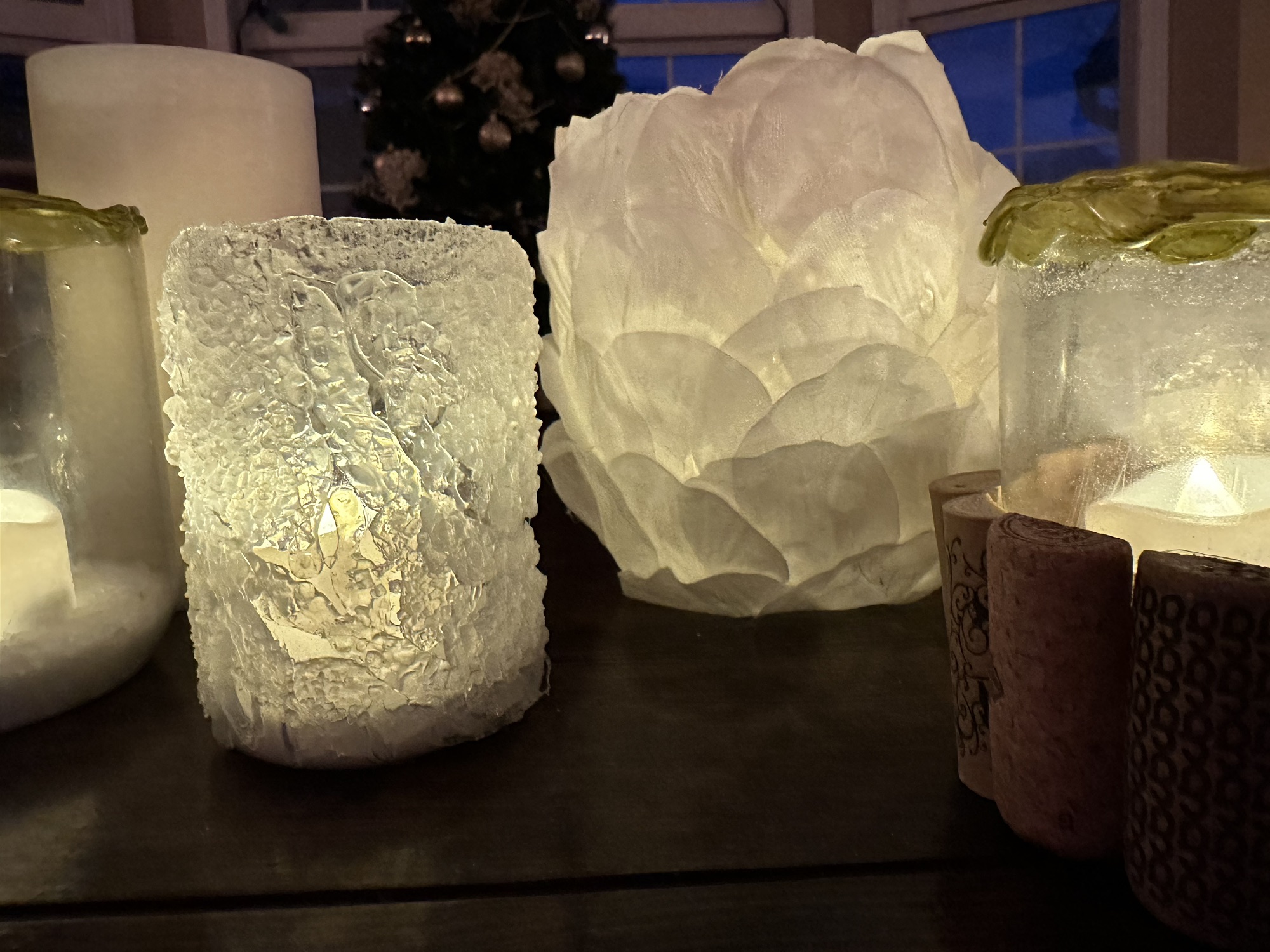
AFTER: A variety of candle holders!
(Left to right) Options 3, 2, and 4.
(Left to right) Options 1, 2, 5, and 3.
Candle holders in action…

I’m sure there are many other things you could stick on the outside of these candle holders too! Beads, sequins, wood sticks – what else can you think of?

One IMPORTANT note: The hot glue might deform the plastic bottles a little bit if too hot. Since I was covering the bottles anyway, this wasn’t much of a problem. But it’s a good reminder that you MUST use flameless votive candles, because real fire will absolutely melt these and be a serious hazard.

I found flickering, LED votive candles on Amazon, and you can buy packs of them for pretty cheap…so I’m certainly making even more candle holders in the future. 😜


DIY Must-Have Lists

Click to see more!
Click to see more!
Click to see more!
Posted on Leave a comment

Decorative “Mosaic” Bowls

At the risk of spoiling Christmas gifts, here’s how I took plain bowls and decorated them. This was a pretty easy and fun way to make gifts for people, so here’s a Christmas gift idea if you’re looking!

BEFORE: Plain serving bowl.

I first heard that you could decorate these bowls using markers, but I experimented and didn’t really like the stroke marks that markers created. Instead, I used acrylic paint pens, and these worked much better to get brighter, sharper color and smoother, more “liquidy” strokes. What works best might depend on what kind of bowl you use – wood, ceramic, etc. – but these were made from bamboo fiber materials, and acrylic paint pens worked best for me to get the results I wanted. 🤷‍♀️I really like these bowls because they’re eco friendly, the lid stays put and doubles as a cutting board, and they come with two serving utensils, so you’re giving someone a nice set rather than just a plain bowl, too.

I got it in my head that I wanted to do mosaic patterns around the bowls, and this was probably more time consuming than if I’d drawn/painted normal pictures or shapes. But I think the end result looks pretty cool, and it looks a little fancier than just drawing straight flowers on a bowl (something I’d done first to 2 other bowls).

So here’s how I made “mosaic” art on these decorate bowls!

Supplies:

(As an advertising affiliate and Amazon Associate, I earn a small commission from qualifying purchases. But it doesn’t cost you anything extra and helps me keep up my site!)

Step 1: Sketch the plan. In order to be sure my design would be evenly spaced between top and bottom as well as matching up as I worked around the bowl, I took a pencil and outlined my basic plan. This was way easier once I flipped the bowl upside-down, and that’s how I worked with the bowls from then on. Just remember the bowl is upside-down if you’re drawing pictures and want them to look right once the bowl is flipped back over. 😜

Sketching my plan.

Step 2: Outline. Once my pattern was sketched in pencil, I took a black acrylic paint pen and carefully traced my pencil outline. Then, once sure of my boundaries, I began making my little lines all over to create the “mosaic” look of my design. This is what took time, but it was easy and fun to cross and zigzag and divide my lines to make cool mosaic patterns.

Adding black outlines.

Step 3: (Optional) Fill in mosaic around your main pattern. I gave my black a little while to dry to make sure I didn’t accidentally wipe it as I painted my next step on the bowl. It was also at this time that I carefully scratched a black line and found that it did scrape off a bit, but I’d already planned for this (more later). Just be sure, as you’re adding color, to not drag your hand or scratch over your design – it might smear or scrape off.

Anyway, while the black dried, I stared at the bowl a while and decided I wanted to completely cover it in a mosaic look. But I didn’t want to add more black lines for fear it would just look like I left those blank. So, I took a gold acrylic paint pen (it came in my same acrylic paint pen set) and went to work making lines and patterns all around my main design. I also outlined along the black sections to make them stand out.

Adding gold mosaic lines.

I was careful not to cross onto the black outlines, but wherever I goofed I could easily paint back over the gold with black to fix my slob spots.

Step 4: Add color. Satisfied now with my overall mosaic base, it was time to add color. I decided to use red, orange, yellow, and a light peach – again, all from that same paint pen set, so there are lots of color options! Completely at random, I started filling in the mosaic little squares and rectangles with one color at a time, working my way all around the bowl. I started from darkest to lightest, but I don’t think it really matters how you choose to apply the color.

Adding color.

I noticed that, if I accidentally went over the black outline with the lighter colors, this would lighten the black a little bit. But, it wasn’t super-noticeable and seemed to darken again as it dried. If any slobs were too bad, I painted back over them with black. (My 5-year-old told me I did a pretty good job of staying in the lines, which is nice to hear from such an accomplished artist.)

Color done! Needed some black touch-ups.

Step 5: Spray on sealer/gloss. In order to give the paint as much time as I could to set and dry, I left the bowl overnight on a high shelf where nothing (ahem, the cat) would touch it.

The next morning, I carefully lifted the bowl and carried it to my better-ventilated craft room to spray on some high-gloss, clear sealer. I used a spare paint can on top of my turntable, then rested the upside-down bowl on top. This way, I could spray from the top of the bowl to the bottom evenly while turning the bowl slowly all the way around.

I did a very light first coat to make sure it didn’t run my paint or leave drip trails.

Ready to apply the sealer.

After the first coat dried (about an hour), I touched it to be sure and also found it was now much more difficult to scrape off any of the paint design. To be sure, though, I gave the bowl another good coat of my gloss spray, again making sure to cover the whole upside-down bowl.

That was it! This wasn’t a particularly difficult craft project, but you can make any design of your choosing to cover these bowls. And with the protective gloss on, they’re sure to stay pretty for a while. I wouldn’t submerge the bowls in water or soap or anything – certainly not a dishwasher – but these bowls would work great as serving bowls for nut mixes (especially with the serving utensils), rolls, popcorn balls, or anything that can be easily wiped out of the bowls after use.

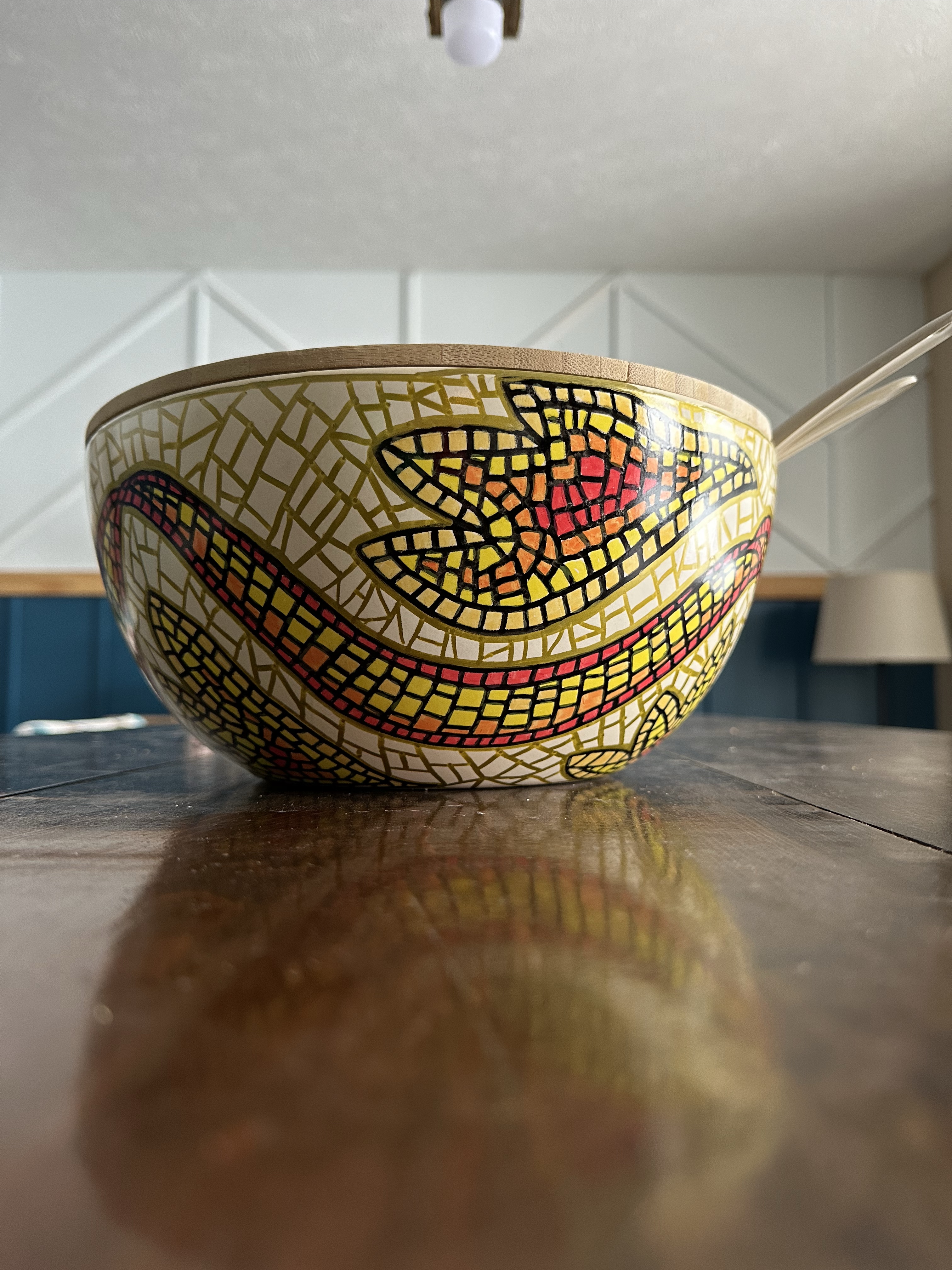
AFTER: Decorative “mosaic” bowl.

Now to make 4 more before Christmas! Wish me luck! (And follow me on Instagram to see how they turn out…which I’ll post after Christmas, so I don’t spoil the rest of my gifts. 😆)


DIY Must-Have Lists

Click to see more!
Click to see more!
Click to see more!
Posted on Leave a comment

Easy, Faux Living Wall Art

Well, it finally happened. Potty training resulted in needing to call a plumber. And, of course, this happened in the basement bathroom toilet the day before I’d planned to redo the floors, meaning I had to put renovations on hold until we could remove the toilet.

To de-stress and avoid glaring at my 3-year-old, I decided to make some artwork for the bathroom walls. This project was cheap, easy, mess-free, and took me less than an hour, plus I was left with enough materials to do more mossy projects in the future. It helped that I already had leftover embroidery hoop inner rings from other projects, and I was happy to finally think of a use for them. And I’m so glad I talked myself out of ordering 2 boxes of fake moss, because one box went a LONG way…even with my 4-year-old stealing it for her own art project when I wasn’t looking at my piles. 🤦‍♀️😂

Continue reading Easy, Faux Living Wall Art