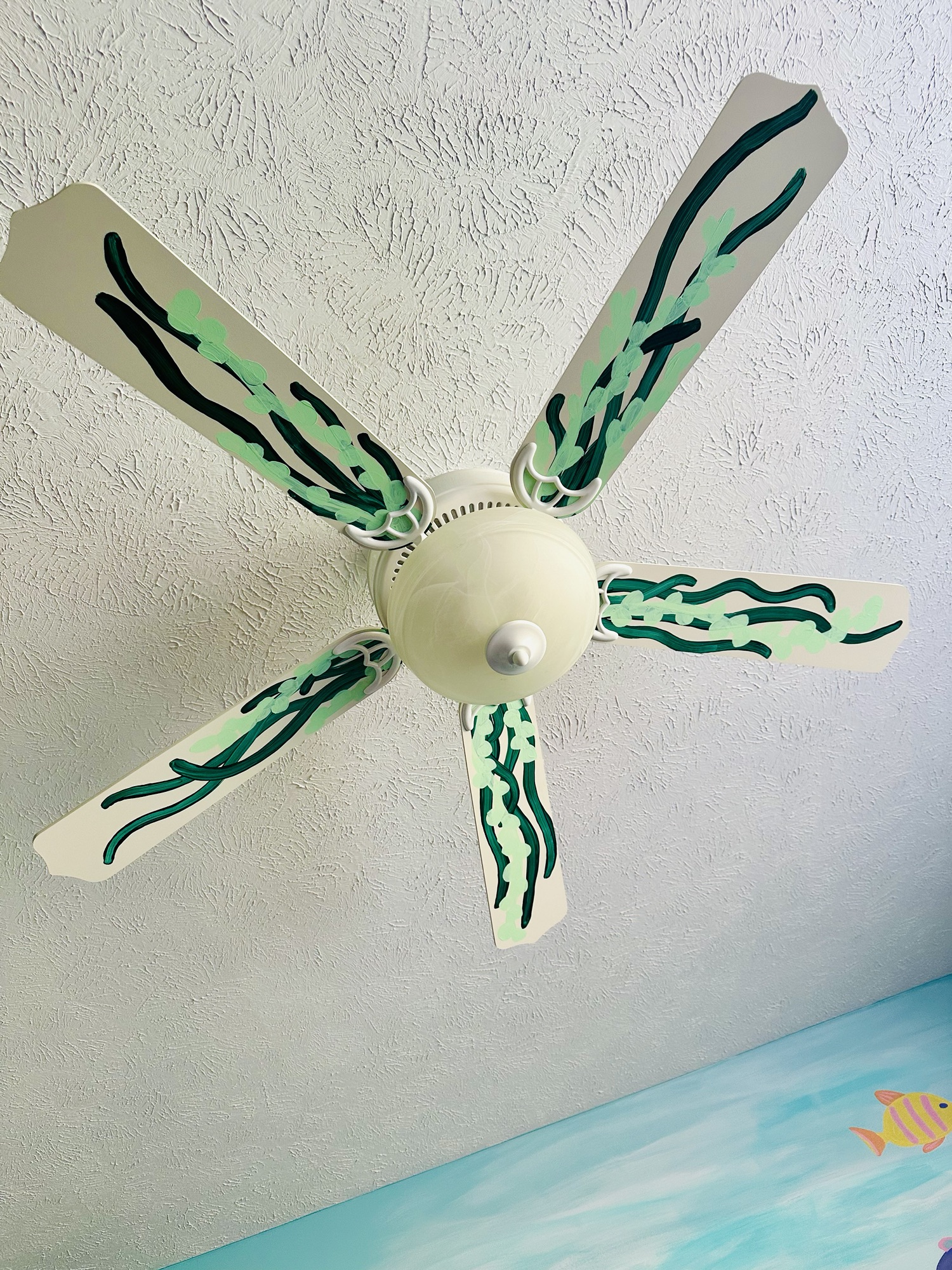
This was the last project for my 6-year-old’s room makeover! She wanted a “kelp forest” ceiling, but after creating a cave over a good chunk of her ceiling, we compromised by deciding to paint her fan blades so that they looked seaweed-y.
Painting fan blades was something I’d never tried before, and it was super easy! This might not be a new idea to anyone, but I can now personally recommend that you give it a go if you’re interested!
BEFORE: Plain white ceiling fan.
Supplies:
(As an advertising affiliate and Amazon Associate, I earn a small commission from qualifying purchases. But it doesn’t cost you anything extra and helps me keep up my site!)
Screwdriver
Paints
Step 1: Detach fan blades. I suppose I could have painted the blades while they still hung from the fan in the ceiling, but I didn’t want to risk dripping paint. Also, it seemed like my arm would get tired. Plus, by taking them down, I was able to clean them. 😜 I was also glad I’d detached them because, in the end, this meant that the painted portions went under the metal decorative parts where the blades attach to the fan, and that looked pretty cool.
My fan blades were held on by 3 screws each, so I used a screwdriver and simply unscrewed one blade at a some, carefully setting aside the washers and screws to reattach the blades later.
Removing the fan blade screws.
Step 2: Clean the blades. Mine were not real wood, and they wiped down pretty easily with a lightly damp cloth. After removing a considerable amount of dust from the top side of the fan blades, I made sure to use a clean paper towel to wipe and dry off the bottom side, which was the side I’d be painting.
Cleaned and ready.
Optional Step: My fan blades were in pretty good shape – and a nice white color – but you might want to apply a base coat of paint over each blade if they look rough. I considered painting them blue (which would make sense with our “under the sea” theme), but I did not obtain permission for that. You could start with whatever base color you choose, especially if your blades are wood and you really want to change the look.
Step 3: Paint the design. I took 2 different green colors – one dark and one light – to make my seaweed/kelp/plants. My dark green was a latex paint, and my light green was acrylic. Both adhered just fine. I started with my dark green and made long, weedy, wavy lines. Once that dried, I took my lighter green and painted more leafy-looking plants. I didn’t want to overdo it, so I stopped there…
Dark green painted.
Light green added.
You could do really pretty flower designs, abstract shapes, stripes, or really anything! I have a feeling I will end up painting my other daughter’s fan too, so let me know if you come up with any great ideas!
Step 4: Reattach the fan blades. Once the paint was dry, I took the blades one at a time and lined up the holes to screw the washers and screws back in place. I did find it was easiest to start with the screw nearest where I was standing between the blades, secure that one first, and then have everything stable to screw in the screw closest to the actual fan.
Screwing the blades back on.
That was it!
This was incredibly easy, and the painting possibilities are endless!
Growing kids have growing feet, and we have a lot of shoes around here. Somehow, it’s almost impossible to keep both shoes of a pair in the same room of our house (why?!), and shoes become invisible once in a pile.
BEFORE: Empty closet nook. Pile of shoes.
So.
For anyone who doesn’t want to buy those shoe racks that sit at the bottom of a closet (which take up floor space, are difficult to see if hanging clothes are in the way, and unfortunately encourage kicking off shoes “near” the shelves on the floor), here was my DIY solution. It also allowed me to make use of that weird nook space inside the side of the closet. This project was very easy, very quick, instantly useful, and WAY better than piling shoes on the floor.
Supplies:
(As an advertising affiliate and Amazon Associate, I earn a small commission from qualifying purchases. But it doesn’t cost you anything extra and helps me keep up my site!)
Step 1: Measure and mark shoe shelf placement. I initially thought I’d put a shelf pretty low, but then I realized it might be good to leave a decent amount of space between the floor and the underside of the lowest shelf. For now, my daughter can put her dirty clothes basket under there. When she’s older, she could put taller boots and heels on the floor as if it’s the lowest shoe shelf.
First, I found a stud along the back wall. Mine was about 8 inches out from the corner. If you don’t have a stud where you’re putting your shelves, you can just use wall anchors, which is what I had to do on the other side between the closet door and the corner. It really doesn’t matter if the two marks are the same distance from the corner or not – it might even help if they’re spaced a bit differently to help balance and support the shelf.
Once I had that stud marked 8 inches from the corner, I decided on 18 inches up from the floor. Like I said, I wanted a pretty good space between the shelf and the floor. If you want to run a lot of shoe shelves up the whole side of your closet (I would if this was MY closet), you could start lower to really commit that side of your closet to shoes.
Marking for bracket placement.
With that lowest shelf’s placement figured out, I decided to put the next shelf 10 inches up from the first. Easily enough, I measured 10 inches straight up from each wall’s marks.
If you’ve got more shelves to do, just keep going up! I’d personally change up the spacing to allow for different kinds of shoes – flats on shorter shelves, heels on higher shelves, etc.
Step 2: Attach L-brackets. With my wall marks done, I took my drill and a screw, held my first L-bracket over my back wall’s mark, and drilled the bracket onto the wall, into the stud. My bracket only required 2 screws, so that was easy!
I then went to the other side where the shelf would run across the side of the closet and repeated this for that wall’s L-bracket, only this time I needed to add a wall anchor first. Finally, I did the next shelf’s brackets the same way.
Back wall brackets on.
I will say that, if you plan to put a lot of really heavy shoes on your shelves, you might want to add a bracket on the side wall too, near the center of where your shelf is going to sit. But really, just these two brackets hold the shelf pretty stable, and that’s also why it helps to drill into a stud.
Step 3: Find and/or cut wood for a shelf. I’m running out of scrap wood, but I do still have a bunch of cabinet doors. With an unusual degree of luck, I had 2 cabinet doors that were exactly 35 inches long – just what I needed to go across the side of the closet! They were 11 inches wide, too, which fit perfectly and would be wide enough to fit even grown-up shoes once my daughter’s feet get to that point.
If you have nice 1×12 pieces of wood, that would work nicely too. Just be sure to measure your space’s width and length, and cut the wood accordingly.
My daughter decided that she wanted her shelves bright yellow, so I painted them quickly before moving on. If you use real wood, I think staining them would look really pretty…or paint them, or wrap them in contact paper – anything goes!
“Shelves” ready for painting.
Step 4: Attach the shelves to the L-brackets. To be sure I could get the drill under the shelf, I started with my top shelf first so that the lower shelf wouldn’t be in the way. Taking 2 little screws, I placed the shelf on top of the highest brackets and drilled the screws through the top of the bracket into the underside of the shelf. Repeating this for the other end, my top shelf was secure!
I lay on the floor and repeated this for the lower shelf.
Bracket screwed into shelf.
That was it! Like I said, this was extremely easy. It’s a great use of that goofy space at the end of a closet, it still leaves the floor free for other uses, and it’s SO much easier for my daughter to store and find her shoes. It’s also low enough that there is still plenty of room to hang clothes on the far end of her closet system, too.
Now, I just have to talk her into taking the stickers off the walls. 😬
Hosting a lot of play dates this summer, I quickly realized our makeshift LEGO setup wasn’t cutting it. I also felt judged by a five-year-old boy who clearly was less than impressed with it. And since the kids always had to dig and dig and dig in the bin to find what they wanted, I knew it would make my life easier if I found a better way to sort through the LEGOs. So, I decided it was finally time to do something about our LEGO problem and make a table with storage. I wanted room for several kids to build at once, and I wanted them to have an easier time where everything was accessible.
Supplies:
(As an advertising affiliate and Amazon Associate, I earn a small commission from qualifying purchases. But it doesn’t cost you anything extra and helps me keep up my site!)
Step 1: Decide on size and cut pieces. I wanted even small kids to be able to reach across to the other side while they build, so I decided on a 20-inch wide tabletop. And to make the table long enough to accommodate several builders, I went with 48 inches long for the tabletop.
Using my table saw, I cut down a large piece of leftover MDF to 20×48 inches. This would be my tabletop. I then took 2 wood 1x4s and cut them to 45 inches each. These would be my braces, where I’d attach the legs, and also how I’d attach my gutters/containers.
Once these pieces were cut, I sanded all the corners to round them smooth.
Step 2: Attach the brace pieces and table legs. Next, I flipped the tabletop piece upside down and positioned the two 1×4 wood pieces so that each end was 1.5 inches in from the edge. I also positioned the boards 1.5 inches from the sides. You want the braces a little under the table, but not too far, so that the attached gutters run under the table just a little bit – this hides the screws.
Positioning braces.
I marked the corners where my 1.5 inches needed to be, and then I double-checked that the boards were right before using 1.25-inch brad nails and nailing the boards onto the tabletop.
With the braces on, I next positioned the 20-inch table legs that I’d purchased. These I brought 6 inches in from the ends of the table, and it was easy to screw them onto the 1×4 braces.
Adding legs.
Step 3: Paint. I flipped the table back over and rested it on sawhorses just because I didn’t want to bend over to paint. 🤷♀️ You could more easily set the table on the floor, but I wanted a little elevation.
I initially had grand plans about drawing map-like scenery on the tabletop that the kids could use to play while building, but my girls requested that the table just be blue instead. That made it easier, but it’s another idea if you’re not sure how you want to paint your table! Taking my blue paint, I brushed it on the MDF tabletop and also along the sides, going a little bit under the table as well.
Once that was dry, I used a light coat of clear gloss spray just to help protect the paint a little and make the surface smooth.
Paint drying.
Step 4: Attach side gutters. If you get new gutters, or if your leftover gutters are longer than mine to begin with, you could just run a gutter the whole length of your table. I, however, had small sections of gutters to work with, and I liked how they let me make different divided sections. It’s a good idea to use vinyl gutters so the corners aren’t sharp and the material is pretty light.
Basically, I measured out my gutter sections until I got enough to make a 48-inch stretch for the length of each side, plus two 16-inch sections for the ends of the table. (These end gutters will be used later.) I needed to cut down one section a little, and this was pretty easy with a small hacksaw. I then took sandpaper and smoothed out that cut side.
Measuring gutter sections.
After cleaning the gutters, I positioned them one at a time along the length of my table so that the taller side of each gutter was against the outer side of the 1×4 brace underneath the tabletop. I marked 3 places where the gutter could screw into the brace, and then I drilled 3 little holes into the gutter where I’d marked.
Underside brace ready for gutters.
Holding the first gutter back in place along the brace, I had to use a handheld screwdriver because the gutter’s angle didn’t leave room for a powered screwdriver. This was easy enough, though. I used a simple drywall screw through each of the gutter’s drilled holes and screwed it into the side of the 1×4 brace.
I repeated this for each gutter along the sides. (They didn’t meet perfectly, but this isn’t a problem because of how I made dividers in a minute!)
Side gutters attached!
Kids were impatient 😂
At this point, I decided to hold off on attaching the end gutters. It’s easier to do the ends a little differently, so you might want to do the same.
Step 5: Cut and attach foam ends. First, I took 4 sheets of colorful foam and measured for 8 rectangular pieces that would cover the ends of the gutters. You want a little overlap around the gutter edges, but not so much that they’ll be in your kids’ way when they’re building. My rectangles ended up about 5×3 inches. I made each end of my long gutters a different color, then made each end of my – still unattached – end gutters a different color, so I had 2 rectangles from each color.
Cutting rectangles.
Next, I cut 6 round foam circles for each of my 8 colored rectangles. (I also made sure to cut 3 more circles of each color for my next step when I’d decorate the dividers.) After warming up my glue gun, I glued these circles onto the rectangles so they looked like LEGO pieces.
Attaching circles.
Once these rectangles were ready, I spread hot glue along the end edges of each gutter, one at a time. Positioning each rectangle in place, I pressed them into the glue so they stuck on the gutter ends.
I also did this for the unattached end gutters (pictured below), and I’m glad I did things this way for the ends because it would’ve been more difficult to get them on correctly if I’d waited until the end gutters were attached. You might have a little more wiggle room with your spacing, but mine were pretty close.
Ends on an unattached gutter.
Step 6: Cut and attach dividers. Using the rest of my foam sheets, I cut a strip of each color about 2 inches wide. These I used like tape by spreading hot glue along one side and then wrapping them to connect one gutter section to another, folding the strip down over the front edge of the gutters to cover the uneven edges.
I had 3 gutter sections along each side, so I used 2 strips for each side of the table.
Glueing on divider strips.
Next, I cut rectangles about as big as before, but these I trimmed and tested until they sat like dividers in the gaps between the gutter sections. Once they were the right size, I glued them in place.
Again, I had 3 gutter sections for each side, so I needed 2 dividers for each side of the table. I made sure to match each divider to the color of the strip they connected to.
Prepping my dividers.
As a finishing touch for these dividers and strips, I took those extra foam circles and glued them down along the strips. This added a nice little LEGO detail and also helped cover any uneven parts showing under the strip.
Dividers done.
Side gutters finished!
Step 7: Attach the end gutters. With all my details glued on, I could now attach the end gutters without having to worry about getting my glue gun in the smaller space at the end.
Similar to what I’d done before for the long-side gutters, I marked where each gutter could be screwed into the ends of the 1×4 braces. Then I drilled holes in the side of the gutter. Finally, I held each gutter and screwed it into place.
Done with that, all I had left to do was sort LEGOs (for over an hour 🤪) and put them in the waiting sections!
AFTER: New LEGO table!
Now my kids (and the five-year-old LEGO expert) have a table where they can all fit, get to the LEGOs easily, and reach everything with ease. I like that the gutters fit all the blocks without being so deep that the kids have to dig forever, and the little foam details look pretty cute.
While struggling over how to make a cave (??!!) for my daughter’s “Under the Sea” themed bedroom makeover, I found another easy project to follow up the mermaid dresser I did last week. Her room needed a mirror, and I needed an excuse to take down the gazillion (approximately) pictures taped to her closet’s bifold doors. I also had a bunch of old shells that I’ve kept in a bowl for years, and I wanted to incorporate them into our design. Plus, I wanted to try a cute craft I’d done many times as a kid, and I had a feeling I’d need it for this project…
BEFORE: Chaotic bifold door.
Supplies:
(As an advertising affiliate and Amazon Associate, I earn a small commission from qualifying purchases. But it doesn’t cost you anything extra and helps me keep up my site!)
Step 1: Plan spacing of mirrors. Since 12 mirrors came in the pack that I’d purchased and I had 4 bifold door panels, that pretty clearly meant I had 3 mirrors for each door panel. Testing on a door, I held one square mirror (mine are 12×12) and moved it up and down to eyeball how the mirrors would look before committing to their placement. I decided that I wanted to cover the top portions of the bifold doors, hiding the decoratively indented portions. This would leave the bottoms of the doors with the knobs exposed and the lower sections still showing the decorative indentations.
Trying out placement.
I decided on 2-inch gaps between each mirror, running vertically. As far as centering the mirrors from the sides, I brought each mirror 1 inch in from the center/hinged side of the door panels. That meant I had a 2-inch gap again between the mirrors on each pair of door panels.
To mark where I would place the mirrors, I made lines at the 1-inch point in from the hinged side of the door. I made sure I had 2 inches between these marks, and then I held the mirrors level on these marks. Next, I traced the corners of each mirror as I held them in place.
Making marks.
Step 2: Attach the mirrors. The mirror pack I purchased came with plenty of little adhesive squares to put on each corner of each mirror. I found it worked best to put the squares directly on the door to be sure they’d be within my markings.
Because of my door’s indented sections, I cut a few of the adhesive squares a bit smaller where they wouldn’t connect with the indentations along the back of the mirror anyway. For the mirrors covering these indentations, I made sure to also place an adhesive square in the center where the mirror’s back would touch the door again.
Adhesive squares ready.
Once I had the adhesive squares on the door, I lined up each mirror with my marked corners and pressed the mirrors gently so the adhesive stuck.
Mirrors on.
Before you start decorating around the mirrors, be sure to remove any film protecting the mirrors. You don’t want that to get stuck under the decorations!
Step 3: Add shells. You could put SO MANY different decorative things around your mirrors. Fake flowers would be pretty. Decorative rope would work. Different wood molding would look very nice too. Because of our theme, I went with shells.
First, I used my hot glue gun and attached as many shells as I could fit over the doors’ exposed indented areas. These were exposed in the 2-inch gap between my middle and lowest mirror.
Shells filling the gaps.
Once I had those funky gaps filled and it looked good, I sighed in relief. Next, I did the easier, solid 2-inch gaps between the vertically spaced mirrors.
Gluing on the shells was very time-consuming, but it was kind of like a fun puzzle where I got to decide which shells looked best together.
However, I ran out of shells. 😜
Optional step: Sculpt shells. I didn’t want to buy even more shells, and I only needed enough for the tops of the mirrors, anyway. So, remembering a craft I often enjoyed as a kid, I asked my mom for the recipe she’d used whenever I wanted to sculpt little figurines or make beads.
Recipe: 1 cup cornstarch, 2 cups baking soda, and 1-1/4 cup cold water. Pouring all ingredients into a medium-sized pan, I stirred it up and cooked on medium heat until it looked like mashed potatoes. Then, I took it over to our counter and scooped it out onto some wax paper.
Glob of sculpting dough.
Once it had cooled enough to handle (it didn’t take long), my girls and I grabbed small globs at a time and sculpted our own shells. I started by rolling a clump into a little ball, next using my palm to flatted the ball. Then I squeezed together a little bit at the bottom to make the bottom of the shell. Taking a toothpick, I softly pressed it to make lines in the shell. Very easy!
Making shells!
We made a few starfish for variety, and a few of my rolled balls I flattened and used a toothpick to make sand dollars too.
When done, I carefully took our creations and placed them on a baking sheet. Heating the oven to 200 degrees, I baked the shells for a few hours until they were no longer damp to the touch. They might crack a tiny bit on the surface as they dry, but they’re still strong and hold together. You can air dry, but it takes much longer.
Keep it mind that the bigger and thicker you make your shells (or beads or flowers or whatever), the longer it takes for them to dry. We made a range of sizes, and the starfish in particular took a while to dry because they were about a half-inch thick.
Once dry and cool, the shells were ready for paint! We used a set of watercolors, and this makes pretty and soft colors on the shells – the watercolors soak in better than normal paint and look more natural without the color being overpowering.
Shells painted.
These dried quickly, and within an hour these “shells” were glued onto the door just like the real thing!
That was it!
AFTER: Bifold doors with character!
I considered putting shells all the way around the mirrors, but that might’ve been too much. I also wanted to avoid breaking any when the doors opened and closed against the doorframe on the sides, so leaving the sides empty saves me from that trouble.
Most importantly, the 5-year-old is happy! Now her doors have mirrors she can “check her makeup in,” and she can admire all her favorite shells, especially the ones she created herself. 😃
Someday we plan to get carpet again for our upstairs bedrooms, hallway, and stairs. For now, however, we have a cat. If you’ve been following along for a while, you’ve seen at least a few projects of mine that came about out of necessity because we needed to get rid of old flooring. I will say, the cat has forced me to get creative. 😜
Around two years, ago, I pulled the carpet off our stairs because of 1) cat and 2) it was 22 years old and consequently quite gross even without the cat’s help. My temporary fix at the time was to paint the stairs white to match the trim work, but obviously white stairs were doomed to fail too. So, this week, I finally got around to making wood-colored treads to hide dirt, crumbs, dog hair, etc.
BEFORE: Gross old carpet.
If you live in a house built in the 90s, you should probably be prepared to not find real, nice wood treads and risers when pulling up carpet. Instead, my treads were like a porous, MDF kind of wood. Also, there was a gap on either end of the stair pieces because of how they left room for the house to settle – my gaps were huge! Like many things I’ve found in our house, the original builders did not have future remodeling in mind when they did what they did.
Anyway, because we do plan someday to put carpet back on the stairs, I didn’t want to shell out $30-80 per stair for real wood stair treads. I could’ve salvaged the existing risers and just put trim on the ends to cover those gaps, but even just buying wood to make my own treads without risers, that was a lot of $$$.
I have gotten weirdly good at making non-wooden things look like real wood, so I decided to give it a go with paint and stain I already had.
My cost for this final part of my stair fix was $0, but even counting the earlier supplies I’d needed 2 years ago, it was still under $200 for this whole stair makeover. That would have been the same amount as about 4-5 stairs if I’d bought treads. I have 14 stairs.
Supplies:
(As an advertising affiliate and Amazon Associate, I earn a small commission from qualifying purchases. But it doesn’t cost you anything extra and helps me keep up my site!)
Step 1: Remove carpet from stairs. This was gross and not fun, I won’t lie. But once I tore it all off and got all the little staples out, it immediately felt worth it. (No pictures of this step because it was a lot of my butt on camera. LOL.)
Step 2: Cover any landings. If you have a landing or two, you’ll want to cover them so it’s not just the rough subfloor. Our staircase has 2 landings, so I covered these with 1/8 inch plywood in a herringbone pattern like I’d done to our upstairs hallway floor. (So, if you need to know how to do herringbone, see that post “DIY Herringbone Floor in a Hallway.”) You could do just one big piece of plywood if you don’t want to bother with the herringbone, but I really like how they turned out.
For the stair-side of the landing, I used outside corner guard molding to cover the edge. I was initially worried about the slight lip this would create, but it turned out not to be an issue. To cover the other sides around my landing where there was existing trim work, I used InstaTrim to cover the edges. But, as I’ll explain below, hold off on the InstaTrim until you’re done painting and staining!
Step 3: InstaTrim. Again, do this step last! But since I’d pulled my carpet 2 years ago, I’d done this step already and so had to work with the InstaTrim already on – hence, you’ll see it in all the pictures. So, I might as well explain how I did it here.
My biggest problem was figuring out how to cover the gaps on the ends of my stairs, because they were not equally spaced and way too wide for any kind of caulk solution. The risers could’ve used normal quarter-round trim, but the treads had curved fronts where ordinary trim wouldn’t have worked. So, I found InstaTrim at a size that would cover the widest areas of my gaps.
Starting at the top of my stairs, I went down one side and then the other, sticking the InstaTrim all along the ends of the risers, across the ends of the treads, over the curved lips of the treads, and down onto the next riser again. It sticks on fairly well with its own adhesive, but I did add a few little nails here and there under the tread fronts to help hold the trim in place. I also had to start a new strip at one point, so I nailed those ends too.
InstaTrim covering gaps.
For a few of the absolutely enormous gaps, I also filled in along the InstaTrim with a bit of paintable caulk.
Once that was on, my end gaps were covered!
The InstaTrim is paintable, which was fortunate for me since mine was already down and I’d need to do touchups once I was done painting the treads and the landings. 🤦♀️ BUT if you wait to add this trim last, that would be way, way easier!!
Step 4: Paint the landings and treads and risers with non-skid paint. Because my stairs were made from very basic materials, I needed to prime the “wood” to make sure knots and other discolorations didn’t show through. I also wanted to make sure the stairs weren’t too slippery when painted. To solve this problem, I used a non-skid paint intended for stairs. It had a gritty texture to it which helped give the stairs a base layer that wasn’t slippery.
If you’ll need to use these stairs while you’re doing this project, it’s a good idea to do every other stair as you work from the top down. That way, you still have every other stair to use while the first set dries. Once those are dry and you can stand/sit on them again, you can go back up and paint the stairs you skipped.
Painting the stairs with this gritty paint was as far as I got two years ago. You can see from my picture below why I needed to do something other than just this white! 🤦♀️ So, I finally got onto the next step this week!
White with 2 years of wear.
Step 5: Paint a base, light brown. Like the step above, you may want to paint every other stair at a time if you need to use them while they dry. I fortunately had shipped my kids off to their Grammy’s for a few days, so I didn’t have anyone using the stairs all day. This meant that I could simply start at the top and do all of my stairs and landings as I painted my way down.
I originally thought I would make both the risers and treads look stained like wood, so I painted both in a light brown color. However, I ended up painting the risers white to lighten up the stairwell again (and it looked better with the trim work of the stairwell). If you KNOW you want your risers white, simply paint those white now instead of brown. Just be sure to use a fine brush to create a straight line where the risers and treads meet at the back of each stair. And if you’re doing white, be sure to paint in good lighting and do at least 2 coats.
For the treads and landings, I applied just one simple coat of the light brown. It doesn’t have to be perfect since the stain will cover and add “character” anyway to cover paint streaks or areas not covered as well.
Brown base painted on.
I let this dry for several hours. You want to make sure the brown paint adheres really well so it doesn’t wipe off with the next steps.
Step 6: Stain over the paint. I thought I’d use a silicone basting brush like I’d done before when making faux-wood beams and my faux-wood light fixture, but that would have taken forever. I decided instead to try just dipping gloved fingers into the stain and wiping it on with my hands, and that actually worked really well! You don’t want to do it too thick, just enough to add a kind of wood grain look over the light brown. It was also nice to use my fingers because I could get right up along the edges. (Yes, too close to the edges, but I knew I’d have to touch up and paint the risers white anyway. You could tape things off for cleaner lines.)
Stain on.
I suppose you could use a brush, but it really helps the “wood” to look natural if you can rub the stain on with your hand. A brush can look too uniform with strokes. Plus, it’s important that the stain gets rubbed into the paint to help it set. I also found that I could make nice, long wipes across the entire length of the treads to make it look like one, natural board of wood without broken up strokes.
I also made sure to wipe the stain around the curve of the tread fronts. I really rubbed it in here to cover the porous texture of the MDF.
Staining curved fronts.
For this staining step, I would definitely recommend doing every other stair if you’ll need your stairs. If you need to step on your landings, leave those until later as well. Long story short, I tried to do it all in one go like I’d done with the brown paint, but the stain needs a LONG time to dry.
If you’re staining the risers as well as the treads, you’ll want to do that as you stain every other stair as well – really, you could stain all the risers as you go, since you won’t be stepping on them while they dry anyway. The stain REALLY ends up covering imperfections like dents, staple holes, etc., so it would look very nice to do both the treads and the stairs. However, for my stairwell, it would have made everything too dark, so again that’s why I ended up painting my risers white.
Step 7: Wipe off excess stain. Once every other stair’s stain has been on for about 6-8 hours, you might be concerned if it hasn’t dried and is still sticky. No worries! Because you were smarter than me and did every other stair, you can take a rag to the top stained tread and wipe off as much extra/wet stain as you can. This actually helps it look even more like natural wood! Work your way down the stairs – standing on the unstained stairs – and wipe each tread and/or riser until you like the look of them.
Stained wiped to dry.
Step 8: Add a coat of polyurethane. You can do this immediately after the above step. I used a brush and took a quart of clear gloss polyurethane to my top tread. Easily and quickly, I brushed a good coat of poly over the stained tread. If you stained your risers, give them a coat of poly too. Work your way all the way down to the bottom stained stair, then let it dry for an hour or two – mine dried really fast.
It would seem that the polyurethane might make the stairs slippery, but the stain and that non-skid paint on the base layer add a lot of texture. In the end, all of this makes the stairs feel more like real wood, too.
Step 9: Finish every other stair and landings. Once the poly is dry, you can now step on these finished treads and go back to stain the treads and landings that you skipped before. So, repeat steps 6-8 for these treads and also any landings. When staining the landings, make sure to wipe one herringbone board at a time to keep them looking like their own pieces of wood. If you do one big board for your landings, just keep the strokes going all in one direction.
Herringbone stained.
Step 10: Touchups. Like I said, I changed my mind and painted my risers white once I had my treads and landings done. Obviously it would have been less work to paint them white before staining. BUT I also liked that I didn’t have to be too careful when staining along the back of my treads, since I knew I could make a nice clean line with my white paint in the end (I don’t always trust tape to give me good lines).
I also had to repaint my InstaTrim, but you should be able to spare yourself that. However, if you make goofs or change your mind about your risers as you go, know that it’s not too late to make fixes! One of the nice things about touching up once the poly is on is that paint wipes off of dried polyurethane pretty nicely with a wet wipe or damp cloth!
Step 11: InstaTrim. Like I said, it would be smart to save this step for last. This way, you don’t get any of your paint or stain on it! (See step 3 for how to attach it.) I will say that, for my landings, the InstaTrim was much easier to put on because I was only dealing with straight lines and no curves like with the treads.
Now my stairs are finally done! This was actually easier than I thought it would be…and should be even easier for you if you follow my instructions rather than guess as you go like I did. 😆
AFTER: Clean, fake hardwood stairs!
Done!
It’s been a few days now with my girls and dogs and husband using the stairs, and I’m happy to report they hide dirt and hair WAY better than my white stairs. Go figure. LOL.