Posted on Leave a comment

Don’t Throw Away That Packing Paper!

After last winter, as I was taking down our front door’s wreath, I looked at the wire wreath frame and thought, “I’m sure I can use this for something.” So I kept it. Fast forward to a week ago when I was watching a video of a woman using packing paper to design a basket, and I had my “Ah-ha!” moment. Could I braid packing paper and make a wreath out of it?

This turned out to be very easy, a little sticky (because I over-glue everything), in the end really pretty, and basically free!!

BEFORE: Scrap wreath form and packing paper.

Supplies:

(As an advertising affiliate and Amazon Associate, I earn a small commission from qualifying purchases. But it doesn’t cost you anything extra and helps me keep up my site!)

  • Long strips of packing paper
  • Hot glue and glue gun (I used 5 glue sticks)
  • Wreath form
  • Decorative ribbons, fake plants, flowers, etc.

Step 1: Cut strips of packing paper. My husband and I are always amused by how Amazon, Bed Bath and Beyond, etc. overpack our orders with way more packing paper and way bigger boxes than seem necessary. We are pretty good about recycling, but I happened to have a large amount of this packing paper in our garage, so I grabbed the 2 longest pieces and brought them inside.

First, I flattened them out on the floor. Then, I folded them lengthwise in thirds. This made it easier to cut even strips, using scissors to cut down each fold. This left me with 3 equally long pieces.

Making 3 strips.

Now that I had my pieces, I squeezed each one back to being scrunched, more like paper rope.

Squeezing paper ropes.

Side note: About the length of your paper… The longer the better, but you could use shorter pieces too if that’s all you have. You’ll just end up tucking them in and glueing more often.

Step 2: Braid the paper “ropes.” I channeled my inner middle schooler and did this like I used to make friendship bracelets. I took each of the 3 ends and taped them to my counter, then began to braid the paper. I was worried that it might rip if I pulled my braid too tight, but it didn’t at all. I had to keep making sure the long ends weren’t getting too twisted up as I went, but that was easy enough.

Braiding.

When I was done, I took my hot glue gun and glued the braid together at the ends. For one end, I really mashed it up and made it as narrow as I could. This would be the end I would tuck into my wreath form to start. For the other end, I tried to make it a little more decorative, kind of like a bow, but I ended up not using that, so don’t worry about it. Just make sure you glue both ends to hold the braid together.

Step 3: Wrap the wreath form. Taking that narrow end, I shoved it between the prong-things and was glad to find that it held pretty well. You may need a string or something to hold it in place, or even glue it. Next, gently pressing the braid around the wreath form, I stretched it carefully all the way around. This part should be the sides of the wreath, not lying flat on top but rather around the sides.

Once I had the braid back where I started, I cut the braid there. Then I used my hot glue gun to hold the cut end in place, blending it into the existing braid where it met the other end.

Cutting the right length.

I then took my second braid (created the same way as what I described before) and tucked the one end near the start of my first attached braid. I kind of wish I’d spaced these differently so I didn’t have an obvious narrower area, but it didn’t end up being too noticeable. Wherever you start your second braid, this is the one you’ll use to wrap around the topside of the wreath, facing up as you work. I again gently pressed the braid around the wreath form, only on top this time. Once I got all the way around, I again cut the end and glued it to blend into the start.

Tucking in the second braid.

There was a gap between the first braid and the second that sat on top of it. This was fixed easily enough by going around with my glue gun and pressing the two braids together.

Gap needing to be glued together.

For my third, inner braid, I used the leftovers from my first braid. Taking the one end, I glued it against the other braids and then pressed the braid in place all the way around the inside of the wreath. Where it ended, I again glued. Then I quickly went around and glued this inner braid to the others where any gaps showed.

Again, how many strips/braids you use depends on the length of your paper. But basically, however many pieces of braids it takes, do an outside layer, a top layer, and an inner layer. OR, you could wrap the braid around the wreath form again and again as you go around – I bet that would look great too, though it would probably take a bit more paper. For my wreath, I like how it looks like a couple of connected braid rings.

3 braid layers on. (With a narrow spot)

Step 4: Decorate. Like I said, I had a narrow spot because of where I attached all the ends. But, since I wanted to add some decorations to my wreath, I knew my decorations could make this spot less noticeable. You could leave your wreath plain, because the braid itself is pretty. Or you could add ribbons, a big bow, fake birds – whatever!

I took a little strip of burlap and tied that on. Then, after hanging the wreath so I could see how I wanted it, I stuck little plastic plants into the braid.

Adding plant decorations.

I really like how this turned out. It’s thick because of the 3 layers of braids, and I can change the decorations depending on the season or holiday.

AFTER: Braided wreath!


DIY Must-Have Lists

Click to see more!
Click to see more!
Click to see more!
Posted on Leave a comment

Fake Pumpkins for Fall

This idea was inspired by 2 different things I saw on Pinterest. Apparently I’m late to the game – there are a ton of people who knew you could make fake pumpkins out of grocery bags! I wasn’t exactly going for real-looking pumpkins with mine, so I used the basic instructions I found combined with another idea for how to decorate them. And, my kids helped, so this was a fun way to make decorations for Fall that we all can take some credit for. Best of all – it cost me practically nothing!

BEFORE: Piles of grocery bags.

Supplies:

(As an advertising affiliate and Amazon Associate, I earn a small commission from qualifying purchases. But it doesn’t cost you anything extra and helps me keep up my site!)

  • plastic grocery bags
  • painters tape
  • twine and/or clear line
  • joint compound or glue
  • sturdy paper towel
  • acrylic paints
  • petals, tissue paper, leaves – whatever you want to decorate with!
  • hot glue and gun

Step 1: Stuff and bundle grocery bags. We have an embarrassing pile of plastic grocery bags in our garage, waiting to be taken for recycling. Now for this project, I was glad we had them! Taking one bag, I fluffed up a bunch of others and stuffed them inside. For 3 of my pumpkins, I also added an empty, cleaned gallon jug to fill some space. You could add newspaper too, or packing paper – whatever will fill the main bag and still let it be squishy around the sides.

Once I had a bag full and generally sphere-like, I tied the top handles together so this could become the stem layer.

Tied stem.

Step 2: Wrap to make dividing grooves and stems. I tried to make pumpkin grooves a few different ways.

For one pumpkin, I used painters tape. Starting at the top “stem” (which I wrapped in tape to create), I put on a long strip of tape and held it tightly near the stem, then ran it down and around the bottom of the bag. I did this a few more times around to make dividing sections around the bag. This worked okay but didn’t make as obvious grooves as other methods.

Tape grooves.

For another pumpkin, I used twine to make the grooves. I tied it around the stem, then wrapped it down and around the bottom of the bag, spacing it a bit and wrapping it around and around until I had a bunch of denting divides. This was my favorite look and worked the best, in my option. When I was happy with it, I tied off the twine at the stem again.

Twine grooves.

Unfortunately, I ran out of twine, so next I tried fine, clear fishing line for the last 2 pumpkins. This worked okay but slipped around a lot more than the twine had done. It was also harder to tie off and keep tight. But, it worked pretty well to make a lot of deep grooves.

Line grooves.

As I’d done for the first pumpkin, I used painters tape to make the other pumpkins’ stems. Holding up the tied handles, I wrapped the tape around the handles to make a stiff, single stem. You can bend these a little bit to give the stems different shapes sticking out the top of your pumpkins.

Pumpkins formed and ready.

Step 3: Paper mache the pumpkins. I’ve seen a lot of paper mache recipes that use flour, but that seemed kinda gross to me and I didn’t want a mess. 🤷‍♀️ Instead, I took about a spoonful of joint compound and stirred it around to dissolve in a bowl of water. If you don’t have joint compound, you could use glue – just be use you get the mixture right so that it sticks and hardens when dry.

You also normally use paper/newspaper, but I used sturdy paper towel. This worked really well because it was pliable and also had a nice texture. Be sure to use a good, thick paper towel so it doesn’t fall apart when wet, though.

Strips ready.

After ripping the paper towel into smaller strips, I dipped each strip in the bowl’s mixture, let it drip off against the side of the bowl, and then stuck it on the pumpkin/grocery bag. I made sure to push the paper towel down into the dividing groves around the pumpkin to keep that shape.

Adding the strips.

It worked really well to set the grocery bag on a whole paper towel to catch the excess water – once this was wet enough, I flipped the pumpkin and used that paper towel to covered the bottom side of the bag. I then added a layer of paper towel strips around the edges of that bottom piece to help it stay on and also blend the edges.

Spreading the bottom piece.

Once I had the whole bag covered, I added a few strips over places where some edges didn’t stay flat. A good trick was to make sure all sides of my strips were ripped so that the wet edges really blended in. This looked better than leaving the paper towel strips with straight, blunt edges.

Step 4: Dry and paint stems. I set my pumpkins in the sun to help them dry, but mine still took overnight to completely dry and harden. The joint compound on the paper towels makes them just stiff enough to hold the pumpkin solid so that you can work with a harder surface for the following steps.

Drying.

Step 5: Paint the pumpkins. Because you’re painting paper towel, little acrylic paints work just fine. One pumpkin I wanted to have a white base, so that one was easy to paint white, barely brighter than the dried paper towel was naturally anyway.

Another pumpkin I painted with a “realistic” orange , then added some brown touches in the groves.

Painting the orange pumpkin.

The remaining 2 pumpkins were claimed by my daughters…and I let them go nuts since I planned to mostly cover these anyway. 😁 They had fun, and the reds and yellows in particular added a cool touch to the end result.

Also, to finish the stems, I took a dark brown paint and painted each stem, covering the blue painters tape.

Girls painting with me.

You don’t have to paint the pumpkins if you’re going to cover them, but I thought it was a good idea to do so in case anything showed through in the end. (I also considered painting a pumpkin in a light brown, since the paper towel looked a lot like burlap – so that’s another option if you’d like to try it for me and see how it looks! lol)

Step 6: Cover the pumpkins in…

For my white pumpkin, I took an enormous, dried hydrangea that I’d spray painted with a rose gold paint last Fall. Pulling off a bunch of individual petals, I glued them on one at a time all over the pumpkin. I even took a few of the dried leaves from the hydrangea and added those around the stem. This option took a lot of time, but it looks really pretty!

LOTS of petals.

For my “realistic” orange pumpkin, I took a lovely tissue paper and cut it up into strips that I then glued onto the pumpkin. Yes, I covered the whole thing, but I’m glad I painted the pumpkin because you can slightly see through the tissue, and this way the pumpkin looks like the real thing. Once I had all the tissue paper on, I added a little strip of burlap tied around the stem for an added decorative touch.

Adding strips of tissue paper.

For my girls’ pumpkins, we headed outside and collected a whole bunch of fallen leaves. This was quite fun. We brought them inside and set them on paper towels to dry, and I placed a paper towel over them along with plates on top to keep them flat.

Taking the biggest leaves first, I spread a little hot glue around the edges and then pressed them onto the pumpkins, pushing them especially into the groves to keep the pumpkin shape as much as I could. I put mostly green leaves down first, then added the prettiest orange and red leaves on top, layering them like a collage.

Adding leaves.

Fun fact: if you spread hot glue on wet, green leaves, they make a smell like cooked spinach. 🤣🤣🤣 I learned after a while to turn the glue gun off if it got too hot, and it was much less painful on my hands to press the leaves on if the glue wasn’t so hot.

Because I didn’t want all their painting efforts to be lost, I left a few gaps where the red or yellow or even blue paint could show through. Much to my surprise, these leaf-covered pumpkins ended up being my favorite.

All finished, here were the end results:

AFTER: Petals pumpkin.
AFTER: Tissue pumpkin.
AFTER: Leaf pumpkin 1.
AFTER: Leaf pumpkin 2.

There are a LOT of ways you could decorate these fake pumpkins. Let me know what you come up with! I ended up putting mine on the top of my kitchen cabinets for some added Fall decor, but you could use them as centerpieces on a dining table or on a mantle or on bookshelves – anywhere they’d look nice! It’s great that they won’t rot like real pumpkins, so all our crafty efforts might even be enjoyed next year.


DIY Must-Have Lists

Click to see more!
Click to see more!
Click to see more!

Posted on Leave a comment

Color Splash Furniture Makeover

This would have gone a little differently without the help of my 4-year-old, but she wanted to help and I didn’t want to disappoint her. It was fun to work together, and at least she’s proud of her work. So, here’s how I made over her dresser…with a few pointers on how I’d planned on doing it by myself.

When we first moved into our current house, I did a quick paint job for my old dresser that had been revamped MANY times already. I didn’t figure a dark brown would be very kid-approved, so I painted the whole dresser a plain white for the time being and added cute knobs. But I didn’t even do 2 coats, and clearly it needed something new.

BEFORE: Plain dresser in need of love.

Fast-forward to now, and it was time for something more fun. Ruby wanted a “color splash” and, boy, did we find a way to make that happen. 😜

Supplies:

(As an advertising affiliate and Amazon Associate, I earn a small commission from qualifying purchases. But it doesn’t cost you anything extra and helps me keep up my site!)

Step 1: Prep and base coat. Our dresser had a glossy white paint that first needed to be cleaned off (think years of sticker gunk and…slime, possibly?). Taking the dresser into my garage, I next removed the drawers and sanded the main body of the dresser. I used my little handheld sander, but you could just use a strip of sandpaper. I went over the whole dresser, sanding over the glossy paint to roughen it up a bit so that new paint would adhere better to the surface.

Lightly sanded.

If your furniture has fresh, never-painted wood, you’re probably fine to just paint a base coat of whatever color you want.

If your wood is stained, you definitely want to sand that down before painting a base coat. If your paint is peeling, you definitely want that off too. There are a lot of videos out there about stripping paint, but basically, just get your wood to the point where new paint will adhere.

Because the pouring paint won’t cover every part of the dresser, you want to give the dresser a base coat of paint that the pouring paints will go over. I left most of our dresser white. For the front pieces that would be exposed around the drawers, however, I used a purple spray paint and quickly did a base coat of that for the front. I didn’t worry about it getting on the top, sides, or bottom because I figured that might look kinda cool with the pouring paint going over these places anyway.

Whatever you use for this base coat, it doesn’t have to be perfectly flawless, since the “color splash” will cover a lot.

Base coat of purple added.

Step 2: Remove hardware. I had an interesting situation where I’d had to use washers to make the drawers thick enough for screws to tighten on the knobs. I’d apparently put on these washers when the white paint had been a little wet, because most of they would NOT come off. So, I decided I’d simply paint over the washers to help hide them anyway.

You can probably just remove whatever knobs or pulls are on your drawers and set them aside for later use.

Hardware removed.

Step 3: Make a plan and set up. I planned to do one drawer at a time simply because that’s what I had room to do. You could try all at once if you have a bigger space, but I liked taking my time too. Just be sure that you put something (I used cardboard) under where you’re working, because the paint will drip. Each drawer should stand on their backside, with the drawer front facing up. Also be sure they are fairly level so the paint will flow evenly.

I kept all of the drawers ready nearby and carried them over one-at-a-time to my piece of cardboard where I was working. I also made sure I had space to set them to dry once each was done – I used my kitchen island for this, since I’d be able to easily wipe off any paint that dripped while drying.

As for the pouring paints, I/we picked the colors we wanted and set these out so they were ready. We used neon yellow, purple, hot pink, and light pink from my box set of pouring paints. (Ruby picked her own, completely different colors for the sides of the dresser that she was painting…yay.) I also kept the Floetrol bottle open and ready next to my pouring paints as well. And, I ran an extension cord for my blow dryer so I’d have room to maneuver. Lastly, I kept a few spare gloves ready if I needed them – though I ended up only using one, and you don’t necessarily have to use a glove, because the paint washes off easily.

Narrowing down colors 😜

It really helped to have all of this ready first so I wasn’t making a mess as I moved things around, and it helped me be able to work more quickly.

Side note: I set up so that I could do the drawers first. However, you could start on the main part of the dresser rather than the drawers…which would have been my plan if I’d had my way. I would start with the top, and once that was dry, then I would turn the dresser on its side and do one side, let that dry, and then turn it over and do the other side. This process would take quite a while because you’d need to let each side dry before moving to the next, but at least I could’ve started the process and given the drying time a head start before starting on the drawers. It is probably easier to practice and get the hang of pouring paints on smaller drawer fronts, but you could tackle the main dresser first if you’re confident!

Step 4: Pour the paints! It is absolutely necessary to use Floetrol for this project, or else the paints won’t flow like they should. I had a leftover bottle that wasn’t even half-full, so it doesn’t take a lot. Also, it’s important to use the appropriate kind of pouring paints for the colors, because regular acrylic paints don’t flow as well. You could mix acrylic paints with Floetrol, but buying the right kind in the first place seemed easier. 🤷‍♀️

Anyway, start by pouring a little bit of Floetrol on each drawer front and then wiping it around so that it covers the whole surface. You also want the Floetrol going over the edges slightly, as this will help the colors flow over the sides instead of building up at the edges.

Floetrol on.

Once the Floetrol was on (and keep in mind that this will basically disappear, so don’t count on it for color coverage), I took each paint color and squeezed out lines, drips, and swirls over the drawer fronts. It doesn’t have to look pretty! The trick is really to just get enough colored paint on so that you’ll be able to blow it around and cover the space you want – you get a feel for this as you go.

Colors ready.

With the Floetrol and pouring paints on, I took my blow dryer and turned it on high. (Yours might work better at a different setting, so practice a few times to get the feel for what you need.) Holding my blow dryer pretty close to the paint, I blew it around and moved in different directions until I got the look I wanted. This is the fun part!

Blowing colors around!

Once all your color is blown around and no longer shows lines or dripped circles, you can stop. Be careful not to overdo it, or your colors will run together too much and get all muddied.

If you make a mistake and don’t like it, you can wipe it off quickly and start over – that’s another nice thing about the Floetrol. Or, if you don’t like a part of the painting, you can add more colors and blow that around to fill in or go over that part.

Step 5: Dry. After I was done with each drawer, I carefully went around the undersides and wiped off the dripping, excess paint with my finger. This helped get rid of the majority of the dripping right away so that I could move them to dry on my counter. I lifted each drawer and kept the top level, making sure they didn’t touch each other in case the drying paint stuck.

As I finished more and more drawers, I paused every now and then to wipe the undersides if I saw drips. After a while I stopped seeing drips altogether, so I just left them alone to dry.

Drawers drying.

I let the drawers dry overnight to be sure they were entirely dry before putting the dresser back together.

Side note: Now is when I poured paint for the top of the dresser. I used the exact same process as I’d used for the drawer fronts, only this was a bigger space. Ruby liked the drips over the sides of the dresser (which she’d painted herself), so I sucked it up and left them be. As I explained above, I would have done the sides of the dresser the same way too. This would have required more time as each side dried before turning the dresser for the next side, but the process would have been the same, repeating the steps above.

Painting the top…with supervision.
Top painted.

Optional step: Apply a clear coat. You could go over the dried paint with a spray-on, clear gloss if you want a protective finish. I opted not to bother, since I’m hoping someday to talk her into letting me do the sides. 😉 But, it would help to protect the paint and also to give the dresser a nicer finish.

Step 6: Return hardware. I used the same knobs I’d used before, but you could always change it up if you like.

After putting the drawers back in place, the dresser was finished! This certainly is a fun way to add some color to a bedroom, and it completely changed the look of the boring white, banged up dresser. My daughter also really likes that she can switch which drawers go where, changing the look even more if it gets too “boring” in this current configuration…which I don’t see as a likely issue, but what do I know? 😆

AFTER: Color splash dresser!


DIY Must-Have Lists

Click to see more!
Click to see more!
Click to see more!
Posted on Leave a comment

Easy Painted Glass Windows

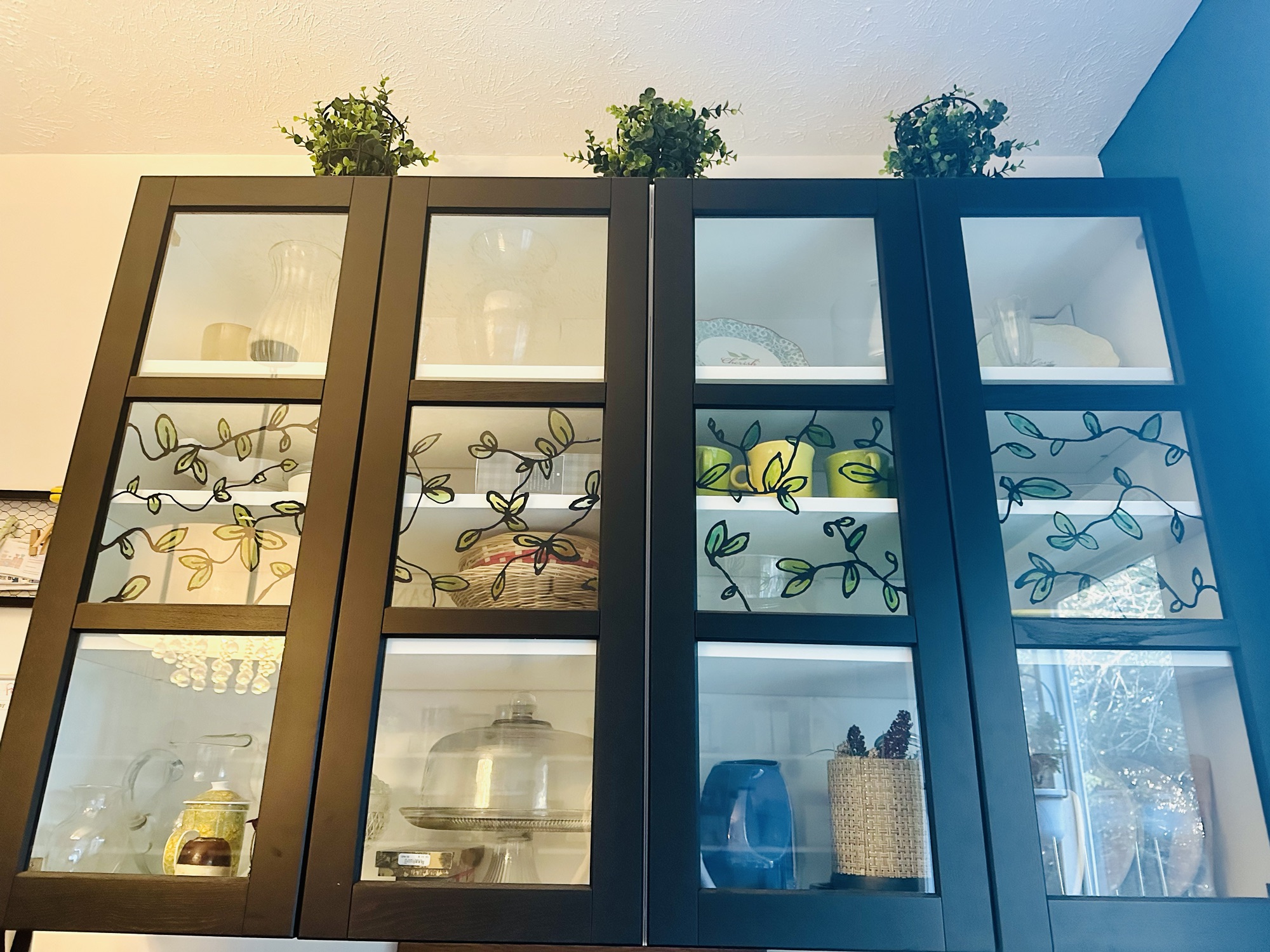
A looooong time ago, I came up with a way to decorate my pantry’s glass cabinet doors so that they looked kind of like stained glass — temporarily. They’ve been like this for so long that I knew I liked the design, so I decided to make it more permanent. The old method (See my post “Faux Stained Glass for Windows or Cabinet Doors”) was done by painting Saran Wrap and then taping that to the backside of the glass door. But now, I’d paint directly on the glass. This is a much better look if you decide you want it to be permanent, because it eliminated the plastic crinkles of the Saran Wrap that you can see from the front.

BEFORE: Temporary version.

I put this off for so long largely because I thought I’d have to take the doors down in order to paint them for real, but after painting vases vertically (see how I did that at “Faux Stained Glass Vase”), I realized the liquid leading didn’t drip like I’d thought it would! This meant I could leave the doors in place and just paint them as they were. I didn’t even have to empty the cupboards at all. Phew!!

Supplies:

(As an advertising affiliate and Amazon Associate, I earn a small commission from qualifying purchases. But it doesn’t cost you anything extra and helps me keep up my site!)

Step 1: Clean the glass. It was very easy to remove the painted Saran Wrap that I’d taped to the inside of the cabinet door, so again I can safely recommend that method if you just want something temporary. Once those sections of wrap were off, I gave the inside of the cabinet doors a quick wipe, but they weren’t that bad. Just be sure that you remember you’re doing this on the INSIDE of the glass doors…though I suppose you might as well feel productive and clean the outside too.

If you’re doing this on real windows (and I’m already looking around my house for options 😜) then you definitely want to give them a good quick wash with Windex or whatever. You don’t want a bunch of dust stuck on the glass while you paint. And remember, this will only work on the INSIDE of the windows, because you don’t want the paint getting ruined by the elements outside.

Step 2: Draw outlines with liquid leading. Again, it’s probably best to do this on the inside of the glass doors, so as to keep your work safer from everyday handling of the doors. So, you’ll want to open the doors and work on that side.

Ready with the liquid leading.

For my vases, I’d painted with the colored glass paints first, but here it seemed smarter to make my outlines first. That way, the black would show up best on the front side of the doors, and the color could slob a little on the black without showing from that side.

Anyway, I tried to make the stems and leaves look like what I’d done temporarily on the Saran Wrap before, since I’d liked that design so much. It helped a lot to stand on a chair so my arm didn’t get tired, but it didn’t take me too long to draw my design with the liquid leading. As with my vases, it didn’t drip, I could wipe it off quickly if I messed up, and it was easy to apply by squeezing out lines as I went.

I did try to get as close to the edges as I could, and it helped that my doors had those black divider sections on the front, so I could go behind those a bit without it being noticeable from the front.

Drawing my outlines.
Outlines drying.

I gave this several hours to dry, just to be sure it wouldn’t wipe away as I used my brush while painting with the colors.

Step 3: Paint with colors! I’d run out of the dark green (Viridian, from my set) that I’d used earlier on the Saran Wrap, but it was easy enough to use the light green first and then add a bit of Cerulean blue to make green leaves – blending these paints looks really pretty when light goes through. I squeezed out a quarter-sized amount of paint at a time and used a small craft brush to paint inside the leaf outlines, not worrying if it got over the black since that would not be visible from the front side of the glass.

The glass paint I used.

Once this was all dry, that was it! The cabinet doors look much nicer now without the plastic crinkles, and the look is now much more permanent, like it was always part of the doors.

AFTER: Finished painted glass doors.

There are SO many different designs you could paint, so let me know if you come up with other great ideas!


DIY Must-Have Lists

Click to see more!
Click to see more!
Click to see more!
Posted on Leave a comment

Painting Fan Blades

This was the last project for my 6-year-old’s room makeover! She wanted a “kelp forest” ceiling, but after creating a cave over a good chunk of her ceiling, we compromised by deciding to paint her fan blades so that they looked seaweed-y.

Painting fan blades was something I’d never tried before, and it was super easy! This might not be a new idea to anyone, but I can now personally recommend that you give it a go if you’re interested!

BEFORE: Plain white ceiling fan.

Supplies:

(As an advertising affiliate and Amazon Associate, I earn a small commission from qualifying purchases. But it doesn’t cost you anything extra and helps me keep up my site!)

  • Screwdriver
  • Paints

Step 1: Detach fan blades. I suppose I could have painted the blades while they still hung from the fan in the ceiling, but I didn’t want to risk dripping paint. Also, it seemed like my arm would get tired. Plus, by taking them down, I was able to clean them. 😜 I was also glad I’d detached them because, in the end, this meant that the painted portions went under the metal decorative parts where the blades attach to the fan, and that looked pretty cool.

My fan blades were held on by 3 screws each, so I used a screwdriver and simply unscrewed one blade at a some, carefully setting aside the washers and screws to reattach the blades later.

Removing the fan blade screws.

Step 2: Clean the blades. Mine were not real wood, and they wiped down pretty easily with a lightly damp cloth. After removing a considerable amount of dust from the top side of the fan blades, I made sure to use a clean paper towel to wipe and dry off the bottom side, which was the side I’d be painting.

Cleaned and ready.

Optional Step: My fan blades were in pretty good shape – and a nice white color – but you might want to apply a base coat of paint over each blade if they look rough. I considered painting them blue (which would make sense with our “under the sea” theme), but I did not obtain permission for that. You could start with whatever base color you choose, especially if your blades are wood and you really want to change the look.

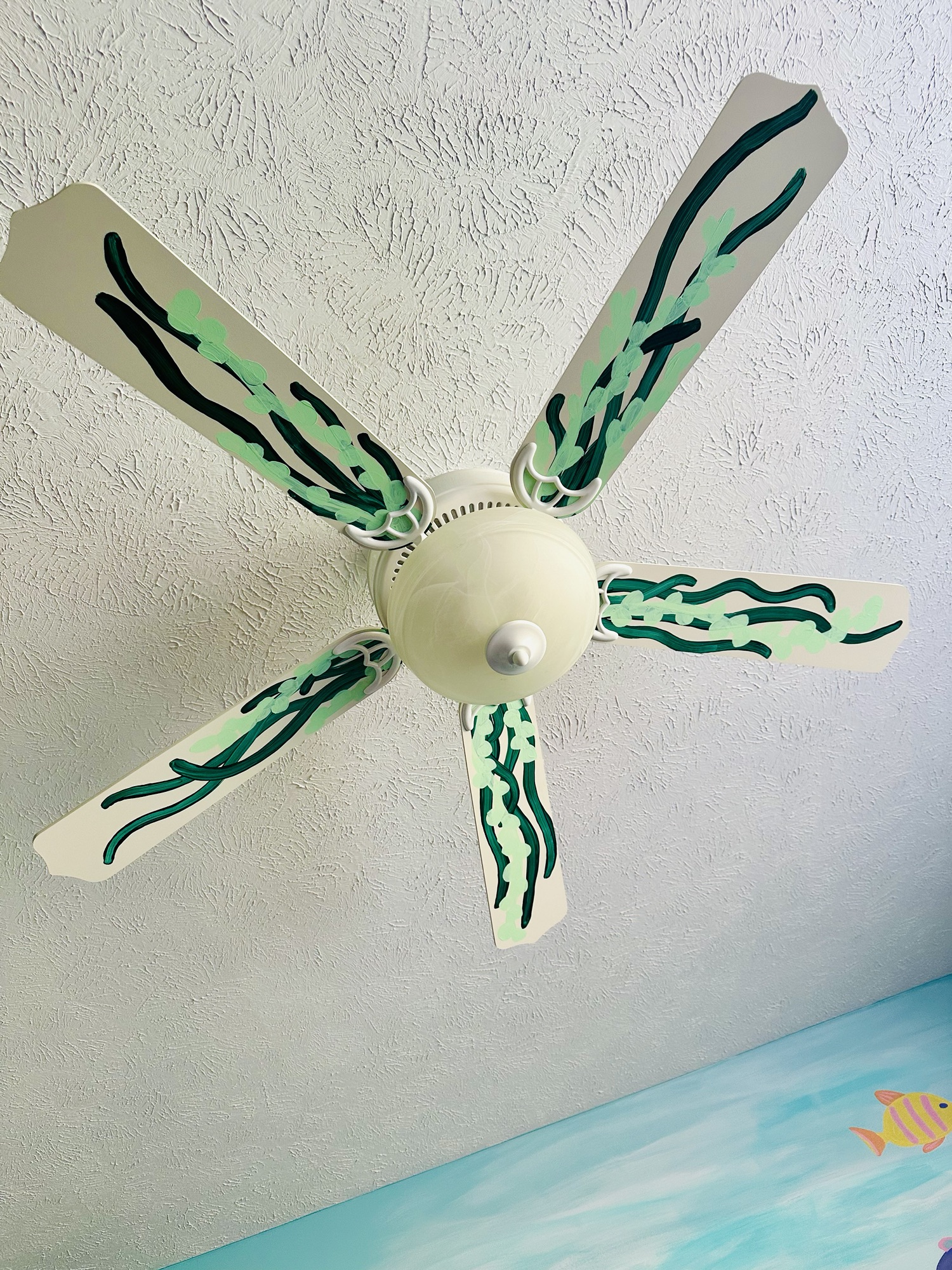
Step 3: Paint the design. I took 2 different green colors – one dark and one light – to make my seaweed/kelp/plants. My dark green was a latex paint, and my light green was acrylic. Both adhered just fine. I started with my dark green and made long, weedy, wavy lines. Once that dried, I took my lighter green and painted more leafy-looking plants. I didn’t want to overdo it, so I stopped there…

Dark green painted.
Light green added.

You could do really pretty flower designs, abstract shapes, stripes, or really anything! I have a feeling I will end up painting my other daughter’s fan too, so let me know if you come up with any great ideas!

Step 4: Reattach the fan blades. Once the paint was dry, I took the blades one at a time and lined up the holes to screw the washers and screws back in place. I did find it was easiest to start with the screw nearest where I was standing between the blades, secure that one first, and then have everything stable to screw in the screw closest to the actual fan.

Screwing the blades back on.

That was it!

This was incredibly easy, and the painting possibilities are endless!

AFTER: Painted seaweed fan!


DIY Must-Have Lists

Click to see more!
Click to see more!
Click to see more!