Posted on Leave a comment

Bifolds – “Under the Sea” Theme

While struggling over how to make a cave (??!!) for my daughter’s “Under the Sea” themed bedroom makeover, I found another easy project to follow up the mermaid dresser I did last week. Her room needed a mirror, and I needed an excuse to take down the gazillion (approximately) pictures taped to her closet’s bifold doors. I also had a bunch of old shells that I’ve kept in a bowl for years, and I wanted to incorporate them into our design. Plus, I wanted to try a cute craft I’d done many times as a kid, and I had a feeling I’d need it for this project…

BEFORE: Chaotic bifold door.

Supplies:

(As an advertising affiliate and Amazon Associate, I earn a small commission from qualifying purchases. But it doesn’t cost you anything extra and helps me keep up my site!)

Step 1: Plan spacing of mirrors. Since 12 mirrors came in the pack that I’d purchased and I had 4 bifold door panels, that pretty clearly meant I had 3 mirrors for each door panel. Testing on a door, I held one square mirror (mine are 12×12) and moved it up and down to eyeball how the mirrors would look before committing to their placement. I decided that I wanted to cover the top portions of the bifold doors, hiding the decoratively indented portions. This would leave the bottoms of the doors with the knobs exposed and the lower sections still showing the decorative indentations.

Trying out placement.

I decided on 2-inch gaps between each mirror, running vertically. As far as centering the mirrors from the sides, I brought each mirror 1 inch in from the center/hinged side of the door panels. That meant I had a 2-inch gap again between the mirrors on each pair of door panels.

To mark where I would place the mirrors, I made lines at the 1-inch point in from the hinged side of the door. I made sure I had 2 inches between these marks, and then I held the mirrors level on these marks. Next, I traced the corners of each mirror as I held them in place.

Making marks.

Step 2: Attach the mirrors. The mirror pack I purchased came with plenty of little adhesive squares to put on each corner of each mirror. I found it worked best to put the squares directly on the door to be sure they’d be within my markings.

Because of my door’s indented sections, I cut a few of the adhesive squares a bit smaller where they wouldn’t connect with the indentations along the back of the mirror anyway. For the mirrors covering these indentations, I made sure to also place an adhesive square in the center where the mirror’s back would touch the door again.

Adhesive squares ready.

Once I had the adhesive squares on the door, I lined up each mirror with my marked corners and pressed the mirrors gently so the adhesive stuck.

Mirrors on.

Before you start decorating around the mirrors, be sure to remove any film protecting the mirrors. You don’t want that to get stuck under the decorations!

Step 3: Add shells. You could put SO MANY different decorative things around your mirrors. Fake flowers would be pretty. Decorative rope would work. Different wood molding would look very nice too. Because of our theme, I went with shells.

First, I used my hot glue gun and attached as many shells as I could fit over the doors’ exposed indented areas. These were exposed in the 2-inch gap between my middle and lowest mirror.

Shells filling the gaps.

Once I had those funky gaps filled and it looked good, I sighed in relief. Next, I did the easier, solid 2-inch gaps between the vertically spaced mirrors.

Gluing on the shells was very time-consuming, but it was kind of like a fun puzzle where I got to decide which shells looked best together.

However, I ran out of shells. 😜

Optional step: Sculpt shells. I didn’t want to buy even more shells, and I only needed enough for the tops of the mirrors, anyway. So, remembering a craft I often enjoyed as a kid, I asked my mom for the recipe she’d used whenever I wanted to sculpt little figurines or make beads.

Recipe: 1 cup cornstarch, 2 cups baking soda, and 1-1/4 cup cold water. Pouring all ingredients into a medium-sized pan, I stirred it up and cooked on medium heat until it looked like mashed potatoes. Then, I took it over to our counter and scooped it out onto some wax paper.

Glob of sculpting dough.

Once it had cooled enough to handle (it didn’t take long), my girls and I grabbed small globs at a time and sculpted our own shells. I started by rolling a clump into a little ball, next using my palm to flatted the ball. Then I squeezed together a little bit at the bottom to make the bottom of the shell. Taking a toothpick, I softly pressed it to make lines in the shell. Very easy!

Making shells!

We made a few starfish for variety, and a few of my rolled balls I flattened and used a toothpick to make sand dollars too.

When done, I carefully took our creations and placed them on a baking sheet. Heating the oven to 200 degrees, I baked the shells for a few hours until they were no longer damp to the touch. They might crack a tiny bit on the surface as they dry, but they’re still strong and hold together. You can air dry, but it takes much longer.

Keep it mind that the bigger and thicker you make your shells (or beads or flowers or whatever), the longer it takes for them to dry. We made a range of sizes, and the starfish in particular took a while to dry because they were about a half-inch thick.

Once dry and cool, the shells were ready for paint! We used a set of watercolors, and this makes pretty and soft colors on the shells – the watercolors soak in better than normal paint and look more natural without the color being overpowering.

Shells painted.

These dried quickly, and within an hour these “shells” were glued onto the door just like the real thing!

That was it!

AFTER: Bifold doors with character!

I considered putting shells all the way around the mirrors, but that might’ve been too much. I also wanted to avoid breaking any when the doors opened and closed against the doorframe on the sides, so leaving the sides empty saves me from that trouble.

Most importantly, the 5-year-old is happy! Now her doors have mirrors she can “check her makeup in,” and she can admire all her favorite shells, especially the ones she created herself. 😃


DIY Must-Have Lists

Click to see more!
Click to see more!
Click to see more!
Posted on Leave a comment

Mermaid Dresser

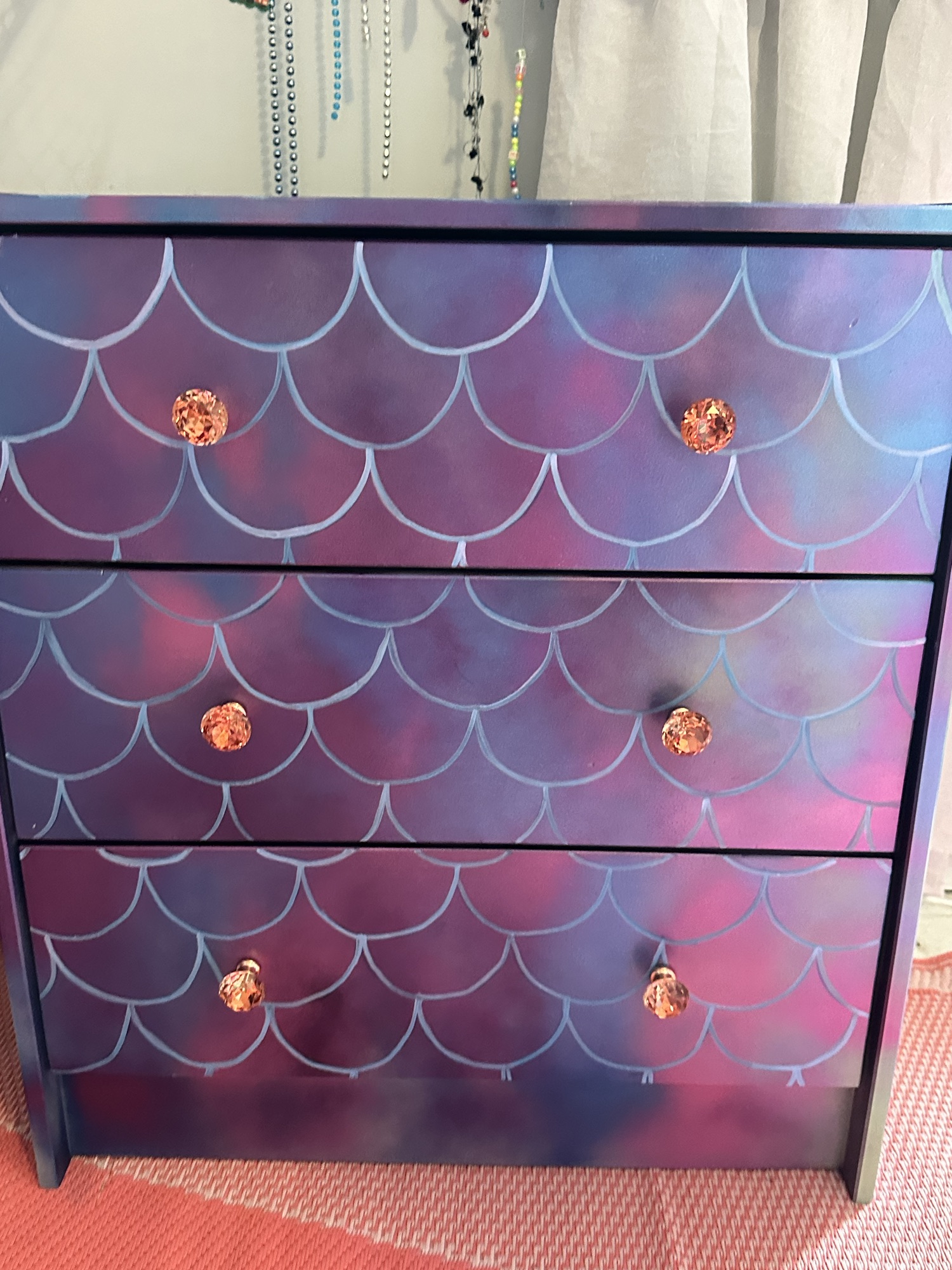
Much to my surprise, my five-year-old held up her part of our deal to clean up after herself for over a month, and now she’s earned a room makeover. Her theme? “Under the Sea.” We have spent a good deal of time looking up very elaborate options, but my first project was easy enough to tackle before really diving in deep.

When she was a baby, we bought a few dressers from IKEA and stained them… By that, I mean my husband and father-in-law stained them without supervision, and now they are grey instead of white. Now, finally it was time to fix them up so they’re more little girl-friendly!

BEFORE: Plain dresser.

Supplies:

(As an advertising affiliate and Amazon Associate, I earn a small commission from qualifying purchases. But it doesn’t cost you anything extra and helps me keep up my site!)

  • Old dresser
  • Spray paints (I used 2 metallic spray paints and 2 flat spray paints)
  • something round for tracing
  • paint pens

Step 1: Clean and prep. I thought I might have to sand the dressers, but they still felt like they’d take paint just fine despite the stain. I did wipe them down pretty well just to make sure I wouldn’t be painting over any dust/gunk. Depending on the finish of your dresser, you may need to sand and/or remove old paint.

Step 2: Spray paint. I wanted the mermaid scales to look a bit iridescent, so I made sure my dark blue and dark purple were metallic spray paints for a sparkly finish. I also used a pink paint and a light green paint for undertones.

I wanted the colors to flow and look right as one “painting” over the whole dresser, so I left the drawers in the dresser as I spray painted.

Starting with the undertones, I sprayed on the green paint first, making sections here and there that I could blend with the other colors.

Starting with the green undertone.

Then I did the pink over other sections.

Adding pink.

For the dark blue, I again sprayed it on its own sections, but I also lightly went over the green to blend the two colors.

Adding blue.

I did the same with the purple, going over the sections that remained and then also lightly going over the pink.

Adding purple.

I did this for the top and sides of the dresser as well as the drawer fronts. I also then pulled the drawers out a little bit to spray a little color on the drawer edges.

That done, I let the paint dry. While staring at this dresser, I decided that I wanted the other, larger dresser to kind of match this one without being too matchy-matchy. So, I hauled out the drawers and spray painted the fronts of the drawers the same way I’d done the whole other dresser.

Spray painting done.

Step 3: Trace mermaid scales. After carrying the dresser and the drawers back to my daughter’s room, I tried to decide how big I wanted the scales to be. I settled on a coaster for my template, but you could use anything round that you can trace.

Starting at the top of the top drawer, I found the middle and held the coaster so that about half of it made the rounded bottom of my first scale. First, I marked on the coaster where each side started my tracing – this helped me be sure from then on that I was making the same size scales. I then traced this bottom portion of the coaster with a blue marker – which ended up being a lucky choice that gave me a cool end result. I went all along the top of that first drawer and made evenly placed “scales” for the first row.

Marking my coaster to trace.

Moving to beneath this first row, I lined up my coaster’s lines on the sides so that this next scale was centered under where the above two scales met. (Basically, stagger the scales.) Again, I traced scales all along this second row.

I repeated this all down my dresser drawers, continuing the scales on the bottom of one drawer onto the top of the lower drawer so it all flowed together.

Making scales.

I then did the top because my daughter wanted “scales all over!” Next came the sides of the dresser.

Scales all traced on.

Step 4: Paint over the traced lines. Honestly, just the traced marker lines looked pretty cool, though they were a little too subtle for my daughter’s taste. So, I took a paint pen and traced over all my lines.

(I let the girls do the top of the dresser, although I was twitching and grimacing the whole time. 😬)

Little helpers.

I used a pinkish-purple paint pen, and the blue marker lines bled into the paint to give it a really cool, shifting hue as I went. This was totally by accident, but it ended up looking pretty.

Painting over the lines.

The nice thing about the paint pen I used was that I could wipe it away if I messed up, though I had to be quick before it dried. For the top that the girls worked on…Well, they’ll always be able to see where they helped. 😆

Scales on!

Step 5: Finishing touches. You could alternate painting the lines in different colors to give a more varied look, but I liked how mine turned out. I worried that I would need to put a clear coat of polyurethane over the dresser to protect the scales from scratching off, but I’d been right that the paint adhered to the stained (or semi-stained, let’s be honest) finish on the wood. IF you need a clear coat, now’s the time.

Deciding I was done, my daughter and I put on the shiny little drawer pulls, and that was it!

AFTER: Dresser with mermaid scales!

For the big dresser with the painted drawer fronts, we added these same drawer pulls as well. I agreed with her that putting scales on these drawers would have been too much, but the two dressers tie together nicely without being overwhelmingly mermaid-y.

Bigger dresser painted without scales.

Now I just have to figure out what “Under the Sea” mural to paint on one wall. And how to build an underwater cave. And how to make a sunken pirate ship bed. Wish me luck! 😜


DIY Must-Have Lists

Click to see more!
Click to see more!
Click to see more!
Posted on 1 Comment

Vase Makeover

Since people enjoyed the last DIY glass vase makeover I did, here’s another way to change the look of a vase! My aunt gave me this whopper of a vase, and I immediately knew what I wanted to do with it. I’ve used this same method on smaller vases and pots before, so I can say pretty safely this works on a number of different shapes, materials, and sizes if you have a container that you want to revamp.

The best part – it’s so easy and costs under $20!

Before: Vase in need of a revamp.

Supplies:

(As an advertising affiliate and Amazon Associate, I earn a small commission from qualifying purchases. But it doesn’t cost you anything extra and helps me keep up my site!)

  • Old vase or pot or any container
  • Drywall joint compound/spackling
  • Paint

Step 1: Smear on spackling. I used quick-drying spackling, the kind that is pink and dries white. I like the texture of that kind because it’s not too wet or runny. You can use your bare hands or gloved hands or, like I did just for the sake of trying it, a baggie over the hand that you use to smear on the spackling.

Applying spackling.

It doesn’t matter whether you start at the top, bottom, side – wherever you want is fine. I took a handful at a time and just smeared it on and around the vase, leaving texture rather than making it too smooth. This gives a kind of pottery look and feel to the vase. You don’t even have to cover every inch of the vase if you want to make swirls, lines, or whatever look you come up with! I also considered running the spackling vertically along the bottom sections while keeping it smeared around the top, just to add some visual interest. This stuff is pretty easy to manipulate, so you could do lots of different designs.

I gave my spackling overnight to dry just to be sure, especially since it was very humid outside at the time.

Spackling drying.

Step 2: Paint. If you like the color and the look of leaving the spackling as it is once it’s dry, that’s cool too, and I’ve done that before as well. But, if you don’t use a paint or some kind of sealer, the spackling can flake off easier and is really vulnerable if it gets wet at all. If you have a container that is never going to be touched, though, the look of the naturally dried spackling is pretty.

Since my vase would be set on the floor (and because we have dogs and children), I chose to paint over my textured, covered base. This helped seal the spackling so it wasn’t as chalky feeling, and it helped me cover some areas where I’d applied the spackling too thin. I used some leftover paint that’s the same color as the top part of my dining room walls, but I’m pretty sure any paint would work fine. I’ve used those cheap little acrylic paints on this spackling before, and that works great too.

I had a helper for this painting step, but it didn’t take us too long. We only needed one snack break.😆

Painting with my helper.

I used a small craft brush to really get the paint in between the grooves I’d created when wiping the spackling on with my baggie-covered fingers. The spackling really soaks in the paint and gives a kind of natural matte finish unless you paint a second coat to get more shine from your paint. The spackling also soaks in the paint so that it dries really quickly, which was nice so I could set it in place almost right away.

Painted and drying.

That was it! So easy, and the end result looks really cool.

AFTER: Vase makeover complete!

Options: You could also paint the vase in several different colors, like an ombré effect or stripes or abstract shapes – anything goes! I wanted my vase to be simple, bright, and fairly minimalistic in color so that the texture really popped, so I went with a very light blue that’s almost white (the same color as the top part of my dining room walls).

Another thing I thought of was the option to add on beads during the process of applying the spackling. Again, I wanted to keep my base pretty simple, but it would look really cool to press a string of beads into thicker sections of spackling, then paint over the whole thing to give it more detail, similar to what I did on my bathroom walls (which I love, and I know it would look cool on a vase too.)

What other options can you think of? I’m sure I’ll do more vases like this in the future, and I’m curious to see how different options could turn out!


DIY Must-Have Lists

Click to see more!
Click to see more!
Click to see more!
Posted on Leave a comment

Faux Stained Glass Vase

For our wedding, I purposefully bought tall glass vases as centerpieces, planning to later use them for decorating our home(s) for years to come. Fast forward, and now I’m looking around at them and wondering how to change up the look they’ve had ever since. Several have homemade candles in them and so I want them to remain clear, but for a few I wanted to find a way to add some color and/or texture.

Since this one was sitting in our dining room beside a stained glass lamp, I figured I’d give it a go and make the vase look like stained glass. I’d done this before to the glass cabinet doors in our pantry, and I hoped it would work on a vase. Spoiler – it works great! You could do this on any glass vase, no matter the shape, too, so I’m sure there are many, many cool looks you could create using this method.

BEFORE: Plain glass vase.

Supplies:

(As an advertising affiliate and Amazon Associate, I earn a small commission from qualifying purchases. But it doesn’t cost you anything extra and helps me keep up my site!)

Step 1: Clean the glass. My vase was very dusty and had smudges from little fingers, so I first cleaned the inside and outside of the vase really well. The last thing you want is gunk stuck on as you’re painting!

Cleaned and ready!

Step 2: Paint the colors. I had absolutely zero plan for what I was painting, and I ended up going pretty abstract but also making flowery shapes. You could copy a pattern and colors you like, or you could plan out shapes first. There are all kinds of cool stained glass pictures you can find online to replicate!

I used a normal crafting brush, a little lid for squirting out the paint, and the glass paint itself. If you want the colors to be really strong, you might want to let it dry and do another coat, or do it pretty thick as you go. I only painted on one quick coat, and I let it be stronger in some places and more transparent in others.

Painting the colors.

Don’t worry if you think your painting doesn’t look too great at first. Once you put the liquid leading on, it really pops! I also didn’t worry too much about having straight or smooth edges, since I would be going over everything with outlines.

I let this dry a few hours just to be safe (and because I got busy doing other things), but it dries pretty quickly.

Paint on.

Step 3: Apply liquid leading as outlines. If you’ve never worked with this stuff, it’s a bit like puffy paint that ends up looking like the lead on stained glass. It has a sticky consistency that dries pretty quickly, and it leaves a painting with a cool 3D effect.

I was worried at first that this would run down the vase or drip as I went, so at first I turned my vase on its side and applied it that way. But once I had to do the other side, I stood the vase up again and had no problem applying it that way. It does take a second to get used to how much you squeeze out as you go, but it’s pretty easy.

After a while, the spout may get clogged and make it harder to get any out smoothly, so just take a second and clear the tip from time to time.

Outlining with liquid lead.

I outlined between my different colors and also added some lines between the shapes where I could see different brushstrokes.

The liquid leading does look a bit grey as it comes out, but it dries nice and dark – black like lead.

Liquid lead drying.

See how beautiful that is with light coming through?!

That is it! I set the vase in place and let it dry. I’m really happy with how this turned out, and of course now I’m eyeing the rest of the vases and wondering how many more I should do. 😉

AFTER: Stained glass vase!


DIY Must-Have Lists

Click to see more!
Click to see more!
Click to see more!
Posted on Leave a comment

Hydro Dipped Easter Eggs

This week, I felt like I’d been a bad mom lately and so decided to spend time with my girls coloring Easter eggs. We started the good-old way with baking soda, food coloring, and vinegar. But after poking and draining about six eggs to color the shells, I’d kind of had enough of that and tried to think of a way to decorate the bagful of plastic eggs we had lying around.

Fun way, but…too much 😆

I’ve wanted to hydro-dip…something (anything really) for a while, and it seemed like painting Easter eggs this way might be kinda cool. So, after a quick trip to Michael’s yesterday, we had all the spray paint colors we could think of and were ready to go.

Is this a particularly kid-friendly art project? Not really. LOL. But my girls were surprisingly helpful and did a great job – the key to my success lies entirely in the plastic gloves I made them wear.

BEFORE: Normal plastic Easter eggs.

Step 1: Spray on a base layer. In order for hydro dipping to really work, I’m told you need a base layer of paint for the spray paint to stick to. So, I took my bag of plastic eggs and popped them apart so they’d sit flat. Then I took a plain white spray paint and sprayed all over the eggs to get a good coat on. I went with white because I figured that would help them look the most “realistic” as eggs when finished.

Supplies:

(As an advertising affiliate and Amazon Associate, I earn a small commission from qualifying purchases. But it doesn’t cost you anything extra and helps me keep up my site!)

  • Plastic easter eggs
  • Spray paints
  • Gloves
  • Cup or other container
Base coat on.

Step 2: Prep for painting. Once the base coat was dry (I gave mine about 4 hours), I snapped all the eggs back together and took them in a basket out to my deck. This seemed like the best place to do this at the time simply because I wanted good ventilation while working with the girls.

Eggs ready to go!

It’s important to have everything ready to go because the paint will dry pretty quickly in the water, so you want your eggs right there when you start. I made sure to shake up all of my spray paint cans really well too. Because I wanted to dry the eggs inside (it was a windy day), I lay a silicone baking sheet and a few paper towels on the kitchen counter to be ready. And perhaps most importantly, we made sure we had gloves in place.

Cup and gloves ready!

Step 3: Hydro dip! I used a solo cup because I figured the eggs didn’t need a lot of room to dunk them, but you could use a spare Tupperware container or an old whipped cream container or something else entirely. Really, it just has to be a container that’s deep enough to submerge the egg.

I filled my cup a little over 3/4 full of water, then took it to the deck. My girls stood ready with an egg each, and then I began spraying the paint into the cup. I made sure to spray in the center of the cup each time, and I held the can about 6 inches above the cup as I sprayed so it didn’t shoot everywhere. It only took little bursts at a time to get enough paint into the cup to cover the surface.

We found that we really liked the metallic spray paints, and the blue and purple covered the surface really well. I alternated my combinations of colors, and really there was no bad way to go.

Paint ready.

Each time, when I had enough paint to cover the surface, the girls would slowly lower a plastic egg down through the paint. Sometimes we’d have to turn the egg over and do the other side again, but this was no problem because the paint on the egg adheres REALLY fast, so it doesn’t drip or anything. For a few eggs, we also found that setting them to float on the surface and then just rolling them also pulled the paint to cover the eggs, though this took a little longer.

Dipping an egg.

We did about 30 eggs in 45 minutes, so it went pretty quickly. I never had to refill the water, and I never bothered cleaning the cup because the paint you don’t use moves to the edges anyway. The girls had a lot of fun dunking the eggs, shaking off the water, and then running them inside to sit and dry. Our gloves got messy, and I was worried about the paint pulling off the eggs as we set them down, but that turned out to not be an issue because of how fast the paint sets.

I will say that my eggs had little holes at the tops and bottoms, so that helped to drain any water that got inside. Once they were all on the paper towel to dry, I did give them a few hours before using them to decorate.

Eggs drying.

Now we have cool eggs that I can use again next year too! And they were so easy, I’m sure we’ll make more again. 🙂

AFTER: Awesome Easter eggs!


DIY Must-Have Lists

Click to see more!
Click to see more!
Click to see more!